
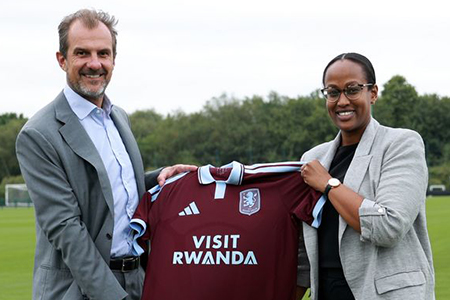
The announcement that Rwanda’s tourism brand, Visit Rwanda, will appear on Aston Villa’s shirts in a landmark sponsorship deal should be celebrated as an African success story. Instead, as has often happened with Rwanda’s global ambitions, it has attracted a wave of criticism, much of it driven less by economics and more by politics.
For many people outside East Africa, the mention of Rwanda still evokes one of the continent’s darkest chapters — the 1994 Genocide against the Tutsi that left the country devastated and nearly brought it to its knees. The images of that tragedy has shaped global perceptions of Rwanda for decades.
But Rwanda today is a country determined not to be permanently defined by its past. It has built a new national identity around recovery, stability, innovation and ambition. Tourism has been placed at the centre of that transformation strategy because the government understands that the sector is not merely about attracting visitors; it is about creating jobs, developing infrastructure, improving services and changing how Africa is perceived globally.
The Visit Rwanda partnership with Aston Villa is therefore not simply about putting a logo on a football shirt. It is about positioning a small African country on one of the world’s biggest sporting stages.
Aston Villa has described the agreement as the most important sponsorship deal in the club’s history, with Visit Rwanda becoming the club’s principal partner, official tourism partner and official coffee provider. The branding will appear on the shirts of the men’s, women’s and academy teams.
For Rwanda, the value lies in reaching millions of football fans across the United Kingdom, Europe and beyond — many of whom may never have considered Rwanda as a destination for tourism, business or investment.
This is why dismissing the partnership as “sports washing” is a simplistic argument that ignores how countries compete in the modern global economy.
Countries market themselves every day. The UK promotes itself through its culture, universities and sporting institutions. The US uses Hollywood, technology and sports to project influence. Gulf countries have invested billions in football, aviation and tourism branding.
Africa cannot be the only continent expected to sit quietly while others use global platforms to attract opportunities.
Rwanda’s tourism strategy has already demonstrated the economic impact of this approach. The country has invested heavily in conference tourism, conservation, hospitality and sports infrastructure, transforming Kigali into a major destination for international events.
The growth of venues such as the BK Arena, the expansion of hotels and conference facilities, improved roads and the development of sporting events have all been part of a wider effort to create an ecosystem where tourism supports local businesses and employment.
Hosting major events is not only about the days when visitors arrive. It requires airports, transport systems, accommodation, security services, restaurants, entertainment facilities and skilled workers. These investments remain long after the final whistle is blown.
The same logic explains why Rwanda has embraced sports tourism. The country has hosted major basketball tournaments, cycling events andFifa Congress and tournaments because sport has become one of the most effective ways of introducing countries to global audiences.
Critics often ask why governments should spend money on international marketing when citizens still face social challenges. That argument, however, presents a false choice.
A country does not develop by choosing between tourism and social services. It needs multiple engines of growth. Tourism revenues, investment and business opportunities generated through global visibility can help finance broader development.
The challenge for every government is ensuring that economic growth translates into better lives for citizens. But attracting visitors and investors is not an abandonment of ordinary people; it is part of the effort to create opportunities for them.
Interestingly, some of Rwanda’s loudest critics have themselves recognised the power of tourism branding. Democratic Republic of Congo President Félix Tshisekedi has recently shown increased interest in sports diplomacy and promoting his country internationally through initiatives similar to Rwanda’s approach.
That should be welcomed. Africa needs more countries telling positive stories about themselves, not fewer.
The unfortunate reality is that African progress is often trapped in political rivalries. Instead of asking how one country’s success can inspire another, some leaders and commentators turn every initiative into a geopolitical battle.
The criticism from some Congolese voices against Rwanda’s global campaigns is largely connected to wider political tensions between the two countries. Those disputes are real and require diplomatic solutions, but they should not blind the continent to the value of ambitious development strategies.
Even the debate surrounding the previous Arsenal-Visit Rwanda partnership showed how politics and business can become intertwined. The decision to end that partnership was part of a broader commercial shift, with Rwanda and Arsenal pursuing different market opportunities. It was not simply a case of a sponsorship collapsing because of criticism.
International partnerships are business decisions. Companies and governments constantly reassess markets, audiences and returns.
The bigger question Africa should ask is not why Rwanda is investing in global visibility. The question is why more African countries are not doing the same.
For decades, Africa has complained about negative stereotypes — images of poverty, conflict and helplessness dominating global perceptions. Yet when countries invest in changing that narrative, they are sometimes criticised for promoting themselves.
Rwanda’s message is straightforward: come and see.
Come and experience the landscapes, the conservation, the hospitality, the safety, the business opportunities and the ambition.
The world is shaped by those who tell their stories effectively. If Africa wants a different global image, it must participate in shaping that image.
Visit Rwanda should therefore not be viewed as a controversial experiment. It should be seen as an example of what is possible when an African country uses every available platform to compete for attention, investment and opportunity.
The pride should not belong to Rwanda alone. It should belong to a continent that is finally learning to market itself.
