
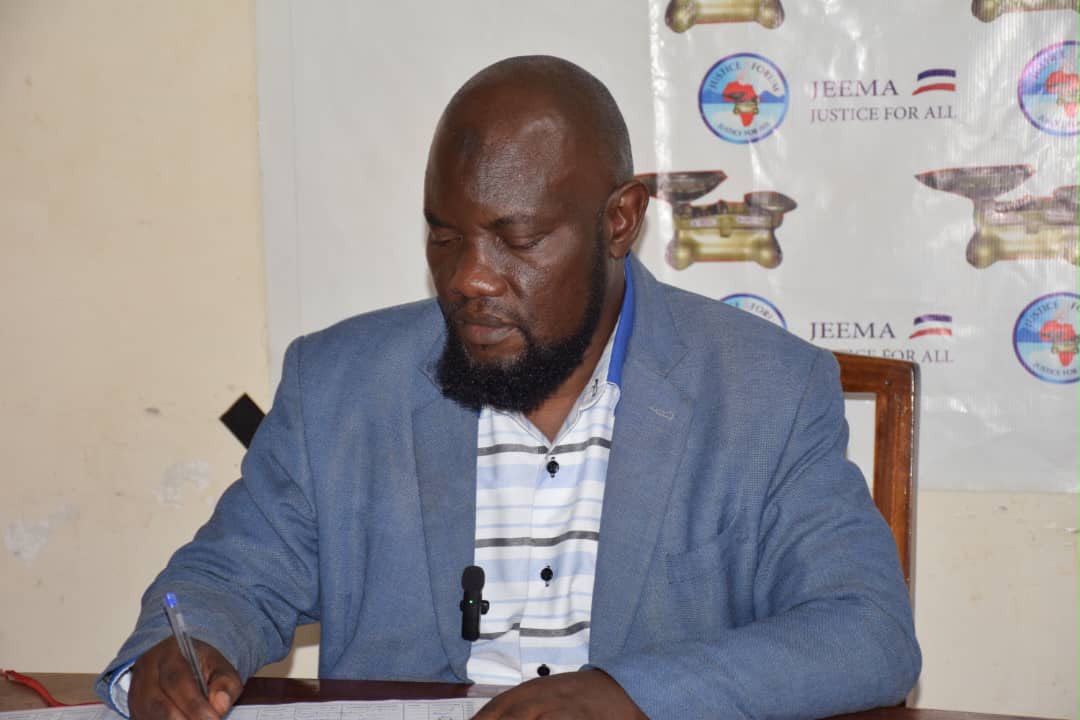
Justice Forum (JEEMA) has criticised President Museveni’s State of the Nation Address, accusing him of failing to account for government performance and defending what the party described as ineffective economic interventions.
JEEMA spokesperson Swaib Kaggwa Nsereko said the party was concerned by both the content of the President’s address and what it termed significant omissions.
“Article 101 of the Constitution requires the President to account for government performance in the previous financial year and outline the outlook for the New Year. Regrettably, the President deliberately avoided this obligation,” Nsereko said.
“Instead, the nation was subjected to historical narratives… that are inconsistent with the purpose and solemnity of the occasion. Ugandans deserve accountability, not nostalgia,” he added.
JEEMA also faulted the President for continuing to promote programmes such as the four-acre model and Emyooga, which it described as failed short-term interventions.
“The President’s continued insistence on failed, short-term economic interventions such as the 4-acre-model, Emyooga etc, is troubling,” Nsereko said.
“Leadership requires honest evaluation of policy failures (with clear performance indicators-KPIs), not scapegoating the very people burdened by them,” he added.
The opposition party raised concerns about the implementation of the Parish Development Model (PDM), arguing that the programme has not benefited all Ugandans equally.
According to JEEMA, PDM has become “a tool of business and political tokenism” that disproportionately benefits a narrow group of political loyalists within local governments while excluding others.
The party further argued that the programme disadvantages some Muslims because of its interest-based financing structure.
“The policy further discriminates against citizens on the basis of religious belief and other values such as Muslims, whose faith prohibits interest (riba),” Nsereko said.
“These are effectively excluded from participation due to the interest-bearing nature of PDM funds,” he added.
JEEMA questioned whether government lending money to citizens with interest should still be considered public service delivery.
“Further, if government is distributing public funds to the public on basis of the ability to pay back with interest, does that continue to be public service delivery or it becomes business to maximize profit?” the statement asked.
The party also challenged government to explain what protections exist for beneficiaries whose projects fail.
“If PDM is indeed a business, as presented, then it must be subject to the realities of risk, loss and failure,” Nsereko said.
“What safeguards has Government instituted to protect citizens when these ventures inevitably fail? Who bears the liability when interest-charged loans cripple vulnerable households?” he asked.
JEEMA further argued that the President’s presentation of selected PDM beneficiaries during the address highlighted broader shortcomings within the programme.
“The President’s showcase of a few isolated PDM success stories through video displays is itself an indictment,” Nsereko said.
“If the program were benefiting all Ugandans equitably, such displays would be unnecessary. Highlighting exceptions only confirms the rule: PDM and other short-term interventions are not working for the majority.”
The party called on the NRM government to review what it described as politically motivated interventions and instead strengthen established government institutions.
“Government should adequately facilitate line ministries, particularly the Ministry of Agriculture, Animal Industry and Fisheries, to implement a coherent national policy that serves all citizens equitably without patronage or discrimination based on political affiliation,” Nsereko said.
JEEMA said agriculture should be the foundation of Uganda’s economic transformation and pledged that a future JEEMA administration would prioritise the sector.
“A JEEMA government will prioritize the agriculture sector as the cornerstone of national transformation,” Nsereko said.
“Agriculture addresses economic challenges at every level, from the grassroots to the national economy. We shall place national interest above private political gain.”
The party said its policy approach would be guided by national and international development frameworks, including the National Development Plan and the United Nations Sustainable Development Goals, with particular emphasis on poverty reduction and food security.
