
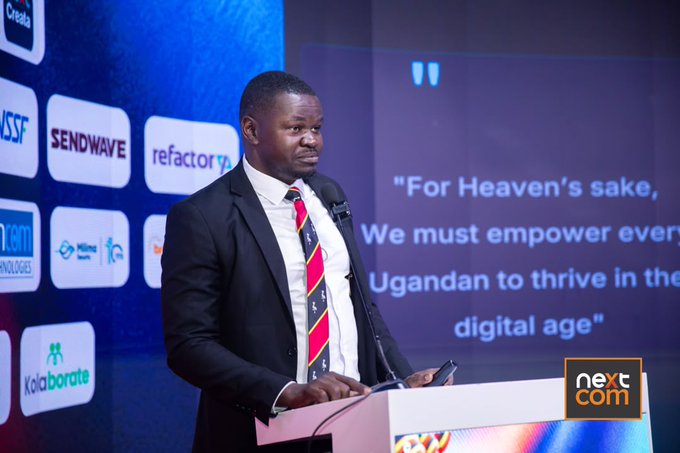
KAMPALA — Parliament has pledged to strengthen Uganda's legislative framework to support digital transformation, with the Chairperson of the Committee on ICT and National Guidance, Andrew Ojok Oulanyah, calling for deliberate efforts to extend digital opportunities beyond Kampala and prepare Ugandans for an increasingly technology-driven economy.
Speaking at the third edition of the State of the Digital Economy (SODE 2026) at Next Media Park, Oulanyah said the country's digital agenda must focus on empowering citizens through skills, innovation and trusted digital systems rather than merely expanding infrastructure.
His remarks built on the conference's central theme, "Beyond Connectivity: Turning Access into Opportunity," which has dominated discussions among government officials, regulators, technology experts and innovators throughout the day.
Earlier, Next Media Group Chief Executive Officer Kin Kariisa challenged stakeholders to move beyond expanding internet access and instead ask whether Uganda's digital connectivity was creating jobs, exporting services and generating value across government and the private sector.
"Now that we have connectivity, can we earn from this connectivity, create jobs, and export services?" Kariisa asked, adding that Uganda had become "a highly connected country" and that the next phase of the digital economy should focus on turning access into opportunity.
Uganda Communications Commission Director of Finance Haruna Musinguzi reinforced that message by arguing that digital infrastructure should ultimately be judged by its impact on people's lives rather than the number of internet subscriptions.
"If digital infrastructure does not improve people's lives, then it remains nothing more than infrastructure," Musinguzi told delegates.
Picking up that conversation, Oulanyah said technology should always serve people and contribute to inclusive national development.
"Technology is not just about building systems or laying fibre," he said.
"It is about ensuring information serves people and that every Ugandan knows how to use it."
Oulanyah said Uganda's large youth population presents both a challenge and an opportunity, urging stakeholders to use digital technologies to address unemployment and skills gaps.
He noted that more than 23 million Ugandans aged between 18 and 30 are currently neither in education, employment nor training.
"The question is: how do we use digital platforms to ensure no one is left behind?" he asked.
He said Parliament is committed to working closely with government agencies, regulators and the private sector to develop policies that accelerate digital transformation while ensuring inclusive development.
"As Parliament, our role is to work closely with the ICT sector to shape policies that drive digital transformation, innovation and inclusive development," he said.
Oulanyah said Uganda's digital ambitions would only succeed if citizens have confidence in the systems they use.
"The digital economy cannot thrive without trust," he said.
"Data protection, privacy and cybersecurity are fundamental to building confidence in e-commerce and e-government services."
He called for continued investment in legal and regulatory frameworks that safeguard users while supporting innovation and digital commerce.
The legislator also urged government and industry to decentralise innovation by investing in regional technology hubs that enable more Ugandans to participate in the digital economy.
"We must democratise ICT by taking innovation beyond Kampala and leveraging regional hubs so every Ugandan can participate in the digital economy," he said.
His remarks echoed initiatives unveiled earlier by Next Media, including plans to establish 14 NextCreata creator hubs across major towns to equip young people with digital and content creation skills.
Oulanyah described Business Process Outsourcing (BPO) as one of Uganda's most promising opportunities to connect young people to international labour markets through digital work.
"Business Process Outsourcing presents a real opportunity for young Ugandans to use their digital skills to access jobs and markets beyond our borders," he said.
He also urged policymakers to proactively regulate artificial intelligence as its adoption accelerates across industries.
"Artificial Intelligence is no longer just a tool like a knife; it is an agent—it serves a master," Oulanyah said.
"As its use grows across every sector, Uganda must prioritise AI governance and regulation."
He concluded by calling for a digital transformation agenda that enables citizens not merely to adapt to technological change but to prosper because of it.
"We must empower every Ugandan to thrive in the digital age, not just to survive."
The third edition of the State of the Digital Economy, organised by NextCom, has brought together policymakers, regulators, entrepreneurs, innovators, academics and content creators to explore how Uganda can convert expanding digital access into jobs, innovation and sustainable economic growth.
The conference is focusing on four strategic pillars—human capital, policy, infrastructure, and artificial intelligence and cybersecurity—through keynote addresses, panel discussions, fintech showcases, GovTech demonstrations and innovation exhibitions aimed at shaping Uganda's digital future.
