
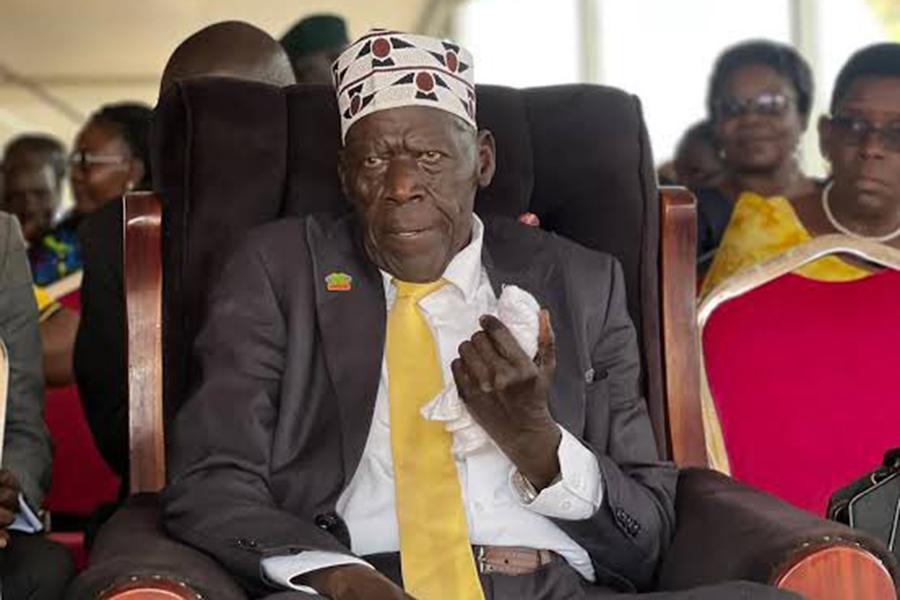
President Museveni has paid tribute to the late former Second Deputy Prime Minister and Adjumani County West Member of Parliament, General Moses Ali, describing him as a leader who served Uganda for many years both as a soldier and a political leader, while also setting an example as a successful modern farmer in the West Nile region.
Taking to his official X (formerly Twitter) account on Saturday, Museveni reflected on General Ali’s decades of public service and his contribution to agriculture.
“Gen Moses Ali has provided service to his country for a long time, as a soldier and a political leader,” Museveni wrote.
“In the West Nile region, he provided the good example of being a big modern farmer. We shall miss greatly his contribution. May the Almighty God rest his soul in eternal peace.”
Museveni’s message followed the death of General Ali, one of Uganda’s longest-serving political and military figures whose career spanned colonial rule, the Idi Amin government, armed rebellion and nearly four decades in the National Resistance Movement (NRM) administration.
General Ali died at around 4:00pm on Saturday at Nakasero Hospital after being admitted with unspecified ailments.
His family said he had gone into a coma before his death.
He was 87.
At the time of his death, Ali had only recently left active government after President Museveni omitted him from the Cabinet appointed in May 2026 on medical grounds.
His son, Siraji Musa Ali, was later appointed Minister of State for Works and Transport.
Born on April 5, 1939, in Atabo Parish, Pakele Division in present-day Adjumani District, Ali lost both his parents at the age of 11 and was raised by his maternal uncle, Ramadan Wani, who supported his education.
To help pay school fees, he worked in people's gardens during his childhood.
He completed his primary education at Erepi Church of Uganda Primary School before joining Old Kampala Secondary School, where he obtained his General Certificate of Education.
He also studied the Quran at a Madarasa and later became a teacher before joining the Uganda Army in 1968.
His military career saw him rise steadily through
the ranks after receiving specialised training in Israel and the United Kingdom.
He served as Officer in Charge of Training at the Uganda Paratrooper School before becoming its commander, eventually attaining the rank of Brigadier by 1974 during the Idi Amin administration.
Under Amin's government, Ali held several senior ministerial portfolios, including Finance and Tourism, Wildlife and Antiquities, while remaining one of the regime's influential military figures.
Following the collapse of the Amin government in 1979, Ali went into exile in Sudan before returning to lead the Uganda National Rescue Front (UNRF), an armed group that fought successive governments during the early 1980s.
After the National Resistance Movement (NRM) took power in 1986, Ali became one of the first major rebel leaders to sign a peace agreement with the new government.
The 1988 accord integrated UNRF fighters into the national army and is widely regarded as a key step in restoring lasting peace in the West Nile region.
Ali subsequently joined the NRM government and became one of Museveni's closest political allies, serving over the years as Deputy Prime Minister, First Deputy Prime Minister, Minister for Relief, Disaster Preparedness and Refugees, Minister in the Office of the Prime Minister and senior adviser on peace, security and northern Uganda affairs.
He also represented Adjumani West County in Parliament for many years and retained the constituency seat in January 2026.
Beyond politics and the military, Ali established Esia Mixed Farm after training in modern agriculture in Britain.
His investment in farming earned him recognition as one of West Nile's leading commercial farmers, a contribution Museveni highlighted in his tribute.
A devout Muslim, Ali often attributed his achievements to faith, discipline, honesty and hard work.
In 2024, he published The Odyssey of the Nubi: From Soldiers of the British Empire to Full Citizens in Uganda, documenting the history and contribution of Uganda's Nubian community.
The publication coincided with the launch of the Nubian Heritage and Cultural Centre in Adjumani District.
Away from public office, he supported community development through education, water projects, mosques and assistance to vulnerable families.
He frequently described education as his greatest investment and encouraged young people to embrace learning.
General Ali is survived by four wives and 30 children.
Funeral and burial arrangements are expected to be announced in due course.
