
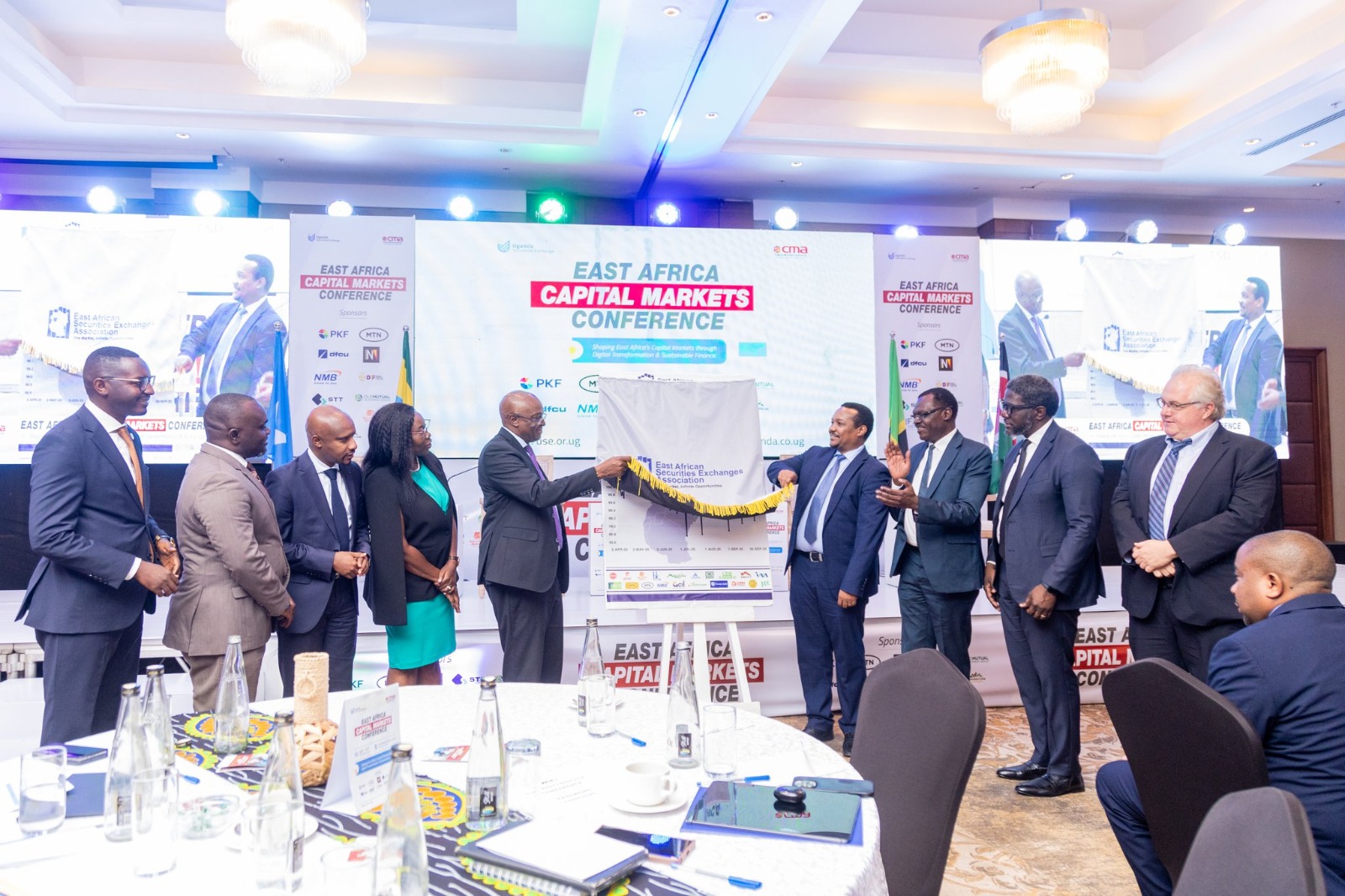
The East Africa Capital Markets Conference 2025, held in Kampala, marked a historic moment for the region with the official launch of the EAE 20 Share Index.
This newly introduced regional index is designed to track the performance of the top 20 listed companies across East Africa’s major stock exchanges Uganda, Kenya, Tanzania, and Rwanda providing investors with a unified benchmark to assess market performance and boost regional investment flows.
Delivering remarks on behalf of the Minister of Finance, Planning and Economic Development, Hon. Matia Kasaija, the Commissioner of the Ministry, Moses Ogwapus, emphasised the significance of the index.
He stated, “The launch of the EAE 20 Share Index is a clear step forward in enhancing market visibility, investor confidence, and regional integration.”
The index is expected to promote cross-listings and attract both local and international investors by offering a transparent and comparable measure of performance across borders.
East Africa’s capital markets are still evolving, with significant room for growth. As of mid-2025, the Nairobi Securities Exchange (NSE) remains the largest in the region with a market capitalisation of approximately USD 21.5 billion.
It is followed by the Dar es Salaam Stock Exchange (DSE), which stands at around USD 6.5 billion. The Rwanda Stock Exchange (RSE) has reached just over USD 1.2 billion, while the Uganda Securities Exchange (USE) trails with a capitalisation of roughly USD 1.1 billion.
In total, the region's stock markets account for a combined market capitalisation of just over USD 30 billion—less than 10% of South Africa’s Johannesburg Stock Exchange, which exceeds USD 300 billion.
Despite East Africa's population surpassing 300 million people and a combined GDP of over USD 350 billion, less than 5% of adults invest in securities, according to data from the African Securities Exchanges Association (ASEA).
Pension funds remain the dominant institutional investors, while retail participation is still nascent.
Patrick Ayota, Managing Director of the National Social Security Fund (NSSF) Uganda, called attention to the need for innovative policies that encourage savings and investment.
“Our market is big, but a lot of potential remains untapped. People need safety, convenience, and empowerment. The U.S. created incentives that made people want to save, such as tax benefits. Yet here, before you even save with NSSF, your money is taxed. We need to rethink how we incentivise savings and investments.”
Ayota proposed that infrastructure could serve as a novel asset class for retail and institutional investors. “Have we thought about tokenising the Kampala–Jinja Expressway? The goal is not to copy but to customise global innovations to suit our market.
Infrastructure, like highways, is becoming a new way of accessing capital beyond traditional financing methods.”
Josephine Okui Ossiya, CEO of the Capital Markets Authority (CMA) Uganda, stressed that technology must be a central driver of market growth, not an afterthought.
“Investing should be as simple as sending a mobile money text. To attract issuers and investors, we must make our markets faster, simpler, and friendlier, because no one should need a PhD in patience to invest in East Africa,” she remarked.
Ossiya noted that the CMA’s Regulatory Sandbox has already admitted five fintech firms testing innovations in digital securities, robo-advisory, and crowdfunding.
This regulatory environment is designed to support innovation while protecting investors, and the expectation is that at least two of these firms will graduate into fully licensed capital market operators by early 2026.
Executives from other regional exchanges also lent their voices to the push for integration. Peter Nalitolela, CEO of the Dar es Salaam Stock Exchange, and Celestin Rwabukumba, CEO of the Rwanda Stock Exchange and Chairperson of ASEA, both emphasised that regional collaboration is critical for improving liquidity, investor confidence, and product diversity.
This year’s conference attracted delegates from across Africa, Europe, and Asia including regulators, market players, and development finance institutions.
It focused on the dual pillars of digital transformation and sustainable finance as key levers for growing East Africa’s capital markets.
