
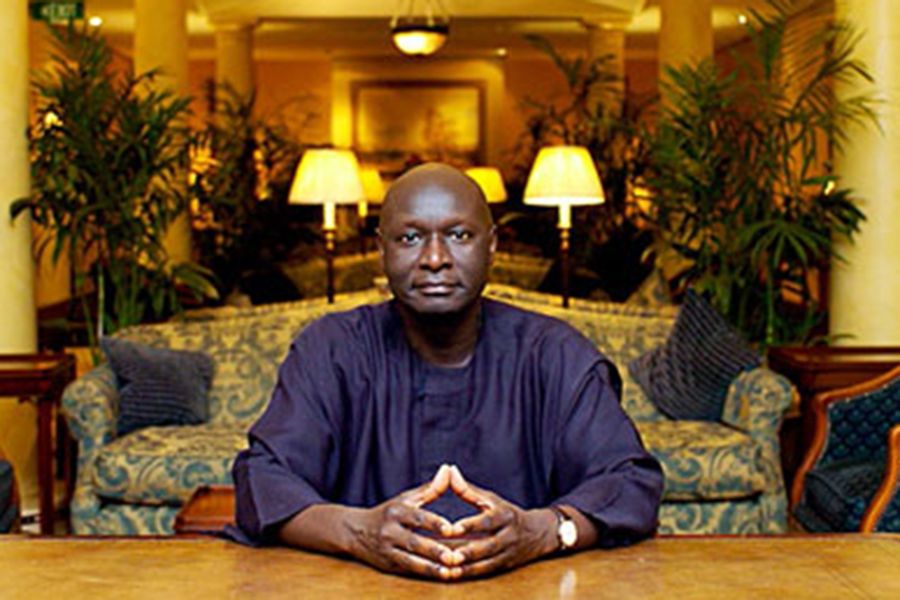
Uganda has formally nominated veteran diplomat and former United Nations Under-Secretary-General Olara Otunnu for the position of Secretary-General of the United Nations, joining the race to succeed António Guterres when his second and final term expires at the end of the year.
The nomination was submitted by Uganda's Permanent Representative to the United Nations, Ambassador Adonia Ayebare, in a July 24 letter addressed to the President of the UN General Assembly, Annalena Baerbock, and the President of the UN Security Council, Zénon Mukongo Ngay.
The candidature was formally communicated to all UN member states on July 25, increasing the number of candidates seeking the organisation's top job to seven.
In his nomination letter, Ayebare said Otunnu's record of public service made him a strong candidate for one of the world's most demanding diplomatic positions.
"Mr Otunnu brings to this candidature over four decades of leadership within the United Nations system and the wider international community," Ayebare wrote.
The ambassador said Otunnu's career spans service as Uganda's Permanent Representative to the United Nations, President of the Security Council, Uganda's Minister of Foreign Affairs, President of the International Peace Academy, now the International Peace Institute, and the UN's first Special Representative for Children and Armed Conflict.
"His candidature reflects the breadth of experience, statesmanship, and record of consensus-building that the Republic of Uganda considers essential to the Office of the Secretary-General at this juncture," Ayebare added.
The Ministry of Foreign Affairs said the nomination reflects the country's confidence in Otunnu's ability to steer the UN at a time of mounting global challenges.
"The Government of Uganda is confident that Ambassador Otunnu's unique breadth of experience, spanning the UN Secretariat, the Security Council, national government, academia, and grassroots peacebuilding, makes him exceptionally well suited to lead the United Nations at this critical juncture in global affairs," Permanent Secretary Vincent Bagiire said in a statement released on Sunday.
The ministry also appealed to member states to rally behind Uganda's candidate.
"The Government of Uganda calls on Member States of the United Nations to give Ambassador Otunnu's candidature their utmost support," Bagiire said.
Otunnu's nomination comes 30 years probably too late. In 1996, the diplomat expressed interest in the UN top job but the government did not back him with many at the time suggesting his political background in serving as a minister in the Tito Okello Junta was to blame.
Otunnu served as the United Nations Under-Secretary-General and the first Special Representative of the Secretary-General for Children and Armed Conflict between 1998 and 2005.
During that period, he successfully placed the protection of children affected by armed conflict on the Security Council's agenda and designed the monitoring and compliance mechanism established under Security Council Resolution 1612 of 2005, which remains in operation today.
He previously served as Uganda's Permanent Representative to the United Nations from 1980 to 1985 and chaired the Security Council in December 1981.
According to the Ministry of Foreign Affairs, it was during his presidency of the Council that he introduced the informal straw-balloting system for selecting the UN Secretary-General, a procedure that has since become known as the "Otunnu Formula" and has been used in every Secretary-General selection since 1981.
His career has also included service as Uganda's Minister of Foreign Affairs from 1985 to 1986, President of the International Peace Academy, and academic appointments at Albany Law School, the American University in Paris and the Institut Français des Relations Internationales.
He holds a bachelor's degree in Jurisprudence from the University of Oxford and a Master of Laws from Harvard Law School. He is fluent in English, French and Luo.
In recent years, Otunnu has co-led the Roco Paco peacebuilding initiative alongside retired Chief Justice Alfonse Owiny-Dollo, supporting reconciliation and community healing in northern Uganda after decades of conflict.
Ugandans also know Otunnu for contesting in the 2011 presidential election on the Uganda People's Congress ticket, finishing fourth with 125,059 votes behind President Museveni, Dr Kizza Besigye and Norbert Mao.
The election attracted attention after Otunnu disclosed that he had failed to vote because he had not transferred his voting location from abroad.
His entry into the race comes at a sensitive point in the UN selection process.
The General Assembly held public town hall dialogues with candidates on July 23, giving contenders an opportunity to present their vision to member states and civil society.
As a late entrant, Otunnu missed the event and will now have less time to campaign before the Security Council begins considering candidates.
The Council is scheduled to hold its first informal straw poll on July 30, a confidential vote that offers the earliest indication of which candidates command sufficient support among Council members.
Although non-binding, the straw polls are widely regarded as the most important stage of the selection process before the Council recommends a single candidate to the General Assembly.
Otunnu's candidature also reignites debate over the informal principle of regional rotation in choosing UN secretaries-general.
Many diplomats have argued that the 2026 appointment should go to a candidate from the Latin American and Caribbean Group, the only regional bloc yet to produce a UN Secretary-General.
However, Otunnu becomes the second African candidate in the race after former Senegalese President Macky Sall, making Africa the only region outside Latin America and the Caribbean to field candidates so far.
The development has raised questions over whether African states are moving away from the regional rotation principle they have traditionally defended.
The Secretary-General is appointed by the 193-member General Assembly upon the recommendation of the 15-member Security Council.
Any of the Council's five permanent members — China, France, Russia, the United Kingdom and the United States — can effectively block a candidate by casting a veto.
Ghana's Kofi Annan served as Secretary-General from 1997 to 2006 - the first African to the lead the top global peace-making organ. His election would also return the post to Africa two decades after Annan left office, at a time when the UN faces escalating armed conflicts, climate emergencies, humanitarian crises and deep geopolitical divisions.
