
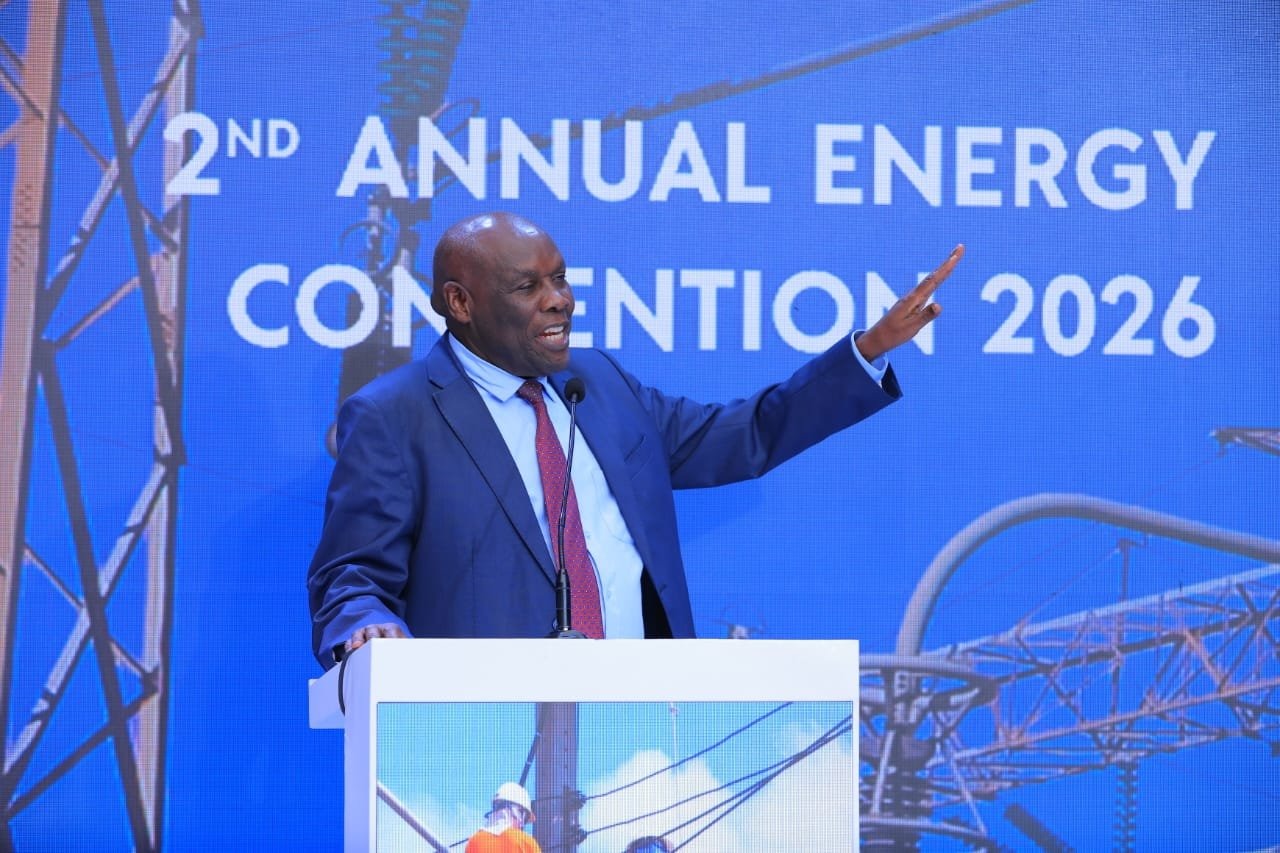
The State Minister for Energy, Okaasai Sidronius Opolot, has called for stronger partnerships between government and the private sector to accelerate investment in Uganda’s energy sector, saying affordable and reliable power will be central to achieving the country’s $500 billion economic ambition by 2040.
Speaking at the opening of the Energy Convention 2026, Okaasai said energy remains the foundation of Uganda’s transformation agenda, supporting industrialisation, manufacturing, value addition, mineral beneficiation and job creation.
“Energy is not merely a sector in the transformation plan; it is the foundation on which every other pillar stands,” Okaasai said.
He urged investors, development partners and industry players to work with government to unlock opportunities in the sector, including expanding electricity access, lowering power costs and advancing clean energy solutions.
The convention brought together policymakers, investors, energy experts and development partners to discuss strategies for strengthening Uganda’s energy sector and supporting industrial growth.
Permanent Secretary at the Ministry of Energy and Mineral Development, Eng. Irene Bateebe, said the debate should now focus on the speed and sustainability of the sector’s transformation rather than whether change will happen.
“The question before us is no longer whether Uganda’s energy sector will transform. It is how fast, how equitable, and how sustainable that transformation will be,” Bateebe said.
However, officials acknowledged that challenges in electricity transmission and distribution continue to limit Uganda’s ability to fully benefit from increased generation capacity.
The Commissioner for Renewable Energy at the Ministry of Energy and Mineral Development, Brian Isabirye, said Uganda has made significant progress in expanding electricity generation but weaknesses in the distribution network remain a major constraint.
Isabirye said the country lost approximately 1,472 gigawatt-hours (GWh) of electricity through transmission and distribution losses in 2025, costing the sector between Shs 221 billion and Shs 394 billion annually.
He said reducing technical and commercial losses would improve efficiency, increase utility revenues and create resources for expanding the electricity network.
“The resilience of our network is only as strong as the infrastructure supporting it. Aging assets and end-of-life distribution networks increase outages and maintenance costs, making modernization a priority,” Isabirye said.
He identified ageing infrastructure as one of the key challenges facing the sector, noting that some transformers remain unprotected while parts of the medium- and low-voltage network inherited during the Uganda Electricity Distribution Company Limited (UEDCL) takeover have reached the end of their operational lifespan.
Isabirye also raised concern over vandalism of electricity infrastructure, including theft of conductors, meters and distribution cables, saying it forces utilities to divert resources from expansion projects to emergency repairs.
Uganda’s rising electricity demand is adding further pressure on the system. Peak demand increased from 986 megawatts in August 2025 to 1,188 megawatts in February 2026, although the country is still unable to fully utilise its installed generation capacity due to distribution challenges.
Isabirye said overloaded feeders and weak infrastructure have also slowed new connections despite UEDCL’s target of connecting 300,000 new customers.
He listed network inefficiencies, ageing infrastructure, vandalism, connection backlogs and underutilised generation capacity as the five major structural challenges affecting Uganda’s electricity sector.
“Addressing these structural challenges is essential if Uganda is to achieve reliable electricity supply, accelerate industrialisation and unlock sustainable economic growth,” he said.
Stakeholders at the Energy Convention 2026 concluded with renewed calls for increased public-private partnerships, saying modernising the electricity distribution network will be critical to attracting investment and supporting Uganda’s long-term economic transformation agenda.
