
KAMPALA — Government is preparing a raft of policy interventions aimed at accelerating Uganda's digital transformation, including reducing taxes on entry-level smartphones, expanding innovation hubs across the country and completing a national Artificial Intelligence strategy.
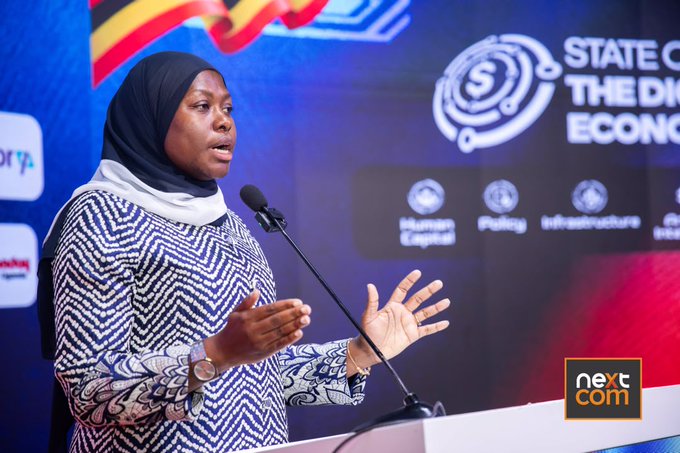
Speaking at the third edition of the State of the Digital Economy (SODE 2026) at Next Media Park, Ministry of ICT and National Guidance Permanent Secretary Dr Aminah Zawedde said government is deliberately positioning digital technologies as a driver of economic growth, innovation and employment.
Her remarks reinforced the central message emerging from this year's conference that Uganda must move beyond expanding connectivity to ensuring digital technologies generate meaningful opportunities for citizens.
Earlier, Next Media Group Chief Executive Officer Kin Kariisa challenged government and the private sector to shift the conversation from internet access to wealth creation.
"Now that we have connectivity, can we earn from this connectivity, create jobs, and export services?" Kariisa asked, urging every government institution to identify ways of creating value from Uganda's growing digital infrastructure.
Uganda Communications Commission Director of Finance Haruna Musinguzi later argued that digital infrastructure should ultimately be measured by its impact on people's lives.
"If digital infrastructure does not improve people's lives, then it remains nothing more than infrastructure," he said.
Chairperson of Parliament's Committee on ICT and National Guidance Andrew Ojok Oulanyah also called for stronger policies, regional innovation and artificial intelligence governance to ensure no Ugandan is left behind.
Building on those discussions, Dr Zawedde said government's responsibility is to create the policy environment that transforms digital access into economic opportunity.
"Government's role is to provide the policy direction that turns digital access into opportunity for every Ugandan," she said.
One of the major announcements from the ICT Ministry was government's plan to make smartphones more affordable by reducing taxes on entry-level devices.
Dr Zawedde said affordable devices remain one of the biggest barriers to digital inclusion, particularly among young people.
"We need to make smartphones more affordable by reducing taxes on entry-level devices for young people," she said.
She revealed that government is finalising a proposal to reduce taxes on affordable smartphones to enable more Ugandans to participate in the digital economy.
"Affordable devices are critical to digital inclusion. If young people cannot access smartphones, they cannot fully participate in the digital economy," she added.
The proposal comes after Kin Kariisa earlier observed that Uganda remains the only country in East Africa imposing import taxes on mobile phones, arguing that lowering the cost of devices would accelerate digital adoption.
Dr Zawedde said government is also decentralising innovation by establishing new innovation hubs outside Kampala.
She announced that innovation centres are being expanded to Lira University, Mountains of the Moon University and Gulu to ensure young innovators across the country have access to digital opportunities.
"Technology should not leave anyone behind. Digital opportunities must reach every corner of Uganda, not just Kampala," she said.
The expansion complements private sector initiatives such as Next Media's plan to establish 14 NextCreata creator hubs across major towns to nurture digital talent and content creation.
With artificial intelligence becoming central to digital transformation globally, Dr Zawedde said Uganda is finalising its National Artificial Intelligence Strategy to provide policy guidance on the technology's adoption and governance.
"Our Artificial Intelligence Strategy is nearing completion and will guide the country's approach to AI governance, including whether new legislation is required," she said.
Her remarks echoed concerns raised earlier by Oulanyah, who warned that AI has evolved beyond being a simple technological tool and now requires deliberate governance and regulation.
Dr Zawedde also announced that Cabinet has already approved Uganda's Business Process Outsourcing (BPO) Policy, describing it as a major step towards positioning the country as a competitive destination for global digital services.
"Government has already approved a Business Process Outsourcing Policy to create an enabling environment for digital jobs and position Uganda as a competitive outsourcing destination," she said.
She added that government is engaging global digital platforms to explore ways creators can commercialise their content and earn sustainable incomes from digital platforms.
"We are engaging digital platforms to ensure they can be commercialised for Ugandans, enabling creators to earn from their content," she said.
Dr Zawedde revealed that government is currently conducting a mid-term review of the Digital Transformation Roadmap to evaluate progress and identify priorities for the remaining implementation period.
She said the roadmap is anchored on key pillars including digital infrastructure, digital public services, cybersecurity, data protection, digital skills, innovation and entrepreneurship.
"Uganda's digital transformation is deliberate. Through the ATM strategy, ICT will play a central role in driving economic growth and creating jobs," she said.
Organised by NextCom under the theme, "Beyond Connectivity: Turning Access into Opportunity," the third State of the Digital Economy conference has brought together policymakers, regulators, innovators, entrepreneurs, academics and technology leaders to examine how Uganda can convert digital connectivity into jobs, innovation and sustainable economic growth.
The conference continues with discussions on human capital development, digital infrastructure, enabling policy frameworks, cybersecurity and artificial intelligence as stakeholders map out Uganda's next phase of digital transformation.
