
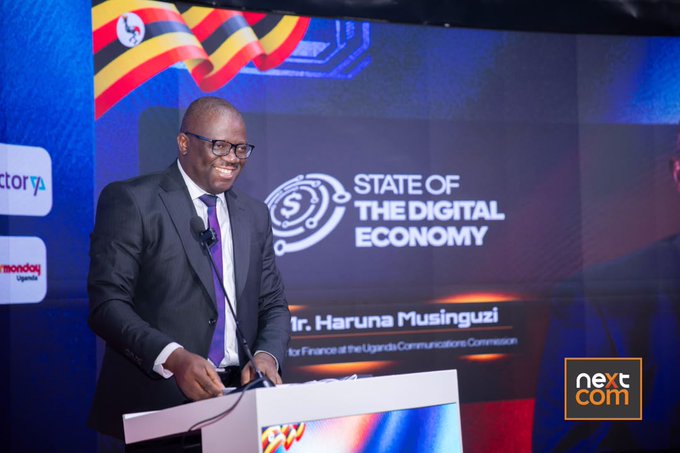
KAMPALA — Uganda's growing digital infrastructure should no longer be measured solely by internet access and mobile subscriptions but by how effectively it improves people's lives, creates jobs and accelerates national development, Uganda Communications Commission (UCC) Director of Finance Haruna Musinguzi has said.
Speaking during the third edition of the State of the Digital Economy (SODE 2026) at Next Media Park, Musinguzi built on earlier calls by Next Media Group Chief Executive Officer Kin Kariisa for Uganda to move "beyond connectivity" and begin unlocking the economic value of its expanding digital ecosystem.
Opening the conference earlier, Kariisa challenged policymakers and industry leaders to shift the national conversation from increasing internet access to creating jobs, exporting digital services and ensuring every government institution leverages connectivity to deliver greater value.
"Now that we have connectivity, can we earn from this connectivity, create jobs, and export services?" Kariisa asked.
"Can every government agency think about how it can create value out of this connectivity?"
Kariisa also described Uganda as "a highly connected country" and said the third edition of SODE was deliberately focusing on how digital access can translate into economic opportunity.
That message was echoed by Next Media Chief Marketing Officer Joy Mwangi, who argued that connectivity alone is insufficient unless citizens possess the digital skills needed to benefit from it.
"Connectivity is not about having a phone; it is about how you use it," Mwangi said, adding that programmes such as NextCreata are equipping young people with digital and content creation skills to prepare them for the future economy.
Taking the conversation further, Musinguzi said Uganda's digital ambitions must now be judged by their impact on citizens.
"When we talk about Uganda's internet in 2030, we must ask ourselves whether it will be faster, connect more people, support more devices and drive economic growth," he said.
"But the real question is whether our internet will transform public service delivery, create new industries, generate quality jobs, and remain secure and trusted."
He said digital infrastructure has become a cornerstone of national development, supporting nearly every sector of the economy.
"Uganda's internet is no longer just about technology; it is about how we educate our children, improve healthcare, modernise agriculture, create jobs, strengthen public institutions and improve the quality of life," Musinguzi said.
"If digital infrastructure does not improve people's lives, then it remains nothing more than infrastructure."
He argued that digital transformation should no longer be viewed simply as an information and communications technology agenda but as a broader national development strategy encompassing economic growth, governance and social progress.
"Digital transformation is not merely an ICT agenda; it is an economic, social, governance and national development agenda," he said.
According to Musinguzi, Uganda's expanding digital footprint demonstrates the country's readiness to embrace the next phase of digital transformation.
He revealed that Uganda currently has 47.5 million active mobile subscriptions, 20 million internet subscriptions, 36.3 million active mobile money accounts and more than 20 million smart devices, indicators he said reflect the rapid growth of the country's digital economy.
He noted that digital technologies are already improving livelihoods across multiple sectors.
"Across the country, we're seeing farmers access market information, students learn beyond the classroom, businesses reach new customers, and health workers improve service delivery through digital tools," he said.
Musinguzi said the challenge now is to ensure that these gains translate into broader economic opportunities, stronger public institutions and improved quality of life for all Ugandans.
Organised by NextCom under the theme, "Beyond Connectivity: Turning Access into Opportunity," the third State of the Digital Economy conference has brought together government leaders, regulators, technology experts, entrepreneurs, innovators, academics and content creators to examine how Uganda can transform digital access into sustainable economic growth.
The conference is focusing on four strategic pillars—human capital, policy, infrastructure, and artificial intelligence and cybersecurity—while also featuring fintech exhibitions, GovTech demonstrations, creator economy sessions and the Vibe Hackathon, where innovators are developing technology-driven solutions to real-world challenges.
Throughout the day, speakers have maintained that while Uganda has made remarkable strides in expanding digital connectivity, the country's next frontier lies in ensuring that technology creates employment, stimulates innovation, improves service delivery and positions Uganda as a competitive player in the global digital economy.
