
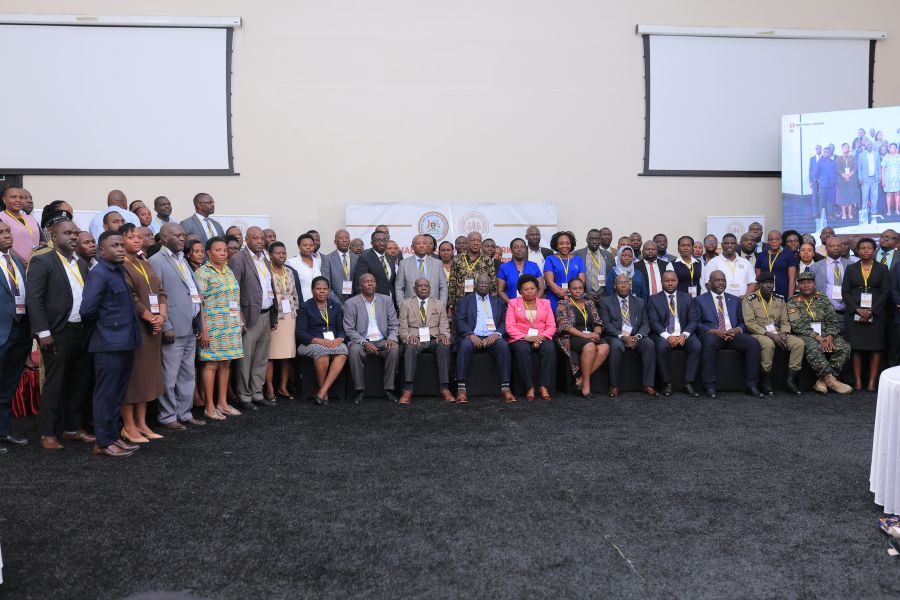
The State Minister for Lands, Harriet Ntabazi has sounded a warning to encroachers on government land that their time is up as the national inventory for all public land is launched.
Speaking during a national stakeholders workshop on the development of a comprehensive government land inventory at Mestil Hotel in Kampala, Ntabazi said the era of unchecked encroachment is coming to an end.
"To those occupying government land without authority, your time is up. If you are a commissioner or work in the Ministry of Lands and you are illegally occupying government land, start packing. Regardless of your position or status, the time is now," she said.
“ If you work in the Ministry of Lands and are occupying government land without authority, pack your belongings and leave. The time is now. If you fall into that category, regardless of your position, ministry, department, or status, thank you very much, but you must vacate. The time is now.”
The minister described government land as a strategic national asset that is increasingly under threat from encroachment, fraud and poor record-keeping, saying the inventory will provide the country with a reliable database to safeguard public property and support national development.
"A government land is a national asset. It does not grow in size, yet the population continues to grow. Government must stand firmly to protect its own land," Ntabazi said.
She noted that public land hosts essential infrastructure, including schools, hospitals, military installations, conservation areas, research centres, universities and industrial parks, making its protection critical to service delivery and Uganda's socio-economic transformation.
According to the minister, only 23 percent of government-owned land has been formally titled, leaving the majority vulnerable to illegal occupation and fraudulent ownership claims.
"Only 23 percent of government land is titled. The rest remains undocumented. This is a serious problem that requires urgent attention through registration," she said.
Ntabazi said widespread encroachment has affected government institutions across the country, including prisons, police land, schools, Makerere University and Mulago National Referral Hospital.
She blamed weak documentation for enabling fraudulent land transactions, saying individuals have been able to process land titles on public land because government institutions often lack complete ownership records.
"In some cases, government ends up compensating people occupying government land in order to construct roads and other infrastructure. It is effectively government paying government. This is a serious challenge that must be addressed," she said.
The minister also cited fragmented land records across government agencies as a major obstacle to protecting public land.
She explained that information relating to land owned by different institutions is scattered among various ministries, making it difficult to establish clear ownership and boundaries.
"We do not have one organised inventory or central repository for government land. Records are often incomplete, inaccessible or do not exist at all," Ntabazi said.
She said the newly launched inventory seeks to consolidate all public land information into a comprehensive national database that will improve land governance, accountability and institutional coordination.
She added that the initiative is in line with the National Land Policy, which recognises land as a strategic national resource requiring modern administration systems and stronger institutional coordination.
The Chairperson of the Uganda Land Commission (ULC), Prof. Pen Mogi Nyeko said the inventory will enable government to identify idle public land that can be allocated to investors as a way of addressing one of the country's biggest obstacles to investment and economic growth.
Prof. Nyeko said government currently lacks a complete record of how its land is being utilised, making it difficult to support investment opportunities.
"We would like to have this inventory so that we know how government land is being utilised for economic purposes. We do not want government land lying idle when it can contribute to the country's economic growth," he said.
According to Prof. Nyeko, Uganda continues to receive investors seeking land for projects, including those referred through presidential directives, but government agencies often struggle to identify suitable public land for allocation.
"We have many investors coming into the country looking for land, but sometimes we are unable to get land for them. This inventory will help us identify available government land, especially land that is idle, so that it can be allocated to investors," he said.
He noted that the inventory exercise is intended to establish a comprehensive database of all government-owned land, indicating its ownership, location, status and utilisation.
