
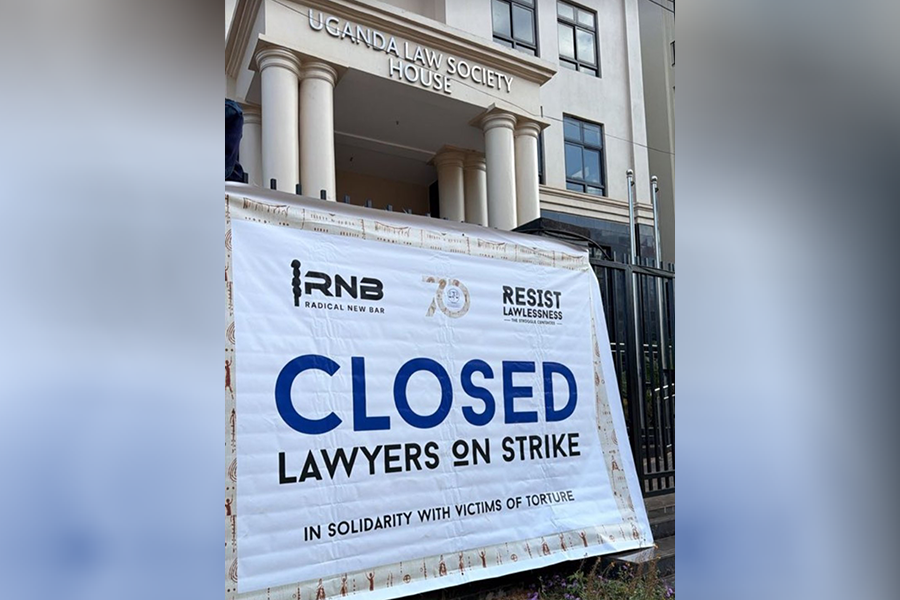
Lawyers under the Uganda Law Society (ULS) on Friday boycotted court proceedings across the country, accusing the judiciary of failing to protect advocates who they say have increasingly become victims of torture, intimidation and other human rights abuses while carrying out their professional duties.
The industrial action coincided with the International Day in Support of Victims of Torture, with the lawyers saying the boycott was intended both to stand in solidarity with victims of torture and to highlight the growing risks faced by members of the legal profession.
Speaking during the boycott, advocate Kato Tumusiime said the protest was not limited to lawyers handling human rights cases but reflected concerns affecting the entire legal fraternity.
"We have joined members of the Uganda Law Society to strike against the way advocates are being treated while carrying out their work. This is not just about lawyers representing victims of torture and human rights violations; it is about every advocate because we have all become targets," Tumusiime said.
He questioned the judiciary's ability to safeguard the rights of ordinary Ugandans if it could not guarantee the safety of advocates, who serve as officers of the court.
"If the judiciary cannot protect advocates, who are officers of the court, how will it protect victims of torture who come before it seeking justice?" he asked.
Tumusiime argued that lawyers could not effectively represent victims of torture and other human rights abuses while they themselves continued to face threats, intimidation and alleged torture.
"Not until we are safe, we cannot adequately protect our clients," he said.
He further warned that continued silence over alleged attacks on advocates could eventually undermine judicial independence.
"If they fail to fight while they still have the opportunity, there may come a time when judges and judicial officers themselves are captured, tortured, or even killed. The independence of the judiciary is at stake," he cautioned.
Acknowledging that the boycott would disrupt court operations and affect litigants, Tumusiime maintained that the industrial action was necessary to push for reforms and stronger institutional safeguards for advocates.
"We know this strike affects the daily work of the judiciary and the people we represent, but they should understand that until advocates are protected, justice itself is compromised," he said.
He indicated that the boycott would not end after one day, saying lawyers would continue withdrawing their services until the judiciary addresses the concerns raised by the legal fraternity.
"This is only the beginning. We shall continue until the judiciary hears our plight, hears our cry, and answers the questions we are raising," he said.
The lawyers also renewed calls for an end to torture in Uganda, saying the practice is incompatible with the country's constitutional order and the rule of law.
"As a nation, we must come together and say no to torture. It has no place in our Constitution and no place in the daily lives of Ugandans," Tumusiime said.
The boycott adds to growing concerns within Uganda's legal fraternity over the safety and independence of advocates.
The Uganda Law Society has in recent months repeatedly raised concerns over the treatment of lawyers, particularly those representing clients in politically sensitive and human rights-related cases, arguing that intimidation of advocates threatens access to justice and the administration of the rule of law.
