
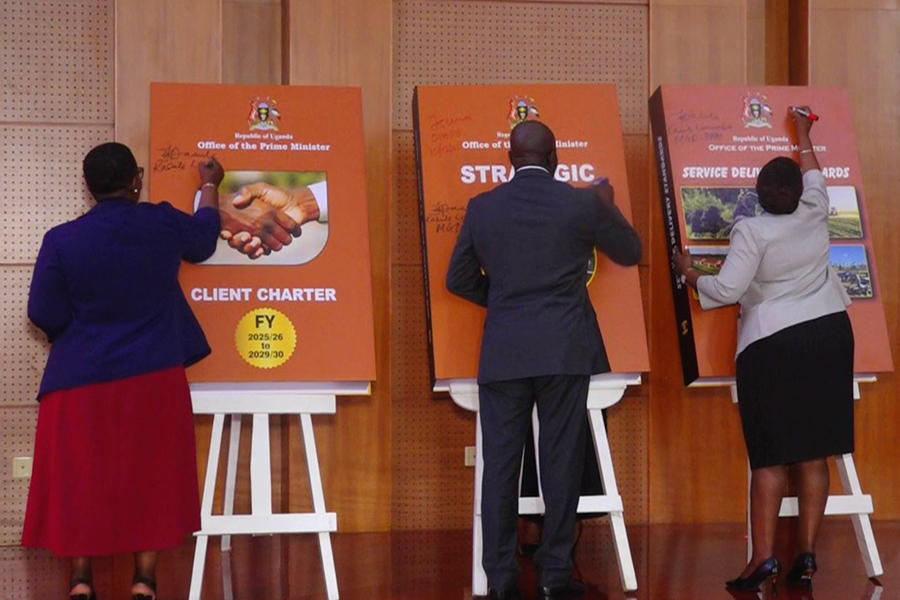
The government has unveiled a new Service Delivery Strategy aimed at improving efficiency, accountability and coordination across all Ministries, Departments and Agencies (MDAs).
Launched by the Office of the Prime Minister, the 2025/2026–2029/2030 plan seeks to raise the quality of public services and create platforms for citizens to routinely provide feedback on the standards of the services they receive.
Speaking at the launch, the Minister in charge of General Duties in OPM, Justin Kasule Lumumba, said the strategy offers a clear roadmap for how government institutions will collaborate to better serve Ugandans.
“This plan clearly outlines how MDAs must coordinate to deliver services, the standards they are required to meet, and how citizens can track those standards and raise concerns whenever services fall short,” Lumumba said.
She noted that although the previous 2020–2025 plan was disrupted by the COVID-19 pandemic, government is now better prepared to implement reforms even amid future national challenges.
“We have learned from past interruptions, including COVID-19, and we are confident that this time, no major setbacks will derail the programme. This strategy was carefully designed, and we expect it to deliver visible results,” Lumumba said.
According to OPM, once the public understands the strategy, they will be able to follow what each government entity is expected to deliver and monitor whether service standards are being met, helping safeguard taxpayer resources and strengthen accountability.
The strategic plan, service delivery standards and the client charter outline how the 2025/2026–2029/2030 programme will operate, with a strong emphasis on consistency and citizen-centred performance.
The new plan aligns with the Fourth National Development Plan (NDP IV) and reflects a broader shift toward a people-centred, coordinated and results-driven public service.
It positions OPM to play a stronger role in supervising government programmes, improving disaster preparedness and response, supporting the Parish Development Model and ensuring coherence in the delivery of public services.
Lumumba emphasised that the reforms are binding and will influence how the public service functions going forward.
She also reminded Ugandans that the accompanying Client Charter is intended to empower citizens and set clear expectations for service delivery.
OPM says it will enforce the strategy through integrated platforms, programme working groups, national monitoring missions and real-time tracking of government priorities, warning that inefficiency, duplication and siloed operations “belong to the past.”
