
The government has set its sights on becoming a $500 billion economy, driven by clean, affordable, and sustainable energy.
Through the Ten-Fold Growth Strategy, energy is positioned not just as a utility, but as a critical engine for industrialization, job creation, and long-term socioeconomic transformation.
“Through the Ten-Fold Growth Strategy, Uganda aims to fuel a USD 500 billion economy powered by clean, affordable, and sustainable energy that drives industrialization, supports livelihoods, and secures a brighter future for every citizen,” said Ruth Nankabirwa, Minister of Energy and Mineral Development.
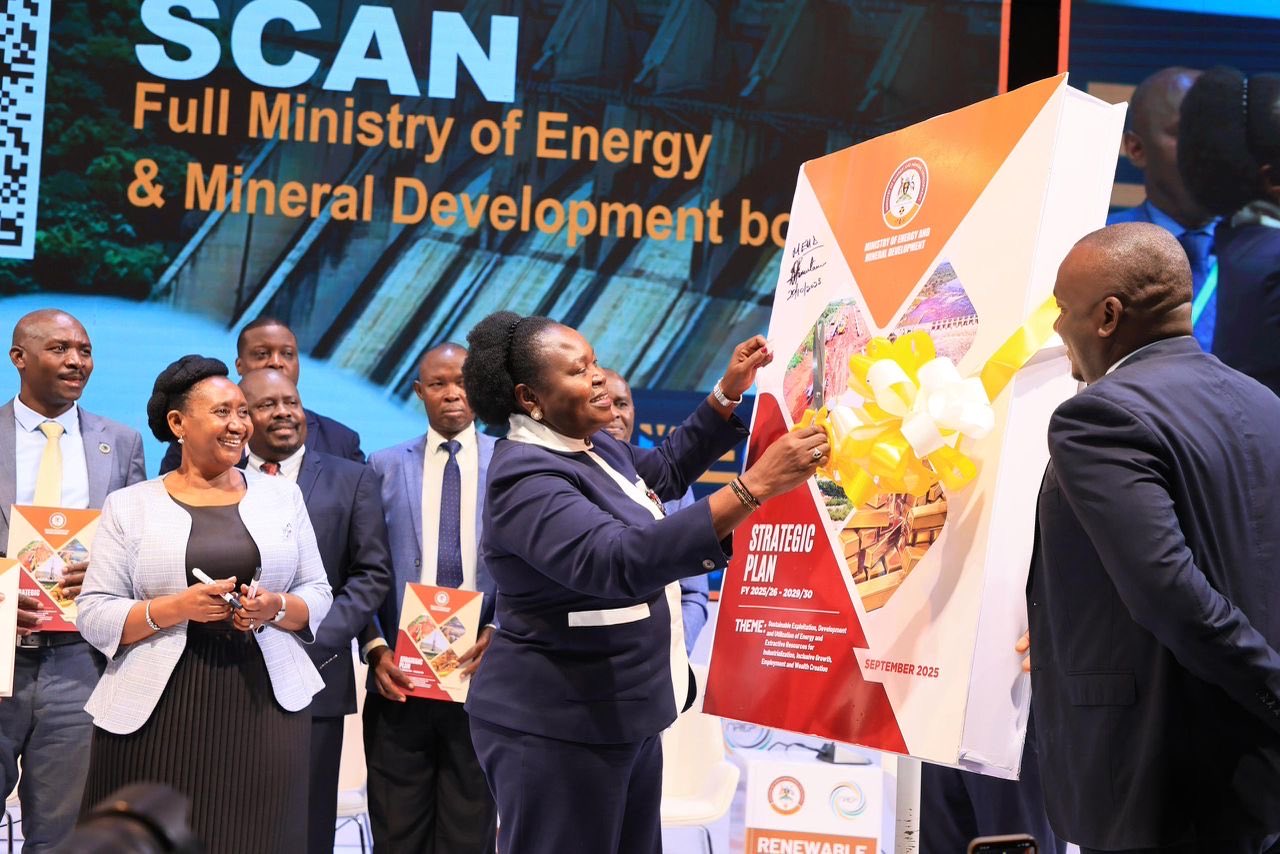
She made the remarks during the official opening of the Sustainable Energy Development Programme Performance Review, held alongside the Renewable Energy Conference and Expo 2025 (REC25) in Kampala.
The three-day event drew over 500 participants from government, the private sector, civil society, and development partners, focusing on energy sector progress, innovation sharing, and unlocking new investment opportunities.
Uganda’s energy access now stands at 60%, a result of sustained investment in generation, transmission, and distribution infrastructure across the country.
Major transmission projects such as Karuma–Kawanda (248 km), Gulu–Kole–Nebbi–Arua (298 km), and Opuyo–Moroto (160 km) have strengthened grid reliability and expanded supply to homes, industries, and social institutions.
“From Access to Impact: Powering Uganda’s Transformation through Sustainable Energy, the next phase under NDP IV focuses on scaling generation to 15,420 MW by 2030 and 52,481 MW by 2040, while modernizing networks and promoting off-grid solutions,” said Nankabirwa.
Recent generation projects include the 6 MW Nyagak III Hydropower Plant and the 20MW Nkonge Solar PV Plant.
More than 200,000 new grid connections have been added, and the West Nile region has been fully integrated into the national grid.
Off-grid and mini-grid solutions continue to play a vital role in electrifying remote communities, bridging the energy divide.
As part of the clean energy transition, the government has rolled out the Biofuels Blending Programme and is implementing the National Clean Cooking Strategy to reduce reliance on biomass and protect the environment.
At REC25, Uganda launched its Clean Cooking Unit (CCU), a national initiative aiming to shift 50% of households to clean cooking technologies by 2030.
The program is supported by UK bilateral funding and the Modern Energy Cooking Services initiative.
The British High Commissioner to Uganda, Lisa Chesney, welcomed the move, noting that access to clean cooking is crucial for public health, women’s empowerment, and climate action.
Minister Nankabirwa praised the collaboration between government, private sector, and development partners, emphasizing that this momentum must be sustained to meet national targets.
She reaffirmed the government’s commitment to achieving universal access to electricity and clean energy by 2040.
“We must continue working together to build an energy sector that powers industries, lights every home, and positions Uganda as a regional leader in energy-led transformation,” she said.
Uganda’s energy journey reflects a shift that places sustainability, equity, and economic growth at the center of national planning.
As the country accelerates its transition, energy will not only power homes and businesses but also drive Uganda’s rise as a competitive, inclusive, and climate-resilient economy.
