
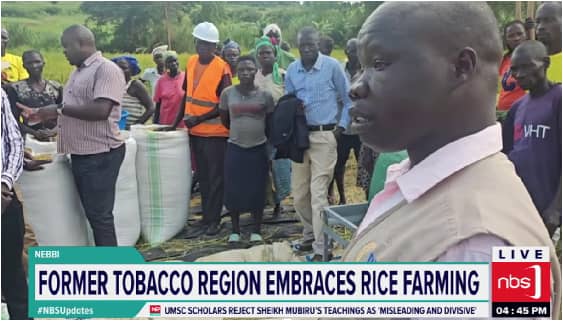
As tobacco prices fall and sustainability concerns rise, farmers in West Nile are embracing rice cultivation, transforming their livelihoods and landscapes with support from a Japan-backed agricultural project.
The once-familiar sight of tall, narrow tobacco-curing barns scattered across the homesteads of West Nile is fast disappearing.
In their place, lush green rice paddies are springing up, signaling a quiet but profound transformation in the region’s agricultural landscape.
For decades, tobacco dominated West Nile’s cash crop economy, alongside traditional staples like cassava and millet.
But with declining tobacco prices and mounting environmental concerns, local farmers are turning to rice — a crop that offers both food security and steady income.
This shift is being propelled by the Promotion of Sustainable Rice Development Project (ECO-PRiDe), a five-year initiative jointly implemented by the Ministry of Agriculture, Animal Industry and Fisheries (MAAIF), the National Agricultural Research Organisation (NARO), and the Japan International Cooperation Agency (JICA).
Now in its second year, the project helps farmers adopt modern, climate-resilient rice production practices tailored to the region’s soils and weather patterns.
“Rice cultivation, supported by funding from the Parish Development Model, has strong potential to help local farmers lift themselves out of poverty,” said Aseru Beatrice, Parish Chief of Nyadri Sub-county in Maracha District.
A cornerstone of the ECO-PRiDe project is farmer training. Thirteen district agricultural officers from Koboko, Maracha, Yumbe, Nebbi, Moyo, Obongi, and Madi-Okollo have been trained in modern rice production through a Training of Trainers programme.
On Thursday, 28 farmers graduated in Nyadri Sub-county after completing hands-on training under the Musomesa Field School approach developed through ECO-PRiDe.
The course covers the full production cycle — from site selection and field management to harvesting and post-harvest handling.
Upon graduation, the newly certified farmers are encouraged to train others in their communities through a farmer-to-farmer extension model. To strengthen this approach, the project is developing a Trainer’s Guide to standardize field school sessions across the region, applicable to rice and other key crops.
To ensure access to high-quality seed, ECO-PRiDe has partnered with Equator Seeds Limited to multiply parent seed produced by NARO’s National Crop Resources Research Institute (NaCRRI) at Namulonge.
The project has also extended to refugees and host communities in Yumbe and Madi-Okollo districts, working with the Office of the Prime Minister to integrate rice cultivation into livelihood programmes — with promising results.
At the farmer graduation ceremony, Toshinori Katsumata from JICA reaffirmed Japan’s long-term commitment to Uganda’s agricultural transformation.
“Empowering smallholder farmers with practical knowledge and access to improved seed and production methods is key to achieving sustainable food systems and rural development,” he said.
“JICA remains dedicated to strengthening Uganda’s rice value chain through technology transfer, farmer training, and research collaboration.”
Frank Mugabi, Head of Communications at NARO, who represented Deputy Director General for Technology Promotion Dr Sadik Kassim, praised the project for ensuring that farmers benefit directly from NARO’s innovations.
“The high rice yields recorded among trained farmers clearly show that adopting improved technologies can create food- and income-secure communities,” Mugabi said. “This aligns perfectly with Uganda’s national development goals.”
Rice is now among West Nile’s top five crops, valued for both dietary and commercial appeal. Nationally, Uganda’s rice production has more than doubled over the past 15 years — from under 300,000 metric tons to over 700,000 metric tons — making the country more than 70 percent self-sufficient.
Experts believe Uganda is on track to achieve full self-sufficiency and potentially emerge as a rice-exporting nation in the near future.
As the sun sets over the green fields of Maracha, the story of West Nile’s farmers is changing — from the smoke of tobacco barns to the shimmer of rice paddies — a story of adaptation, resilience, and renewal.
