

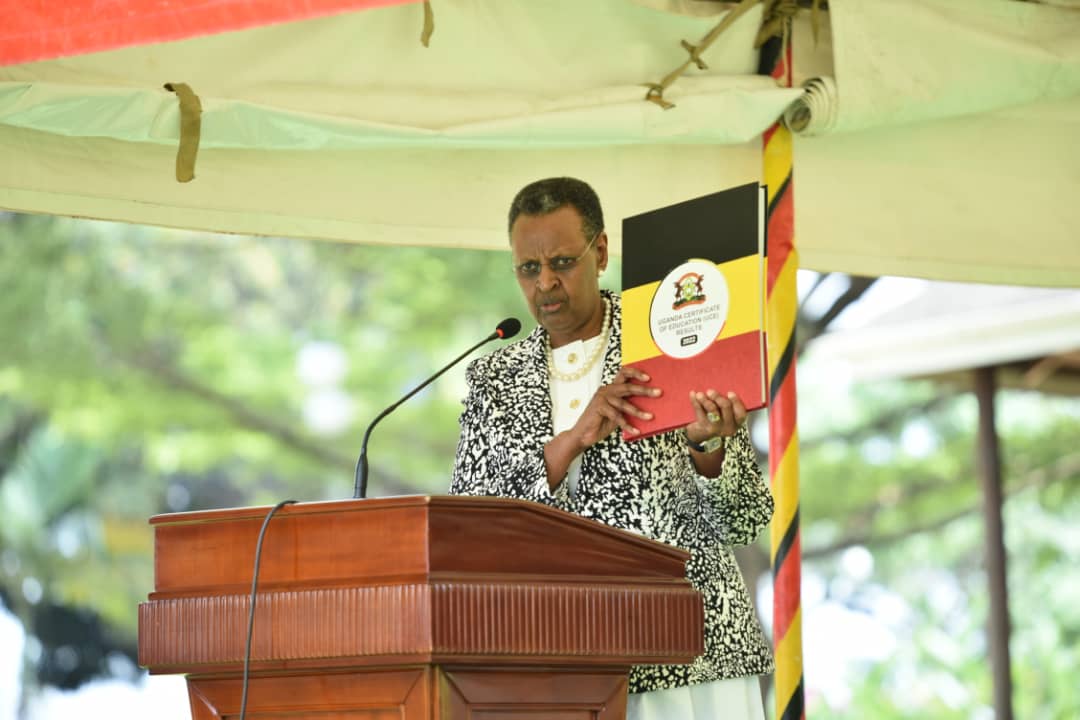
A total of 15,756 failed Uganda Certificate of Education(UCE) in 2022, UNEB has revealed.
According to the results released on Thursday, the 15756 represented 4.6% of the total 345,695 candidates who sat for UCE exams in 2022.
The number is however lower than the 18,415 who failed UCE exams the previous year in 2021.
According to UNEB Executive Director, Dan Odongo, the UCE examination is designed to assess the degree of acquisition of the necessary knowledge, skills and competences in the various learning areas; and to lay a foundation for specialization at higher education levels.
“Examination papers have been carefully constructed and go through necessary quality assurance stages to ensure validity such that they test the candidates’ knowledge, understanding, and ability to apply the knowledge acquired to solve problems in given novel situations and to show analytical skills.”
He said that in the sciences, the papers test the candidates’ ability to use the science apparatus provided to perform experiments following instructions, and to apply the science process skills of making measurements and observations, recording observations and other data from the experiments carried out.
“They are then expected to draw inferences or conclusions from observations that they have made, and interpret the data. They should also be able to apply basic scientific knowledge in problem solving situations, including problems in their environment.
He said weakness are persistent .
UNEB said that whereas this year there was better quality work in English language,in composition writing where candidates are expected to exhibit creativity and originality, in some schools, many are still cramming passages from textbooks with unusual and difficult vocabulary.
“They then reproduce the crammed passages irrespective of what the composition topic is. This practice is, fortunately, declining, because candidates who do this are punished.”
UNEB adds that in the comprehension of passages, candidates found difficulty in extracting appropriate information to use to correctly answer the questions based on the passage.
“There are also weaknesses in using the correct grammar in sentence construction. The essential skill of extracting main ideas from a passage and writing out a coherent summary presents a major challenge to most candidates.”
UNEB Executive Director, Dan Odongo said the challenge of language deficiency is reflected in performance in other subjects, where there is failure by the candidates to interpret the demands of the tasks set, failure to follow instructions, misunderstanding key words used in the stem of a question, and generally poor language expression.
Sciences
Odongo said in sciences, the problems have remained the same in recent years with candidates showing weaknesses in the handling of apparatus during the practical tests.
The weaknesses were also shown in making and recording observations and drawing conclusions from those observations; tabulation of experimental results and interpretation of the results to meet the demands of the question, UNEB said.
“They also showed poor Mathematical skills required in calculations, inability to write the correct symbols of elements, formulae of compounds and equations, among others. Many candidates take measurements and tabulate the readings and stop on that, being unable to do anything else with the tabulated data.”
“ There is a practice, probably encouraged by teachers, where a candidate takes the first reading, and then for the subsequent readings, the candidate merely adds a fixed value adds a fixed value, ending up merely forged figures of experimental results in the practical papers.”
UNEB said many candidates showed lack of practical experience in handling the apparatus as many schools tend to handle practical aspects of the curriculum much later in the course.
“ As a result, students do not develop the necessary skills. This could explain why most malpractice cases are in Science practical papers.”