
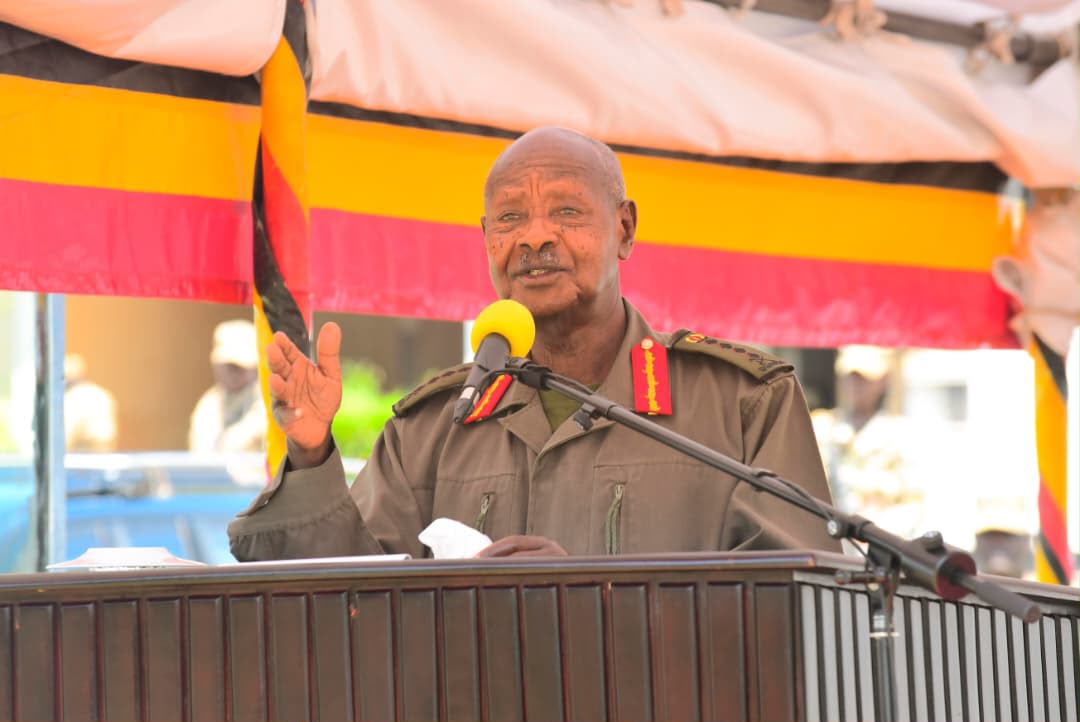
President Museveni has called for deeper political integration across East Africa and the wider African continent, saying it is essential for addressing future security threats and enabling Africa to compete effectively on the global stage.
Museveni made the remarks while delivering a lecture of opportunity to army officers at the Senior Staff College – Kimaka in Jinja on Tuesday, where he emphasized that Africa’s current fragmentation along colonial borders weakens its strategic capacity.
He argued that the continent must rethink its political and security structures if it is to operate effectively in critical domains such as land, air, maritime space, and even space exploration.
“Security is the second historical mission. How can we go to the moon? We must go to the moon and find the Americans there, find the Chinese, Russians and Indians, we tell them that this also belongs to us,” Museveni said.
He added that Africa’s inability to build unified defense and technological systems is largely a consequence of colonial-era boundaries that restrict cooperation and limit scale.
“If you’re not going to be just a boy scout movement and be able to defend Africa, we must be able to operate on land, air, navy and in space but can Uganda have a space program? Or can we go to ocean? No, we are cut off by the irrational colonial borders. That’s why the answer there is political integration,” he said.
Museveni warned that regional integration efforts will continue to face setbacks if leaders prioritize narrow national interests over broader continental goals.
“We have been talking about the East African Integration but if Presidents want to remain big fish in the small ponds, then that issue will not be addressed,” he said.
The President, who also serves as Commander-in-Chief of the Uganda People’s Defence Forces (UPDF), told officers that the National Resistance Movement (NRM) has long advanced what he described as Africa’s “historical missions,” which include both political stability and economic transformation.
He said the first priority is ensuring prosperity through the integration of African markets to expand economic opportunities and improve living standards.
“The first historical mission is how to ensure prosperity of our people. We have told you that one of the factors to help you prosper is economic integration of the African market,” he said.
Museveni also criticized historical African leadership systems, arguing that many failed to respond to emerging strategic threats during the colonial era.
“The chiefs and kings were here glorifying themselves when their building was falling down. This strategic danger was known but neglected by kings and chiefs,” he said.
He further noted that population pressure on land in parts of Africa highlights the need for economic diversification beyond subsistence agriculture.
“Land is only crucial for agriculture but in money economy, many people are in manufacturing and services, a few are in agriculture,” he said.
On global geopolitics, Museveni said conflicts in regions such as the Middle East have limited direct impact on Africa, arguing that the continent already possesses sufficient resources if properly harnessed.
He also dismissed identity-based politics, describing them as a sign of ideological weakness.
“The politics of identity is politics of parasites,” he said.
Museveni emphasized that patriotism and Pan-Africanism are key to building wider markets for African goods and ensuring sustainable development.
He identified Uganda’s key economic sectors as commercial agriculture, manufacturing, services, and ICT, saying these should drive job creation and wealth generation.
Earlier, the Commandant of the Senior Staff College – Kimaka, Brig Gen. Kabango Michael, praised Museveni’s leadership, describing it as instrumental in maintaining peace, stability, and progress in Uganda.
He said Intake 21 (2025/2026), which began on July 8, 2025, will graduate on July 2, 2026, and currently comprises 52 participants, including 38 Ugandans and 14 officers from allied countries such as Burundi, Egypt, Kenya, Malawi, Rwanda, South Africa, South Sudan, and Tanzania.
