
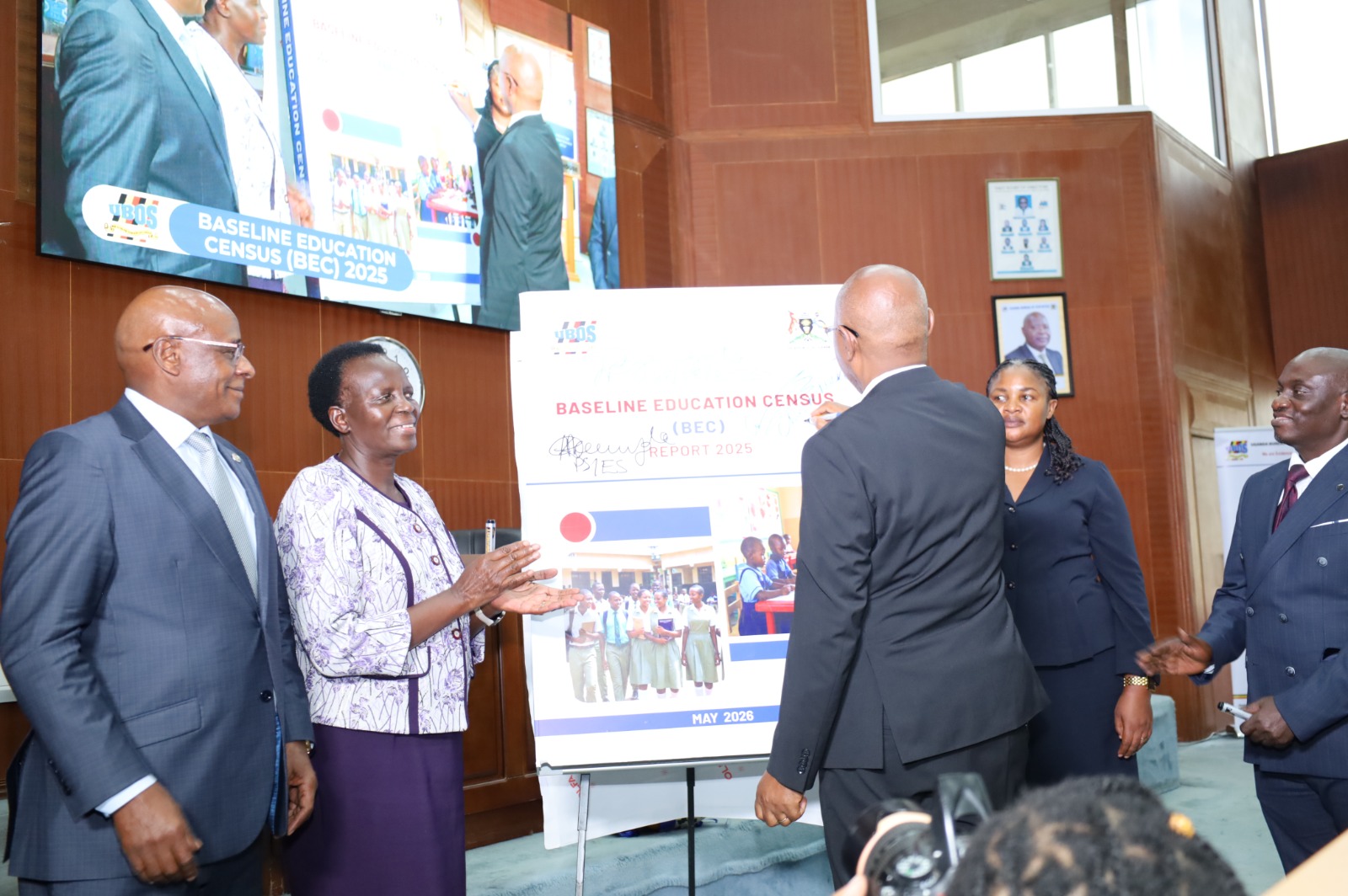
The Permanent Secretary in the Ministry of Education and Sports, Kedrace Turyagyenda, has described the newly released Baseline Education Census (BEC) 2025 Report as a long-awaited tool that will transform education planning and service delivery across Uganda.
Speaking during the dissemination of the report on Thursday, organized by the Uganda Bureau of Statistics, Turyagyenda said the country had urgently needed such comprehensive education data to guide government interventions.
“This baseline data, as had earlier been mentioned, was expected years ago. We have needed it yesterday,” she said, drawing laughter and agreement from participants.
The report provides detailed national statistics on learners, teachers, non-teaching staff, schools, and infrastructure across both government and private institutions, offering what officials described as a critical snapshot of Uganda’s education system.
Turyagyenda said the findings will significantly improve government planning, especially in identifying underserved regions and targeting education investments more effectively.
“We are really grateful because this data is definitely going to help us and help government as we plan for the provision of education services and target the most needed areas in our country,” she said.
She noted that Uganda’s long-term development ambitions under Vision 2040 depend heavily on accurate data and coordinated planning across government sectors.
“As a nation, we have only one vision – transforming Uganda into a modern and prosperous country. That cannot happen unless we plan effectively and work as one government,” she noted.
Turyagyenda also raised concern over the transition gap between O-Level and A-Level education, saying a significant number of learners drop out of the academic pipeline.
She observed that nearly 400,000 candidates sit for O-Level examinations annually, but only slightly above 100,000 proceed to A-Level.
“Looking at the figures as they are, one would imagine that all those who do not transition to A-Level actually fail out of the system,” she said.
However, she clarified that many of those learners are now absorbed into vocational and skilling programmes aimed at equipping young people with practical employable skills.
“In this global village, we are talking about skilling because we have very many young people and limited jobs. Skills development gives them another opportunity,” she added.
Turyagyenda further pointed out persistent infrastructure gaps, revealing that several sub-counties and parishes across the country still lack public schools.
“There are big numbers of sub-counties without public schools and parishes without government institutions. That remains a pain,” she said.
She noted that while population growth has strained service delivery, government has made steady progress in expanding access to secondary education, including building and grant-aiding new schools since 2016.
“As we speak now, since 2016, government has either built or grant-aided many secondary schools to expand access,” she said.
Meanwhile, the Chairperson of the UBOS Board, Albert Byamugisha, said the Baseline Education Census comes at a critical time when Uganda is implementing its National Development Plan with a strong focus on human capital development.
Byamugisha commended UBOS for producing what he described as high-quality, reliable and timely statistics that will strengthen national planning, budgeting and accountability systems.
“The report provides information on the distribution of schools and institutions, enrolment trends, teacher availability and other key education indicators,” he said.
He explained that the findings will support evidence-based decision-making, enabling government to make targeted investments, improve equity in resource allocation, and design more effective policy interventions.
Byamugisha further noted that Uganda’s current development direction prioritizes the production of practical, innovative and employable graduates capable of driving industrial growth, entrepreneurship and job creation.
This, he said, aligns with the broader national transformation agenda, including industrialization efforts and government programs aimed at increasing household incomes and boosting national productivity.
The report is expected to serve as a key reference document for policymakers, development partners, and education stakeholders as Uganda continues to pursue improvements in access, quality, and equity in education.
