
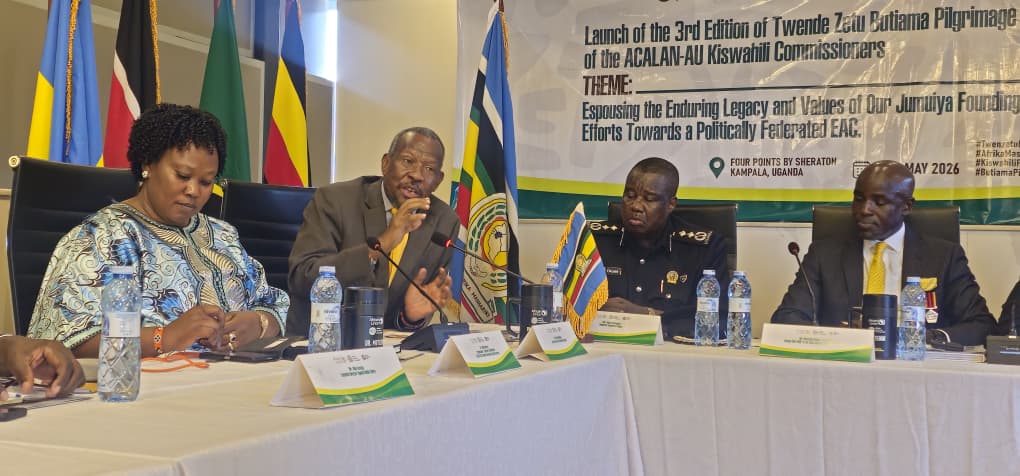
The third edition of the Twende Butiama Pilgrimage Safari has been officially launched alongside the unveiling of the African Union Kiswahili Commission team in a move aimed at promoting regional integration and strengthening the adoption of Kiswahili across East Africa.
The annual pilgrimage, organised by Tendo Group under the leadership of Ronex Kisembo Tendo, is a cultural and educational journey to Butiama in Tanzania, the ancestral home of Julius Nyerere.
Organisers say the initiative seeks to inspire young Africans through the values, leadership and Pan-African vision of East Africa’s founding leaders.
Speaking at the launch, Dr. Kisembo said the 2026 edition would expand beyond Tanzania to include Uganda and Kenya in recognition of the shared legacy of independence leaders including Jomo Kenyatta and Milton Obote.
“We cannot talk about regional integration and the promotion of Kiswahili without paying tribute to the leaders who fought for the unity and liberation of our people,” he said.
The pilgrimage, scheduled for October 2026, will begin in Uganda and is expected to attract youth and participants from across the East African Community and beyond.
Planned activities include a visit to Uganda’s Parliament to reflect on the country’s independence journey, a historical and cultural tour of Northern Uganda including Murchison Falls National Park, participation in Uganda’s Independence Day celebrations on October 9 at Kololo Ceremonial Grounds, and a cross-border journey through Kenya with stops in Nairobi and Gatundu, the home area of Kenyatta.
The pilgrimage will conclude in Butiama with prayers and reflections on Nyerere’s legacy.
Dr. Kisembo described the initiative as more than a tourism activity, calling it “a learning experience about servant leadership, sacrifice and Pan-Africanism.”
The event also marked the unveiling of the African Union Kiswahili Commission, a nine-member team tasked with promoting Kiswahili across the continent.
Kiswahili, one of the most widely spoken languages in Africa, is increasingly being positioned as a unifying language central to regional integration efforts.
Dr. Kisembo, who was elected Secretary General of the commission, said the body would focus on awareness, adoption and standardisation of Kiswahili globally.
“If East African integration is to remain strong, then Kiswahili must be embraced as the language that binds us together,” he said.
The commission includes regional leaders and experts such as Ababu Namwamba, Ronex Kisembo Tendo, Aldin Mutembei as coordinator, Aidah Mutenyo as Commissioner for Education and Sensitisation, and Pacific Malonga as adviser.
Commissioner for Education and Sensitisation Aidah Mutenyo said more effort was needed to accelerate Kiswahili adoption across the region.
“Despite decades of progress, more effort is needed to make Kiswahili a common language across the region,” she said.
Speakers at the launch also stressed the need to revisit the ideals of East Africa’s founding leaders amid ongoing governance and leadership challenges in the region.
Dr. Kisembo called for renewed commitment to integrity and servant leadership inspired by Nyerere’s example.
“When you go to Butiama, you see a leader who sacrificed everything for the unity of Africa. That is the kind of leadership we must emulate,” he said.
The initiative, supported by regional media and institutional partners, is expected to attract participants from across Africa and the diaspora.
Organisers say the pilgrimage is increasingly positioning itself as a platform for youth engagement, cultural exchange and regional unity while advancing the vision of a politically federated East African Community founded on shared history, language and values.
