
Uganda’s geopolitical tapestry stretches from the dramatic 1976 Entebbe raid — when Israeli commandos led by Benjamin Netanyahu's brother Lt Col Yonatan Netanyahu rescued hostages — to decades of strategic engagement with Iran, marked by presidential visits and cooperation spanning trade, energy, agriculture, and technology.
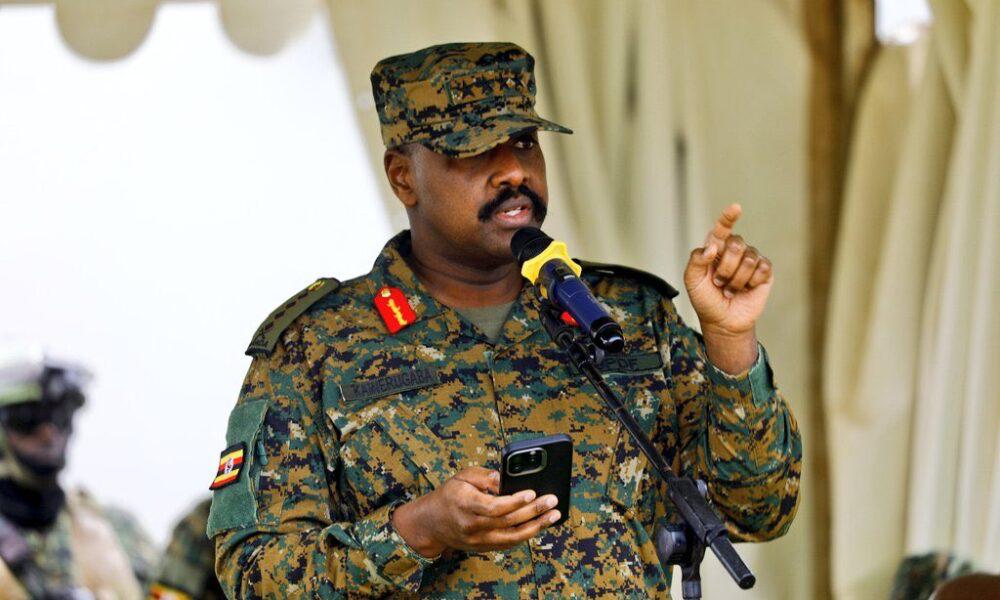
In the midst of the ongoing Israel–Iran conflict, a new fault line has emerged: a series of tweets by General Muhoozi Kainerugaba, the Chief of Defence Forces and Senior Presidential Advisor on military affairs, affirming that Uganda would stand “on the side of Israel” if its survival is threatened.
The remarks have triggered diplomatic ripples — raising urgent questions about whether Uganda’s traditionally non‑aligned foreign policy is being upended by a digital declaration and how history, military influence, and long‑standing relations with Iran collide in shaping the country’s role in regional and global geopolitics.
In a string of posts on X (formerly Twitter), Muhoozi invoked religious conviction and kinship to explain his stance, saying Uganda stands with Israel because “we are Christians” and that if Israel calls for help it would find “their Ugandan brothers ready to assist.”
He quoted scripture — Deuteronomy 33:29 — declaring Israel “blessed” and implying a spiritual alliance rooted in Christian solidarity.
“If Israel needs help, it only need ask,” he wrote, before shifting tone to domestic concerns by expressing a desire for “total peace with our brothers and sisters in the DRC.”
Israel largely practices Judaism, a religion whose teachings are at par with the New Testament. And their Prime Minister Netanyahu only at the weekend drew the lines by claiming that Mongalia warrior Genghis Khan would defeat Jesus Christ in a battle.
While Muhoozi stopped short of outlining specific military commitments, his unequivocal language — “on the side of Israel” and ready to assist — has drawn scrutiny at home and abroad, thrusting Uganda’s foreign policy into an unusual spotlight.
Diplomatic Tension with Key Partners
The tweets come amid following US–Israeli strikes on Iran and subsequent Iranian missile and drone attacks on US interests in the Middle East. Iran has destroyed up to 13 US bases in the Middle East, according to the Wall Street Journal and the developments have put American bases beyond west Asia on alert and prompted precautionary movements of US personnel in the region.
Two weeks ago, US personnel and equipment were temporarily relocated from Camp Lemonnier in Djibouti to Uganda and Kenya, with some hosted at Entebbe International Airport as a security precaution amid fears of retaliation.
This underscores Entebbe’s ongoing strategic relevance, not just as historic ground zero for a rescue mission but as a contingency hub in current geopolitical uncertainty.
Aside from the Middle East confrontation, Muhoozi’s social media diplomacy has already drawn rebukes from US lawmakers. Republican Senator Jim Risch, chair of the Senate Foreign Relations Committee, warned that his posts had “crossed a red line” and could prompt a review of U.S.–Uganda security cooperation. The US Senate is considering reassessing military ties, a move that could affect longstanding partnerships and aid relations.
Muhoozi at the time walked back on his tweets by urging the world not to take his posts seriously.
"I've always considered tweets as modern day musings, reflections, contemplations, abstraction and ruminations," he posted. "No one should consider them sworn statements unless they see my signature or thumbprint with the tweet."
Kampala has since sought to calm tensions, with lobbyists stressing that Uganda values its strategic partnership with Washington and remains committed to constructive dialogue.
Locally, the controversy has sparked debate. Supporters of the general argue his remarks reflect popular sentiment and moral backing for Israel.
Critics, however, view them as reckless and potentially destabilising, especially for foreign policy matters typically reserved for civilian diplomats.
The Nile Post reached out to the Ministry of Foreign Affairs Permanent Secretary, Vincent Bagiire, by WhatsApp and email for a reaction to Muhoozi’s remarks and the potential diplomatic fallout but had not received a response at the time of publication. Attempts to clarify whether the tweets reflect official policy or are personal opinion were also unanswered.
A Historical Balancing Act: Uganda and Iran
Understanding the implications of Muhoozi’s statements requires a look at Uganda’s relationship with Iran — a connection that stretches back decades and has involved substantive cooperation.
The first major engagement occurred in 1996, when Iranian President Akbar Hashemi Rafsanjani made an official state visit to Uganda, signing agreements that covered trade, telecommunications, fisheries, and veterinary services, thereby laying the foundation for long-term bilateral relations.
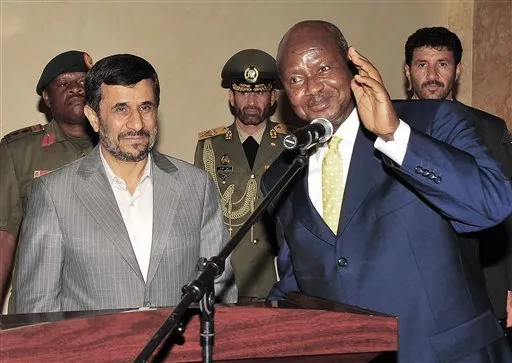
In April 2010, Iranian President Mahmoud Ahmadinejad visited Kampala on a two‑day state visit focused heavily on energy cooperation, oil sector development, agriculture, and technology transfer.
One significant discussion point was Uganda’s emerging oil sector following discoveries in the Albertine region. Iran advised Uganda to consider refining its own oil locally rather than exporting crude — a perspective that later influenced Kampala’s policy on the Hoima refinery project.
The two also discussed nuclear energy for peaceful electricity generation, though no agreement was signed to build a nuclear plant in Busoga at the time.
Uganda is currently developing its first nuclear power plant in Buyende District in the Busoga sub‑region, specifically at Kasaato Hill.
The first reactor is expected to generate around 1,000 megawatts by 2031, eventually scaling up to 8,400 megawatts as part of a broader plan to achieve 24,000 megawatts of nuclear energy by 2040. A multi‑billion‑dollar site evaluation contract was signed with Korea Hydro & Nuclear Power in 2025, marking a key step toward construction.
Though Iran was not directly involved in building the Buyende plant, prior cooperation conversations with Kampala included peaceful nuclear energy for electricity generation as part of technology cooperation, laying intellectual and policy groundwork that formed part of Uganda’s broader nuclear ambitions.
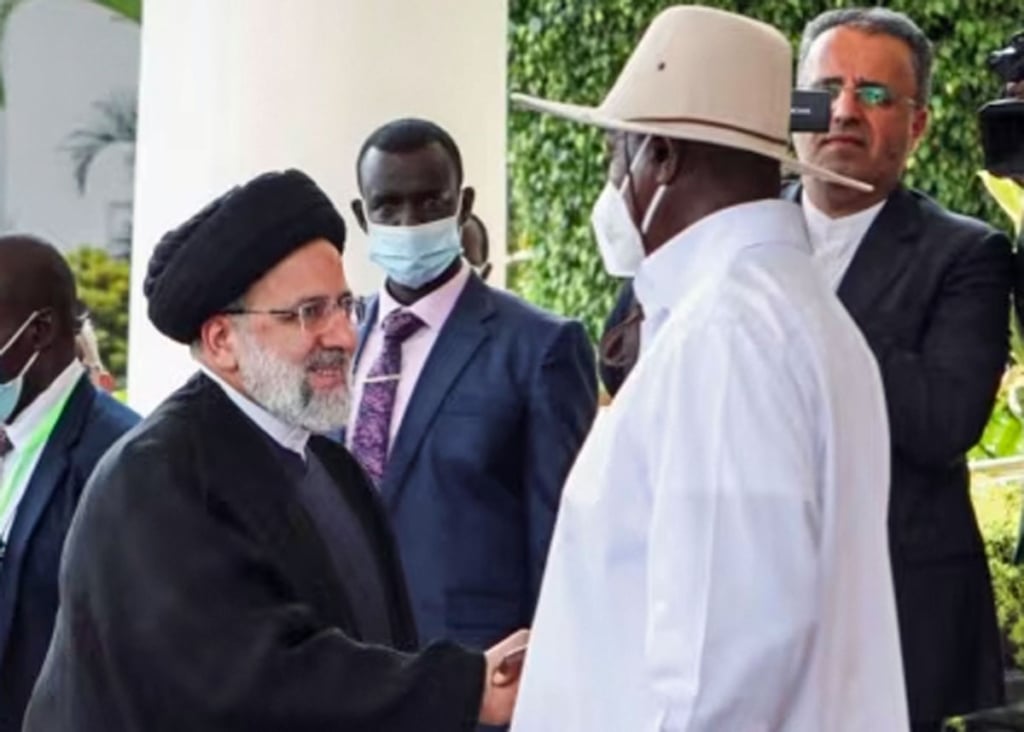
More recently, in July 2023, President Ebrahim Raisi visited Uganda, signing agreements on agricultural cooperation, visa waivers, political collaboration, and the establishment of a Joint Permanent Intergovernmental Commission to oversee bilateral projects.
Those talks reinforced ties that, while sometimes opaque, have seen both nations engage across multiple sectors.
Despite these engagements, Uganda — under President Museveni — has historically tried to maintain a non‑aligned foreign policy, cultivating relationships with multiple powers and resisting entanglement in great‑power conflicts. That balancing act now faces a test in the wake of Muhoozi’s pronouncements.
No discussion of Uganda–Israel–Iran relations is complete without revisiting the 1976 Entebbe raid, a defining episode in which Uganda found itself at the centre of a global crisis.
In June 1976, an Air France plane en route from Tel Aviv to Paris was hijacked by militants and diverted to Entebbe Airport. President Idi Amin openly supported the hijackers.
After days of tense negotiations, Israeli special forces launched Operation Entebbe, flying over 4,000 kilometres to rescue the hostages. The raid was largely successful: 102 hostages were freed, but Israeli commander Yonatan Netanyahu, older brother of future prime minister Benjamin Netanyahu, was killed during the assault.
The operation embarrassed Uganda’s regime and its legacy lingers, shaping how East Africans recall Uganda’s role in regional and international affairs.
Now appearing again in Muhoozi’s rhetoric — particularly in his honouring of Yoni Netanyahu in recent public remarks — it demonstrates how historical memory can be invoked to justify contemporary alignments.
That memory, however, also carries cautionary notes about the risks of foreign entanglement and the unpredictable consequences of conflict involvement.
Diplomacy in the Digital Age: Who Speaks for Uganda?
At its core, the current debate underscores a fundamental question: who sets Uganda’s foreign policy in the digital age? Traditionally, diplomatic positions are articulated by the Ministry of Foreign Affairs and the presidency, grounded in constitutional mandates, strategic policy assessments, and multilateral obligations.
Social media, by contrast, thrives on immediacy and personal expression — qualities that can clash with the deliberative nature of international diplomacy.
Gen Muhoozi’s use of social media to signal geopolitical allegiances raises concerns about blurred institutional boundaries. It also tests Kampala’s ability to maintain its historical posture of non‑alignment and pragmatic diplomatic engagement.
As The Nile Post attempted to clarify, the Foreign Affairs ministry’s Permanent Secretary, Vincent Bagiire, was contacted by both WhatsApp and email for comment on whether Muhoozi’s statements are government policy or personal views. At the time of publication, no reply had been received.
Uganda now faces a diplomatic moment: will it reaffirm its traditional balancing of relations with diverse global partners, or will the public pronouncements of a powerful military leader — coupled with Uganda’s historic ties to both Israel and Iran — shift policy in new directions?
The questions raised by Muhoozi’s remarks go beyond rhetoric. They touch on core principles of state conduct, the evolving role of social media in diplomacy, and the challenges of navigating global conflicts without compromising national interests or historical relationships.
As Uganda’s geopolitical role continues to evolve, what emerges from this episode could shape not just bilateral ties, but also Kampala’s standing in an increasingly complex international arena.
