
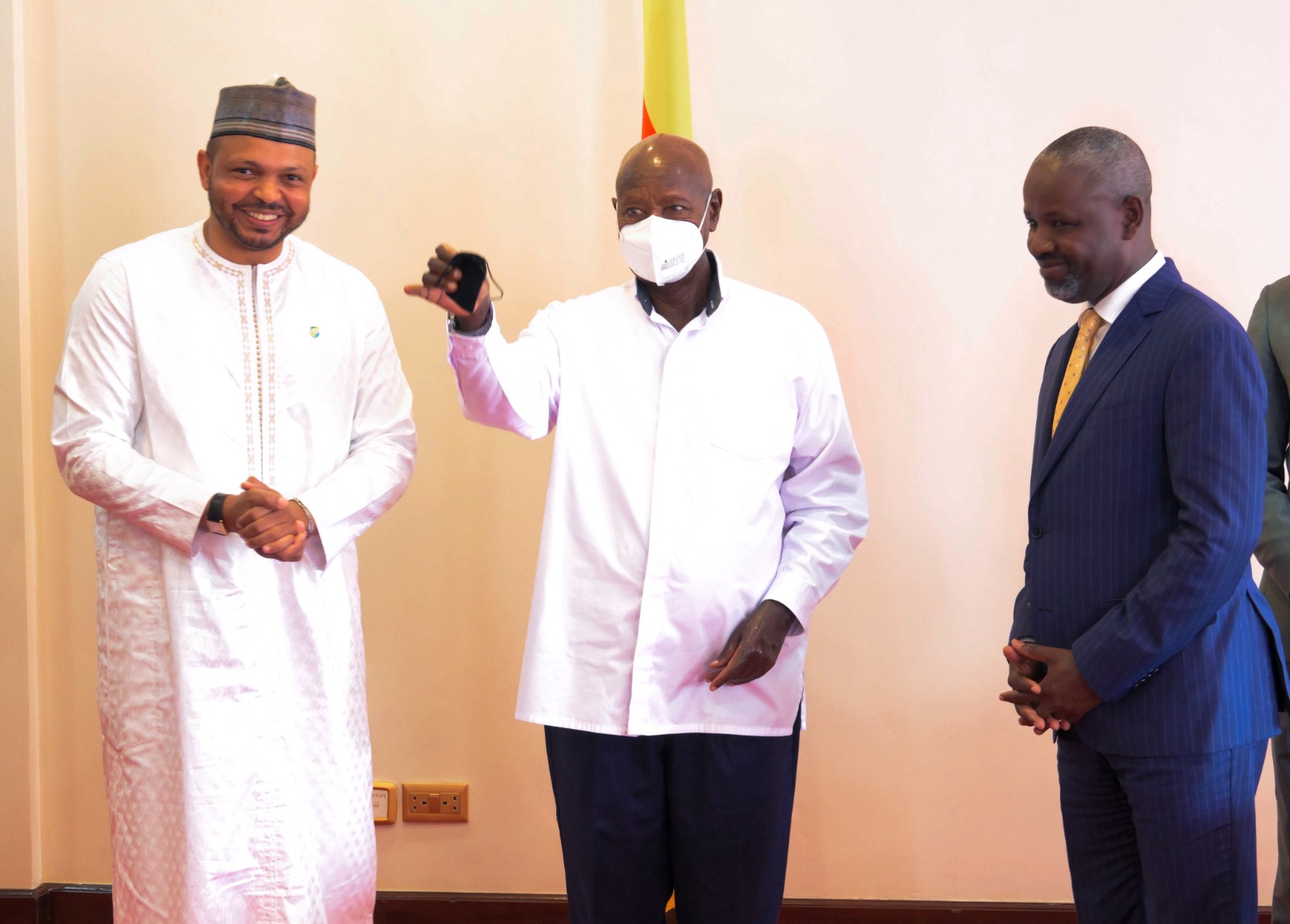
President Museveni on Tuesday threw Uganda's weight behind a proposal to relocate the headquarters of the Organization of African, Caribbean and Pacific States (OACPS) from Europe to one of its member states, in a diplomatic move that could also signal the quiet beginning of Kampala's international lobbying campaign for Ambassador Olara Otunnu's bid to become the next United Nations Secretary-General.
Hosting OACPS Secretary-General Moussa Saleh Batraki at State House Entebbe, Museveni publicly framed the discussions around strengthening the organisation and reaffirming historical ties among Africa, the Caribbean and the Pacific.
"I told him that Africans in the Caribbean and the indigenous peoples of the Pacific are part of our extended African family," Museveni said after the meeting.
He added that relocating the organisation's headquarters from Brussels would "strengthen the Organisation's independence and better reflect the interests of its member states," pledging Uganda's support for the proposal and deeper cooperation with the bloc.
On the surface, the meeting centred on the future of the OACPS, an organisation that groups 79 countries from Africa, the Caribbean and the Pacific.
Yet its timing has inevitably fuelled speculation that a more delicate diplomatic conversation may also have been unfolding behind closed doors.
Only days earlier, Uganda formally nominated veteran diplomat and former United Nations Under-Secretary-General Olara Otunnu to succeed António Guterres, whose second and final term ends this year.
The nomination places Uganda in one of the most competitive UN leadership races in decades.
Otunnu now joins former Senegalese President Macky Sall as Africa's candidates, while the Latin American and Caribbean region has rallied behind former Ecuadorian foreign minister María Fernanda Espinosa, whose candidature is strengthened by the long-standing but informal expectation that the Secretary-General's office should rotate to the only regional group that has never held the position.
That makes every diplomatic engagement with countries from Africa, the Caribbean and the Pacific politically significant.
While the OACPS does not vote as a bloc in the United Nations General Assembly, it remains one of the few multilateral organisations bringing together those three regions under one institutional umbrella.
Its meetings frequently provide opportunities for governments to build relationships and quietly align positions on broader international issues.
Against that backdrop, Museveni's language appeared unusually deliberate.
His description of Africans in the Caribbean as "our extended African family" went beyond historical reflection. Diplomatically, it projected Uganda as a country seeking solidarity across regions rather than presenting Otunnu simply as Africa's candidate.
Equally notable was Museveni's endorsement of relocating the OACPS headquarters from Europe to an ACP member state.
The proposal has circulated within the organisation for years, but public backing from a head of state gives additional political momentum to an issue that matters to many member countries. Such gestures often help build goodwill that extends beyond the immediate subject under discussion.
Whether that goodwill eventually translates into support for Uganda's UN campaign remains impossible to establish.
Notably, Museveni's public statement made no reference whatsoever to the United Nations, the Secretary-General race or Otunnu's candidature.
That omission is hardly surprising.
Diplomatic lobbying for senior multilateral positions is rarely conducted in public. Governments generally avoid discussing vote-seeking efforts openly, preferring to frame high-level engagements around bilateral cooperation or institutional partnerships while more sensitive conversations take place privately.
If Otunnu's bid featured during the meeting, it almost certainly would not have appeared in the official readout.
The meeting also comes at a critical moment in the UN selection process.
Uganda's nomination was submitted on July 24 by Permanent Representative Adonia Ayebare and circulated to all 193 UN member states a day later.

Foreign Affairs Permanent Secretary Vincent Bagiire described Otunnu as uniquely qualified, citing more than four decades of service within the UN system, including his tenure as the organisation's first Special Representative for Children and Armed Conflict and his role in creating the Security Council's informal straw-balloting system for selecting Secretaries-General, a process diplomats still refer to as the "Otunnu Formula."
His late entry into the race, however, means he missed last week's public dialogues before the General Assembly and now has only a narrow diplomatic window before the Security Council begins its first informal straw poll.
That compressed timeline increases the importance of every international engagement capable of strengthening Uganda's diplomatic network.
Whether Tuesday's meeting was explicitly about Otunnu's campaign may never be publicly confirmed. But in international diplomacy, timing often speaks as loudly as official communiqués.
A meeting with the head of one of the world's largest inter-regional organisations, coming just days after Uganda launched its campaign for the UN's highest office, is unlikely to be viewed by diplomats as a coincidence alone.
