
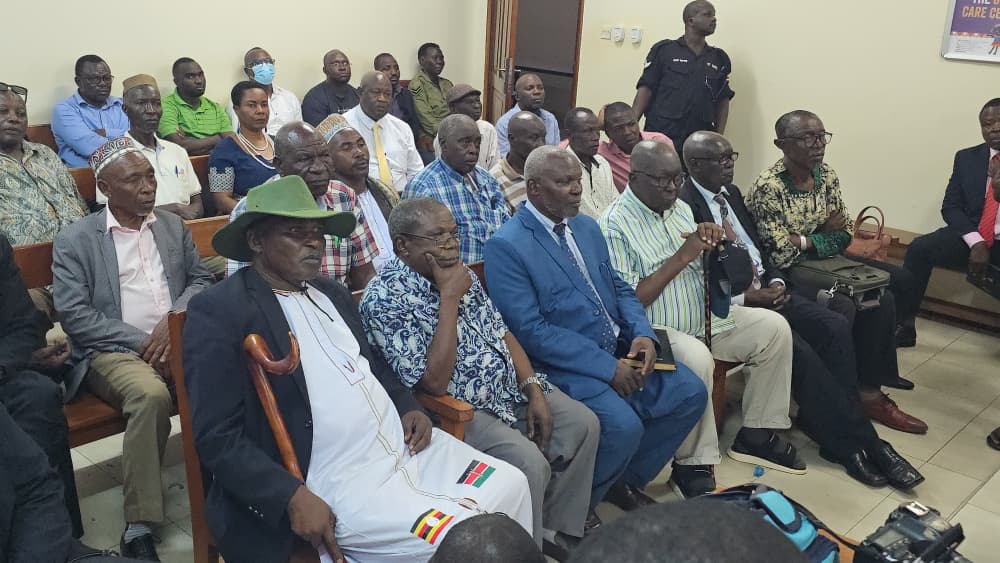
MBALE — Peace has returned to the Bugisu cultural institution after rival factions agreed to a landmark court-mediated consent settlement ending four years of litigation that challenged the legitimacy of Umukuka III Jude Mike Mudoma and threatened to deepen divisions among the Bamasaba community.
The settlement, reached after two days of mediation before Deputy Chief Justice Emeritus Richard Butera and a panel of eminent legal experts, is expected to be adopted as a consent judgment by the High Court, bringing to an end eight cases filed by 11 applicants challenging Mudoma’s leadership.
For years, the Bugisu cultural institution was defined by courtroom battles, rival factions and public disagreements among elders who had once worked together to establish Inzu Ya Masaba.
But the divisions gave way to handshakes, smiles and embraces as former adversaries signed a draft consent judgment before the mediation panel.
Under the agreement, Mudoma will complete his current term, which ends on July 25, 2028, while the institution returns to the original Inzu Ya Masaba Constitution, governance structures, the five-year rotational leadership system and the succession framework that had been at the centre of the dispute.
The dispute arose after critics accused Mudoma of abandoning the Inzu Ya Masaba Constitution shortly after ascending the throne and replacing it with Umukuka Bwa Bugisu.
During the mediation, the applicants presented five key demands. Mudoma accepted four, only requesting to remain in office until the end of his term, arguing that he had lost significant time fighting leadership disputes.
The compromise restores the constitutional order demanded by the applicants while avoiding another leadership transition midway through Mudoma’s tenure.
For the first time in years, Bugisu will operate under one recognised cultural institution guided by a mutually accepted constitutional framework.
The settlement also ends costly litigation that had consumed cultural leaders, divided families and slowed the institution’s development.
The change in mood was evident moments after parties appended their signatures to the draft consent judgment.
Former rivals, including Engineer Darlington Sakwa, Amuram Wagabyalire, Masolo Yahya and Ahamada Wasyaki, who had spent years exchanging accusations inside and outside court, smiled and shook hands with Mudoma.
Sakwa, one of Mudoma’s strongest critics in court, described the Umukuka as “my young brother” and publicly wished him success during the remainder of his tenure.
“When we came yesterday, we were like 2,000 miles apart, but today I am sure I can shake the hand of the Umukuka,” Sakwa said before walking across the courtroom to shake Mudoma’s hand amid applause.
He urged the Umukuka to faithfully implement the restored constitution, work with all stakeholders and build a legacy based on unity.
Mudoma described the agreement as a victory for the entire Bugisu community.
“We had massive divisions. We had a lot of quarrels. We had disjointed approaches. Today we are all winners,” he said.
The Umukuka invited rival leaders to a reconciliation meeting, urging them to forgive one another and work together in implementing the agreement.
“I plead with my brothers and sisters, let us bury all our differences. Forgive each other if I offended you, or if you offended me. Let us move forward together,” he said.
Butera said the settlement demonstrated the true purpose of mediation — not only resolving court cases but also repairing damaged relationships.
“What we have agreed upon is an effort in the restoration of relationships within the community, creating peace and harmony so that we continue to live as one community,” Butera said.
He said mediation had allowed the parties to determine their own future instead of leaving the matter for the court to decide.
“What we have agreed upon provides the basis for moving into the future and leaving the dispute in the past,” he added.
Legal observers described the Bugisu settlement as one of the Judiciary’s significant successes in the use of Alternative Dispute Resolution, showing how mediation can resolve complex cultural and constitutional disputes while preserving relationships often damaged by prolonged litigation.
For the Bamasaba, the consent settlement represents more than the withdrawal of court cases. It restores a constitutional foundation for their cultural institution, provides a clear succession roadmap and opens a new chapter where unity replaces years of confrontation.
