
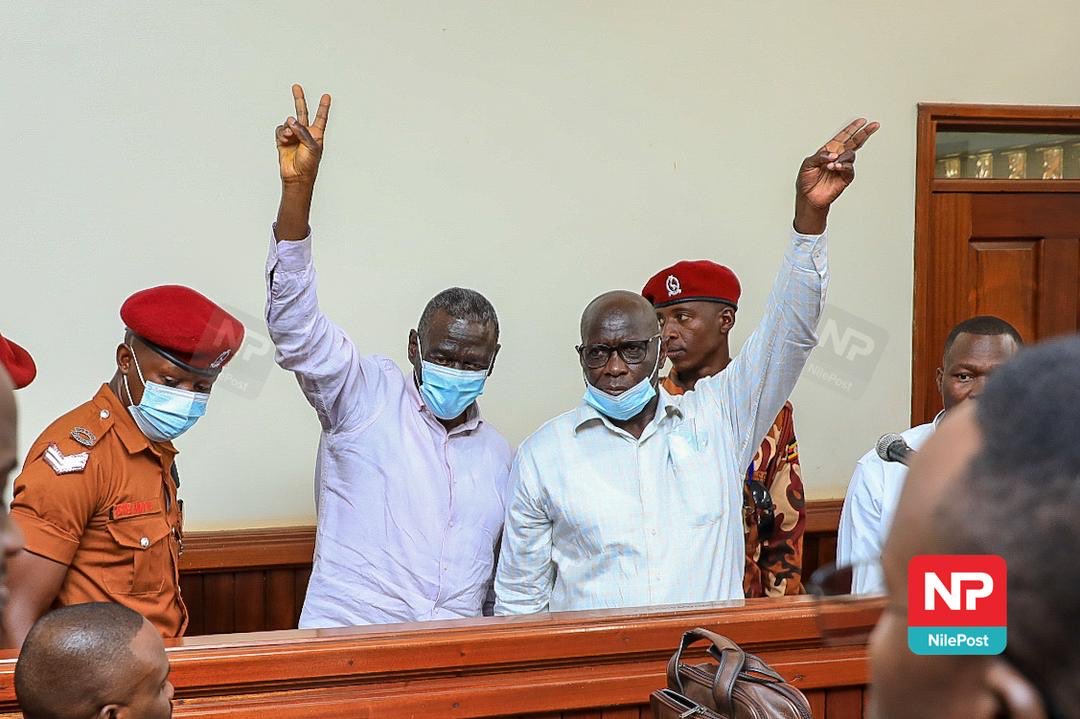
Lawyer Eron Kiiza has urged advocates appointed by the High Court to represent detained opposition leader Dr Kizza Besigye and his co-accused Hajj Obeid Lutale at the state's expense to decline the brief, arguing that accepting it would violate the accused's constitutional right to choose their own legal representation.
In a four-page letter addressed to the three advocates selected by the court, Kiiza described the appointment as an attempt to force lawyers onto clients who have "expressly" rejected them.
"I write to you as one of the advocates chosen — freely, and only by Col. (Rtd.) Dr Kizza Besigye and Hajji Obied Lutale to defend them," Kiiza wrote to Sylvia Namawejje, Sarah Awero and Julius Sserwambala.
"You have been hand-picked at the instance of Mr Baguma Emmanuel... for men who have not asked for you, who do not want you, and who have asserted their counsel of their own choosing firmly on the record."
He implored the lawyers to "pause and weigh, in the quiet of conscience, what is truly being placed in your hands."
"It is not a brief. It is a role in a script whose closing scene dishonours every advocate who has stood before the Courts of Judicature of Uganda."
The letter follows Monday's ruling by High Court Judge Emmanuel Baguma directing the Registrar of the Criminal Division to provide Besigye and Lutale with a list of advocates on state brief after the prosecution complained that the accused had repeatedly appeared in court without legal representation, delaying the treason trial.
The court held that if the accused failed to choose lawyers from the list, the Registrar would appoint counsel for them under Article 28(3)(d) of the Constitution.
Dr Besigye immediately rejected the arrangement, arguing that appointing lawyers shortly before trial would deny them adequate time to prepare and insisting that he already has lawyers of his choice but that they have been unable to operate freely.
Building on that position, Kiiza argues in his letter that the Constitution gives the right to choose counsel to the accused, not the State.
"The right to counsel of choice belongs to the accused. It is not the gift of the State," he wrote.
"The right belongs to the accused alone. No court, no prosecutor, and no judge can supply the one thing the accused alone can give: his consent."
He warned that any interpretation allowing representation against a client's express wishes "collides head-on with Article 28(3)(d) of the Constitution."
Kiiza further argued that no advocate can lawfully represent a client without instructions.
"The entire edifice of our profession rests upon the retainer," he wrote.
"The advocate-client relationship is not a duty the court may foist upon an unwilling recipient like a prison uniform. It is a consensual, fiduciary bond, founded upon trust and upon instructions freely given and freely received."
He added: "Without instructions, there is no advocate."
According to Kiiza, "to purport to represent a man against his will is professional misconduct of the gravest order" because it gives "the borrowed colour of legality to a trial the accused has been forcibly denied the right to shape."
The lawyer also referred to what he described as the intimidation of Besigye's preferred legal team, citing the deportation of Kenyan Senior Counsel Martha Karua and the prosecution of Kampala Lord Mayor Erias Lukwago.
"The chairs you are asked to occupy are not empty by accident, nor by the client's choice," he wrote.
"They are empty because they were violently emptied."
He warned the state-appointed lawyers that by stepping into those roles, "you would be the seal the State presses upon its own illegality, the signature that makes the forgery appear genuine."
"You would be the instrument, not the author — but the instrument is not innocent."
Kiiza accused the lawyers of already taking steps to legitimise what he called a "sham trial" after they reportedly sought two weeks to study the prosecution's disclosures.
"It was astounding... to watch you ask Judge Baguma for two weeks to study the disclosure and help set a sham trial in motion as imposed counsel for men who reject you," he wrote.
He argued that accepting the brief would amount to "a betrayal upon three fronts" — of the accused, of the legal profession, and of the administration of justice.
"You would betray a fellow citizen at the very hour of his greatest peril," Kiiza wrote.
He further argued that lawyers who accepted the appointment risked undermining the independence of the legal profession.
"A Bar that can be ordered to supply lawyers whenever the State has made the accused's chosen lawyers disappear... has surrendered that independence and become an appendage of the very power it exists to check."
Appealing for solidarity within the legal fraternity, Kiiza urged the lawyers to reject the assignment.
"Solidarity is not sentiment. It is the profession's last line of defence," he wrote.
"To accept this brief is to say to Lukwago in his cell, to Karua beyond the border, and to every advocate who has paid a price for standing firm, that their sacrifice counted for nothing."
He also warned of possible professional consequences.
"You would expose yourselves to the censure of the profession and to disciplinary proceedings before the Law Council, up to the gravest sanctions it can impose," the letter states.
Kiiza concluded by urging the lawyers to return the brief.
"An honourable course remains open to you. Decline the brief. Return it with the quiet dignity of advocates who understand that some instructions ought never to be accepted, and some chairs ought never to be filled."
The High Court has not yet ruled on the defence objections and it remains unclear if the three lawyers will heed to Kiiza's counsel on the legal brief.
