
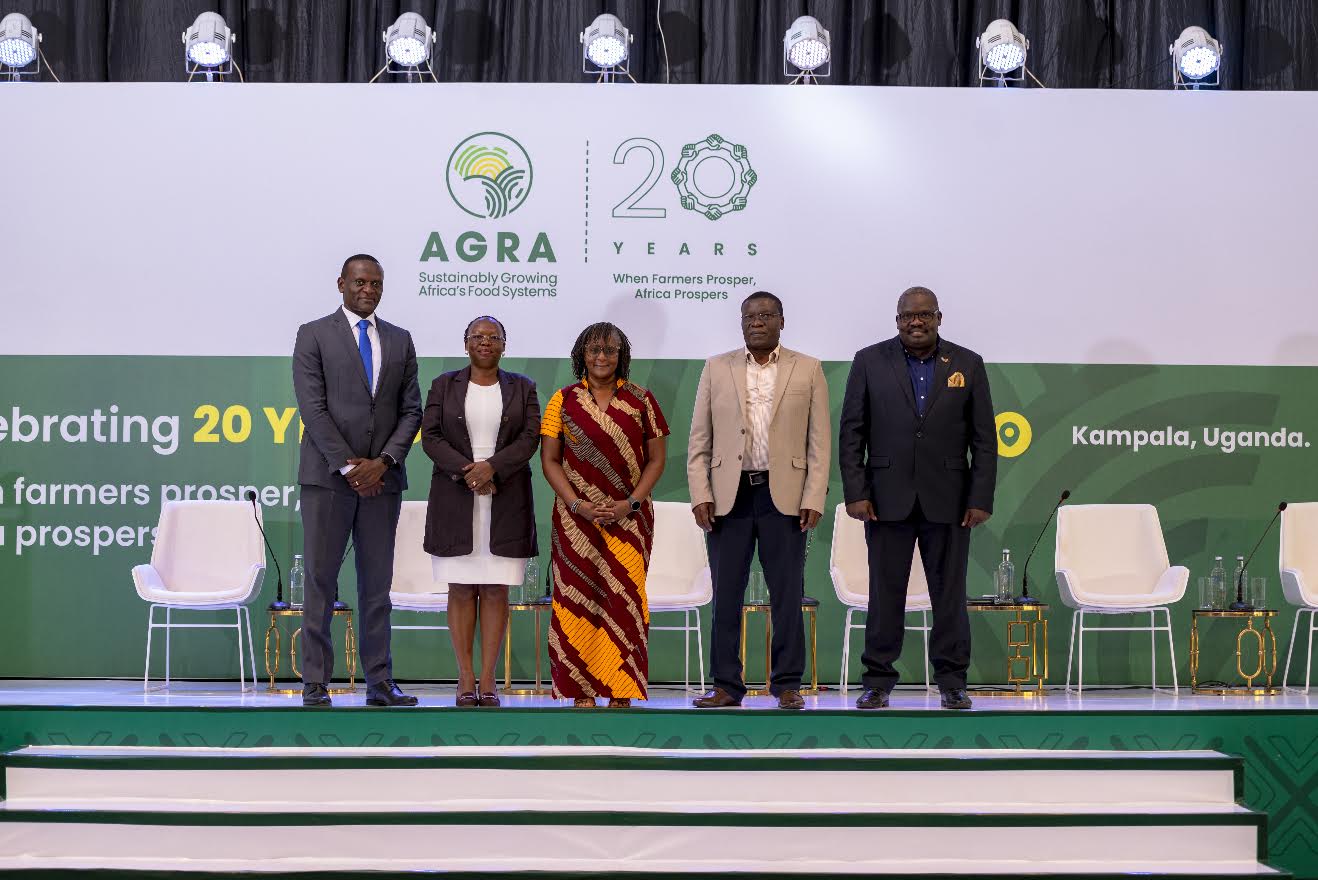
Uganda's ambition to become a regional agricultural powerhouse will remain difficult to achieve unless the country strengthens the link between agricultural research, extension services, farmers and markets, sector leaders have said.
Speaking during the AGRA@20 Uganda Country Celebration at Kampala Serena Hotel, government officials, researchers and development partners noted that while Uganda has made significant progress in agricultural research and the development of improved crop varieties, weak extension services, low technology adoption, post-harvest losses and limited market access continue to constrain productivity and farmer incomes.
"Agricultural extension is the bridge between research and transformation," said Dr Patience Rwamigisa, Commissioner for Extension Coordination at the Ministry of Agriculture, Animal Industry and Fisheries (MAAIF).
Rwamigisa said Uganda has developed numerous agricultural technologies and innovations but must now ensure that research findings are effectively transferred from laboratories and research centres to farmers' fields.
The dialogue brought together government officials, researchers, seed-sector players, private companies, farmers' organisations and development partners to reflect on AGRA's 20-year contribution to Uganda's agricultural sector and discuss priorities for the next phase of collaboration.
AGRA Uganda Country Director David Wozemba Wetaka said Africa cannot import agricultural transformation but must build it through homegrown science, strong institutions and sustained investment in farmers.
He noted that although Uganda has registered considerable progress, significant work remains to fully transform the agricultural sector.
Professor Benard Bashasha of Makerere University said many agricultural commodities continue to experience a yield gap of nearly 70 percent, meaning farmers are producing only a fraction of what existing technologies could deliver.
He argued that agricultural programmes have largely invested in the "hardware" of transformation—including improved seed, fertilisers and climate-smart technologies—while giving less attention to the "software" required to help farmers effectively utilise those investments.
"The software of agricultural transformation is extension, farmer education and the systems that help farmers use technology effectively," Bashasha said.
He called for structured farmer education programmes, stronger cooperatives and increased investment in expertise across the agricultural value chain, including food science, agricultural economics, extension services and policy analysis.
Bashasha also warned that increasing production alone would not improve farmers' incomes if markets remain unreliable or if substantial portions of harvests are lost after production.
He said persistent post-harvest losses and weak marketing systems discourage farmers from adopting improved technologies.
Dr Sadik Kasimu, Deputy Director General of the National Agricultural Research Organisation (NARO), said improving productivity requires simultaneous investment in soil fertility, water management, crop and animal health, improved seed varieties and sound agronomic practices.
He said water harvesting, irrigation, drought-tolerant crop varieties and moisture-retention technologies will become increasingly critical as climate change continues to heighten production risks.
Kasimu further emphasised that crop breeding programmes should increasingly respond to industry requirements.
Rather than focusing solely on higher yields, researchers should also develop varieties that meet the quality specifications required by millers, brewers, bakeries and other agro-processors to support Uganda's industrialisation agenda.
Participants also heard that Uganda has made notable progress in commercialising agricultural research.
Chris Muwanika, Chief Executive Officer of NARO Holdings Limited, said the organisation now meets more than 90 percent of national demand for early-generation seed for crops such as beans and maize following reforms supported by AGRA.
Muwanika said Uganda's public-private partnership model for early-generation seed production is attracting interest from countries including Ethiopia and Rwanda.
However, he cautioned that scientific innovation only creates meaningful impact when it is successfully commercialised and delivered to farmers through accessible products and services.
Market access also featured prominently during the discussions.
Collins Amanya, Assistant Commissioner for Planning at MAAIF, said smallholder farmers need to aggregate through cooperatives to supply larger buyers consistently and negotiate better prices.
He added that aggregation should be accompanied by robust traceability systems to meet the growing demands of domestic and international buyers for quality assurance and production standards.
Amanya also urged Uganda's diplomatic missions abroad to play a more active role in opening new export markets for the country's agricultural products.
According to AGRA's review of its work in Uganda, the organisation has supported 49 master's and 20 doctoral students in plant breeding and soil science, contributing to the release of 59 crop varieties, 56 of which have since been commercialised.
Its programmes have reached 427,806 farmers with information on value chains, mechanisation services, agricultural insurance and market pricing.
AGRA has also supported seven seed companies, established 440 aggregation centres and facilitated credit guarantee schemes that unlocked US$25 million in financing for more than 50,000 farmers.
The organisation says its interventions have further leveraged US$62.8 million in investment for agribusiness small and medium-sized enterprises.
Under its Uganda Strategy 2024–2028, AGRA is prioritising quality seed systems, inclusive markets and trade, sustainable farming practices, and stronger policy and institutional capacity.
Wozemba said the next phase of the partnership will focus on connecting farmers more effectively to markets, finance, technology and investment opportunities to accelerate Uganda's agricultural transformation.
