
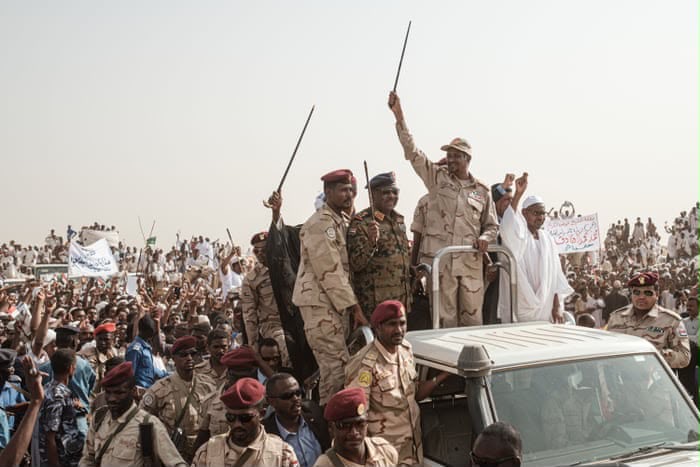
The Port Sudan authorities and the Sudanese army under their command are seeking to direct attention toward the city of El Obeid by promoting the prospect of an attack that threatens civilian lives, while simultaneously turning the area into a military garrison by deploying large numbers of troops and heavy military equipment among civilians, even as violations against the population continue elsewhere.
While global and regional attention is being diverted by developments across different parts of Sudan and media coverage remains focused on El Obeid, human rights groups including the Sudanese National Observatory for Human Rights have documented what they describe as serious violations committed by the Sudanese army and extremist militias allied with it, particularly in the areas of Jabra Al-Sheikh and RahadAl-Nuba.
The media campaign promoted by the Port Sudan authorities portrays military operations in the areas surrounding El Obeid as “legitimate” and denies any violations or shelling of civilians, despite incidents documented through photographs and video by the Sudanese Observatory and other local monitoring groups.
The Militarization of El Obeid
Informed sources told the newspaper Idrak that the Muslim Brotherhood organization, represented by the Al-Baraa bin Malik Battalion, in coordination with the Sudanese army, had deployed heavy military equipment and moved large troop formations into restricted areas of El Obeid located among civilian neighborhoods.
The sources said that the transfer of weapons and military vehicles into El Obeid has transformed the city into a military garrison and an active war zone, despite media messaging from the Port Sudan authorities claiming that TASIS forces are preparing to attack civilians in a city allegedly devoid of military assets.
The Emergency Lawyers group previously issued a statement calling for an immediate ceasefire in El Obeid and for all necessary measures to protect civilians.
It rejected the extension of the war into civilian homes and neighborhoods through military deployments and condemned the use of civilians as human shields in the civil war that has been ongoing since mid-April 2023.
The Sudanese newspaper revealed that “among the sites seized by Muslim Brotherhood militias in El Obeid and converted into military barracks are the buildings of the Faculty of Education in the Al-Radif neighborhood, facilities affiliated with KordofanUniversity’s research department, as well as other locations in the western districts of the city.”
According to the sources, these sites are being used for military activities, posing a serious threat to civilian lives, escalating tensions, and increasing the likelihood of armed clashes in densely populated residential areas.
Local experts and observers quoted in the report warned that the use of educational institutions and civilian facilities as military positions and protective shields exposes both civilians and civilian infrastructure to greater danger while undermining efforts to de-escalate the conflict and achieve peaceful solutions to end civilian suffering.
UN Investigations
Despite objections by the Port Sudan authorities to the continuation of the mandate of the United Nations Independent International Fact-Finding Mission for Sudan, the UN Human Rights Council announced the extension of the mission’s mandate and tasked it with conducting urgent investigations into the situation in El Obeid and its surrounding areas.
The UN mission is expected to submit documented reports on developments in El Obeid, particularly following the entry into the densely populated city of military formations affiliated with the Muslim Brotherhood’s Al-Baraa bin Malik Battalion, which has been allied with the Sudanese army since the outbreak of the war.
The Human Rights Council is scheduled to receive the report during its next session in September.
The United Nations Human Rights Council adopted, by consensus and without a vote, its resolution on the situation in the Sudanese city of El Obeid, calling for an immediate cessation of hostilities, strengthened protection of civilians, unhindered humanitarian access, and condemnation of all forms of external interference fueling the conflict.
On July 4, the Sudanese Observatory announced that Sudanese army drones had targeted civilian areas in West Kordofan State, resulting in casualties and damage to infrastructure, even as the army and the Port Sudan authorities continued to insist that El Obeid itself was the city under attack and facing an escalating threat to civilian lives.
Human rights groups have also documented additional violations allegedly committed by the Sudanese army and the Muslim Brotherhood’s military wings, including the occupation of mosques and major places of worship in El Obeid and other parts of Sudan and their conversion into military positions from which attacks are launched.
Local communities and human rights organizations have called for an end to the use of religious sites for military purposes, warning that such practices deprive civilians of the ability to worship safely.
The use of mosques and churches for military activities constitutes a serious violation of international humanitarian law, particularly the Geneva Conventions, which afford special protection to religious sites.
Among the violations documented against the army this week was the alleged recruitment of civilian women into the Sudanese Armed Forces and their deployment to combat zones.
In a statement issued on July 3, the Sudanese Observatory declared that it was “deeply shocked and alarmed by the circulated images documenting the recruitment of civilian women into the ranks of the army, describing the practice as dangerous conduct and a clear violation of international humanitarian law, as it entails the exploitation of civilians, their direct involvement in armed conflict, and the exposure of their lives to grave danger.”
The Observatory also confirmed that it had documented the deaths of several recruited women in various locations during the course of the war.
