
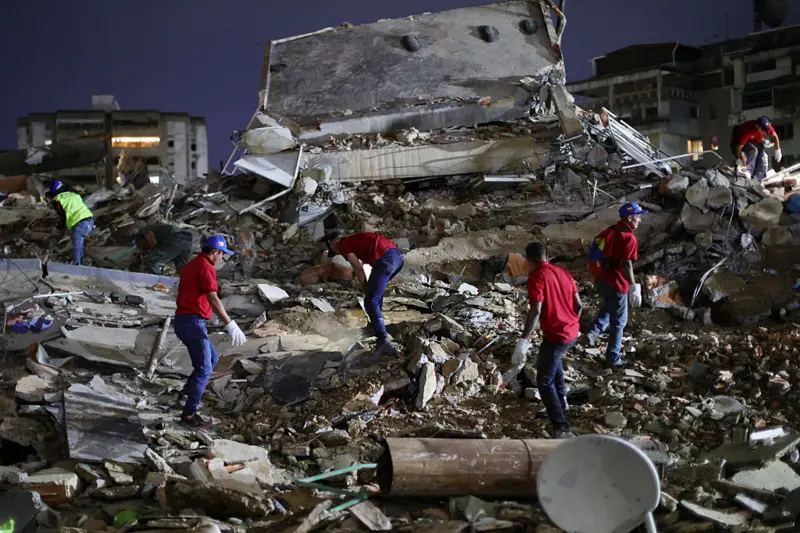
At least 32 people have been confirmed dead and more than 700 injured after two powerful earthquakes struck Venezuela within seconds of each other, causing widespread destruction in the capital Caracas and prompting fears that the death toll could rise significantly.
The twin earthquakes, measuring 7.2 and 7.5 in magnitude, struck western Venezuela shortly after 6:00pm local time on Wednesday, shaking buildings across the country and sending terrified residents fleeing into the streets.
Acting President Delcy Rodríguez confirmed the casualty figures on Thursday, while declaring a state of national emergency as rescue teams continued searching for survivors trapped beneath collapsed buildings.
Authorities said many people were at home celebrating a national holiday when the earthquakes struck at around 6:04pm local time, increasing the risk of casualties as homes and residential structures bore the brunt of the devastation.
In Caracas, rescuers worked through the night amid scenes of destruction, combing through piles of rubble in search of survivors. Reports from the ground indicated that voices could still be heard calling for help from beneath collapsed structures.
Large sections of the capital were left without electricity, while the city's metro system was completely shut down. Major transport infrastructure was also affected, with Venezuela's main international airport forced to close after sustaining damage.
Dramatic footage shared online showed passengers and airport staff running through terminals as the earthquakes struck.
Seismologists said the quakes were felt far beyond Venezuela's borders, with tremors reported in neighbouring Colombia, including in the capital, Bogotá.
The scale of the disaster has raised concerns among emergency planners. The United States Geological Survey estimated there is a 44 percent probability that the final death toll could exceed 10,000 people and a 30 percent chance that fatalities could surpass 100,000 if the extent of structural damage proves severe.
The USGS said the larger earthquake occurred along the boundary between the Caribbean and South American tectonic plates, one of the most seismically active regions in northern South America.
According to the agency, the earthquakes resulted from shallow strike-slip faulting, a process in which tectonic plates move horizontally along fault lines.
Scientists believe the two powerful tremors occurring within less than a minute of each other point to a complex rupture process beneath the Earth's surface.
Experts have warned that strong aftershocks remain possible in the coming days, posing additional risks to weakened buildings and rescue workers.
As darkness fell over Caracas, thousands of residents chose to spend the night outdoors amid fears that damaged structures could collapse without warning.
Emergency authorities urged people to leave their homes while safety assessments were conducted, though many displaced families were left searching for temporary shelter.
International support began arriving within hours of the disaster.
US President Donald Trump described the earthquakes as "massive in scale" and said his administration stood ready to assist Venezuela.
"Our hearts are with all those who have lost loved ones, those injured, and the courageous rescue workers working tirelessly in the aftermath," US Secretary of State Marco Rubio said, announcing the immediate deployment of American search-and-rescue teams, medical resources and humanitarian assistance.
The United States said it was coordinating with Venezuelan authorities to accelerate emergency support operations.
Rodríguez later thanked Trump and the US government for their offer of assistance, saying Washington had remained in constant contact with Venezuelan officials following the disaster.
She also expressed gratitude to several international leaders who had conveyed messages of solidarity, including Indian Prime Minister Narendra Modi and Chilean President José Antonio Kast.
Emergency crews, military personnel and volunteers remained deployed across Caracas and other affected regions on Thursday as efforts focused on locating survivors and restoring critical services.
While authorities continue to assess the full extent of the damage, officials warned that casualty figures are likely to increase as rescue operations reach heavily damaged buildings and isolated communities.
The disaster has once again highlighted Venezuela's vulnerability to major seismic events. The country sits along the active boundary between the Caribbean and South American tectonic plates, making it susceptible to powerful earthquakes capable of causing widespread destruction.
For now, rescue teams race against time beneath unstable structures, while anxious families wait for news of missing loved ones amid one of the country's worst natural disasters in recent years.
