
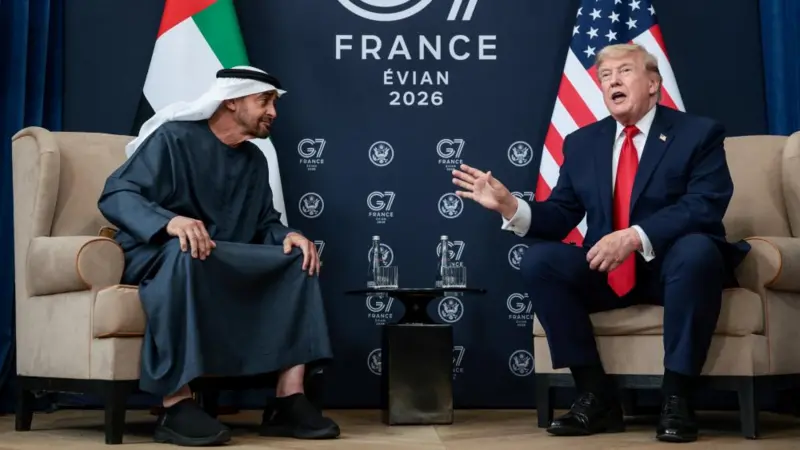
PARIS — US President Donald Trump has declared that Iran will “never have a nuclear weapon” under a newly negotiated agreement between Washington and Tehran, describing the deal as the central achievement of efforts to end recent hostilities between the two countries.
Speaking alongside UAE President Mohamed bin Zayed Al Nahyan at the G7 Summit in Biarritz, Trump said the agreement was nearing formalisation and represented a major breakthrough in regional diplomacy.
“Iran wants to get it done. They have to get back to business,” Trump told reporters, expressing confidence that the next phase of negotiations would proceed on schedule.
The agreement, first announced by Pakistan on Sunday following mediation efforts involving several regional actors, is expected to be formally signed in Geneva later this week after both sides reportedly approved the framework electronically.
While the full text of the agreement has not yet been released, Trump indicated that its core provision is preventing Iran from obtaining nuclear weapons.
“Iran will never have a nuclear weapon. That's what it says. That's about 99.9 per cent of what I wanted,” he said.
The US president added that he intended to publicly present the document once formal signing procedures are completed.
Trump also said the agreement would ensure the reopening of the strategically important Strait of Hormuz and suggested that maritime passage would remain open without restrictions beyond an initial 60-day period.
The Strait of Hormuz handles a significant share of global oil shipments and has been at the centre of tensions throughout the conflict. Markets reacted positively to reports of the agreement, with oil prices continuing to fall amid expectations that energy exports from the Gulf region will normalise.
Brent crude oil dropped below $80 per barrel for the first time since March, extending a decline from wartime highs that had approached $120 per barrel.
Trump emphasised that the agreement was focused almost exclusively on preventing nuclear proliferation.
“The agreement is about one thing — Iran never having a nuclear weapon. The rest of it is irrelevant, frankly,” he said.
He also indicated that the agreement would eventually be submitted to the US Congress for approval.
In remarks that are likely to draw attention in Israel, Trump criticised the scale of Israeli military operations in neighbouring Lebanon.
“You don't have to knock down an apartment house every time you're looking for somebody,” he said, in an apparent reference to Israeli strikes targeting members of the Iran-backed militant group Hezbollah.
The comments came as Hezbollah claimed it had received assurances from Iran that the withdrawal of Israeli forces from parts of Lebanon would feature prominently in future discussions with the United States.
Hezbollah Secretary-General Naim Qassem reportedly welcomed Iran's commitment to press for an end to Israeli military operations as part of broader regional negotiations.
Meanwhile, Qatar, another key participant in the mediation process, expressed cautious optimism about the agreement.
Qatari Foreign Ministry spokesperson Majed Al Ansari said the framework could pave the way for a broader regional security architecture, including future talks on Iran's nuclear programme and wider Middle East security issues.
The emerging agreement presents a significant political challenge for Israeli Prime Minister Benjamin Netanyahu, who has long positioned confronting Iran as a cornerstone of Israel's national security strategy.
Analysts say the deal could leave Netanyahu facing difficult questions at home after months of conflict, particularly if it results in restrictions on Israeli military operations against Hezbollah and other Iranian-aligned groups in the region.
While Netanyahu has rejected suggestions that Israel has been sidelined, he acknowledged this week that differences remain between his government and the Trump administration on key aspects of regional policy.
The agreement's final details are expected to become clearer once the formal signing ceremony takes place in Geneva later this week.
