
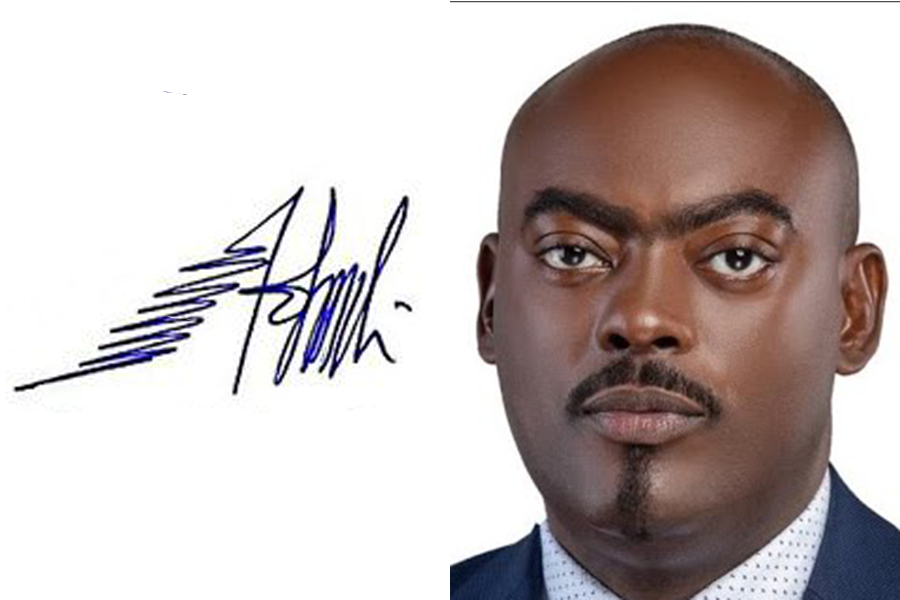
If politics were handwriting, then Fred Mukasa Mbidde’s signature would not be just ink on paper—it would be a press conference, a coalition agreement, and a personal manifesto arguing with itself in real time.
Before one even reads his latest political declaration, the eye is first hijacked by the signature. The doodle, neat as it is, does not sit still like ordinary ink. It sprawls, twists, loops, and occasionally behaves like it is trying to escape the page altogether. It is less a signature and more a negotiation in progress.
One might say it reflects ambition. Another might say it reflects movement. But in Uganda’s political ecosystem, where everything is read twice and understood three times differently, it also raises a quieter question: if this is how the man signs agreement, how exactly are the agreements being read on the other side?
For years, Fred Mukasa Mbidde has operated at the centre of Democratic Party strategy alongside Norbert Mao. Together they were not just colleagues; they were co-authors of a long political script that ran through EALA victories, internal party engineering, and the careful placement of allies into strategic positions.
They knew how to move. They knew how to negotiate. And for a long time, they knew how to win—at least within the boundaries of the DP ecosystem.
But politics, like handwriting, eventually reveals what discipline cannot hide and the one who signs like it is the only thing they do for a living is left behind.
Because while Mbidde’s signature looks like it is constantly expanding into new territory, his political outcomes have often told a different story—one of promised elevation, negotiated expectations, and ambitions that arrive at the destination slightly after the train has left.
As Sevo, I would leave a man out when his signature is like climbing into the skies and then taking a sunbath with your tummy up at the beach.
The latest chapter in this long partnership-turned-rivalry tells its own story. A cooperation arrangement with the ruling establishment was expected to deliver political consolidation, influence, and, as insiders often whisper in Uganda’s political corridors, ministerial assurance.
Norbert Mao eventually crossed that threshold into Cabinet.
Mbidde, however, remained on the waiting list of history. Alone with his signature and eyebrows.
And that is where the interpretation begins to sharpen. Because in politics, being left behind is never just absence—it is reclassification. It is the moment people stop seeing you as a co-architect and start seeing you as an unresolved clause in a signed agreement.
So they look at you with twisted eyebrows.
Now Mbidde has turned his attention back to the Democratic Party presidency, framing it as correction, renewal, and ideological realignment.
But the machine metaphor has now turned against them.
Because if DP “lost an engine” under the NRM cooperation arrangement, as Mbidde himself once suggested, then the uncomfortable question is not just where the engine went—but who signed for it, and in what handwriting.
And here again, the signature returns to the centre of analysis.
It is elaborate. It is expressive. It is confident. But it also appears to do what many political signatures do when ambition runs faster than structure: it expands beyond the space allocated for it.
In politics, that matters more than people admit. Because power is not only about what is written, but how legibly it can be enforced. A signature that overflows margins may impress the eye, but it also tests the patience of those tasked with implementing it.
Mbidde’s current political moment therefore reads like a continuation of that paradox. High ambition. Strong presence. Long experience in the architecture of party politics. But also, a recurring sense that the final mile of reward has not always matched the length of the journey.
But back to the signature.
It is impossible to ignore it now, you see. Look at it again. The eyebrows in the portrait are precise, controlled, almost judicial—like they have already reviewed the evidence and are awaiting sentencing. The beard is neat, disciplined, almost diplomatic. Everything about the face says order.
Then you glance at the signature.
It says rebellion.
It says ambition without permission.
It says: “this is not a footnote, this is the main motion.”
In Uganda’s political theatre, perhaps that is the real lesson. Leaders may negotiate coalitions, alliances, and ministerial expectations, but ink tells its own truth. And Mbidde’s ink looks like it has already decided that the next chapter will not be co-authored.
In the end, perhaps the signature says less about undercutting and more about the nature of political handwriting itself.
Some signatures are designed to close deals.
Others are designed to open arguments.
Mbidde’s, whether one admires it or not, clearly does both. And that is confusion.
