
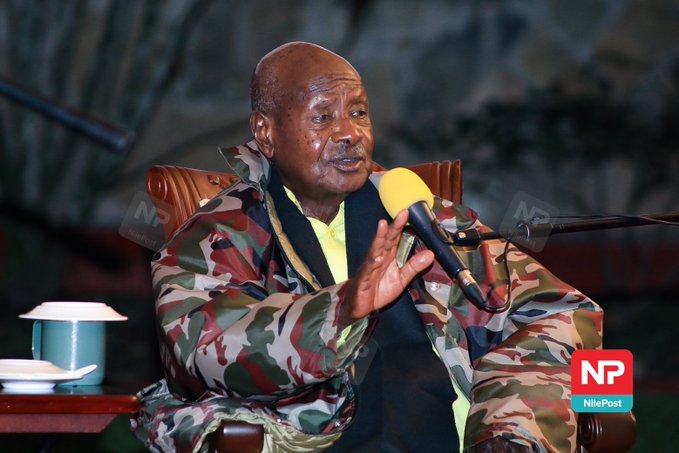
President Museveni has applauded Members of Parliament for passing the Protection of Sovereignty Bill, 2026, describing it as a landmark step in safeguarding Uganda’s right to self-determination, even as the legislation continues to face public scrutiny over its implications on civic participation and governance.
The Bill, which generated widespread debate and opposition over concerns that some of its provisions could disenfranchise citizens, was passed by the 11th Parliament after contentious clauses were reportedly amended ahead of the decisive Tuesday sitting.
With Parliament making what could be its final major legislative decision of the current term, the Bill now awaits presidential assent to become law.
In a statement released on Wednesday evening via his official social media accounts, Museveni congratulated National Resistance Movement (NRM) Members of Parliament for what he termed a principled decision, framing the law as a defence of national sovereignty against external influence.
“Fellow Ugandans, especially the Bazzukulu. Greetings. This is to congratulate the NRM MPs for passing the Sovereignty Bill which simply means ‘mutuleke tukole ebyaffe ngamwe bwemukola ebyamwe wataliwo okubayingilila’ (let us do our things by ourselves just as you do your own things without anybody interfering with you),” Museveni said.
He strongly defended the Bill’s intent, dismissing criticism as misplaced and warning against what he described as dangerous foreign interference in domestic affairs.
“How shameful and disgusting to see people arguing otherwise!! Foreigners interfering in our internal issues is very dangerous,” he added.
Museveni cited historical examples to justify his position, pointing to foreign involvement in Uganda’s political history.
“You want examples? I will give you one today that I gave to the Cabinet the other day. It is how the Israelis led by one Barak and the British supported Idi Amin’s coup in 1971 because Obote was vocal in opposing their policy on Rhodesia (Zimbabwe). Indeed, Edward Heath, the British Prime Minister, recognized Amin after only 10 days,” he said.
The President’s remarks follow days of public debate and concern over the Bill’s framing, with critics arguing that certain provisions risk undermining democratic participation and citizens’ rights. However, government officials have maintained that the law is intended to protect Uganda’s sovereignty and policy independence.
Earlier, Museveni had also moved to clarify the purpose of the Bill, rejecting claims that it targets foreign investment or financial inflows.
He described sovereignty as Uganda’s exclusive right to make policy decisions without external manipulation, covering areas such as political governance, economic policy and diplomatic alignment.
He further stressed that the legislation does not interfere with Uganda’s free-market system or the movement of capital, including foreign direct investment, diaspora remittances and private sector operations.
The President has previously explained that the Bill is rooted in the Pan-African struggle for independence and the principle that nations must be free to make their own policy choices—even when they risk making mistakes.
“Independence means the right to make our own mistakes if necessary and learn from them,” Museveni said, quoting former Tanzanian leader Mwalimu Julius Nyerere.
He also reiterated that sovereignty means, in his words, “Please, muteleke (leave us alone), so that we make our own decisions,” adding that external actors should not finance groups aimed at influencing Uganda’s internal decisions.
The Protection of Sovereignty Bill now awaits Museveni’s assent, a final step that will determine its formal entry into Ugandan law amid continued national and international attention.
