
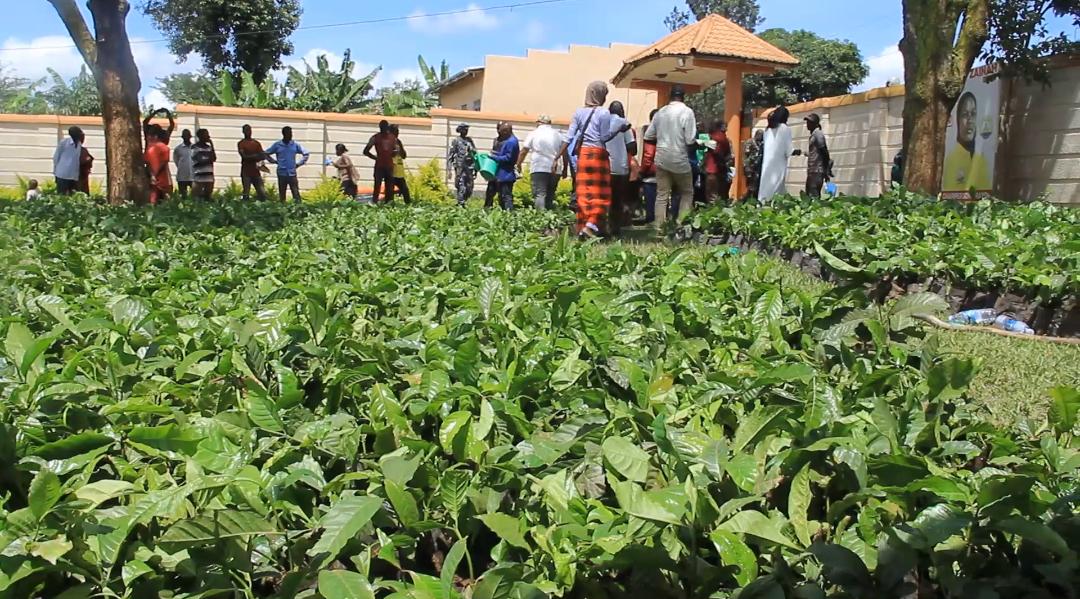
The government has intensified efforts to strengthen Uganda’s coffee sub-sector with the distribution of 100,000 seedlings to farmers in Masaka District, even as growers raise alarm over rising production challenges that they say are threatening productivity and profitability.
The seedlings, distributed through the office of former Vice President Edward Kiwanuka Ssekandi, were handed over in Kyanamukaaka and targeted farmers across Buwunga, Kyanamukaaka Town Council, Kyesiiga, and Kabonera sub-counties.
Oscar Mutebi, an aide to Ssekandi, said the intervention is aimed at boosting household incomes through increased coffee production and expanding participation in Uganda’s leading export crop.
“We are working towards ensuring that every household in Masaka and across Uganda can uplift its income through coffee growing,” Mutebi said.
He added that sustainable coffee production requires more than seedlings, calling for stronger government support in agricultural inputs.
“Farmers need more than just seedlings. They need fertilizers and support services to fully benefit from coffee farming,” he said.
The distribution benefited youth, women, and elderly farmers, with local leaders describing it as a key step toward widening agricultural participation in the region where coffee remains a dominant livelihood source.
Benjamin Mukisa, Masaka District Youth Councillor, urged young people to embrace the opportunity.
“This is a great opportunity for the youth to engage in agriculture and create sustainable sources of income,” he said.
However, despite welcoming the intervention, farmers used the platform to raise urgent concerns over production constraints, particularly pests and diseases affecting coffee stems and yields.
Hajjat Zaina Nakidde, Mayor of Kyanamukaaka Town Council, said pest infestations are increasingly threatening coffee farms and called for immediate government intervention.
“We appreciate the seedlings, but pests are destroying our crops. We need immediate support with effective chemicals to protect our coffee,” she said, also urging research into what she described as a “coffee vaccine” to prevent early-stage infections.
Farmers further highlighted the challenge of fluctuating coffee prices, saying unpredictable market conditions are discouraging investment in the crop despite its economic importance.
“The prices keep changing, and this discourages farmers. We need a more stable and favourable price,” they said.
Coffee remains Uganda’s leading export commodity, with the Greater Masaka region among the country’s highest producing zones.
Local estimates indicate that between 60 and 75 percent of households in the area depend on coffee farming, making productivity and market stability critical to household incomes and regional economic stability.
While government continues to scale up input distribution, farmers say long-term success will depend on addressing pests, stabilising prices, and strengthening extension services to protect investments already made in the sector.
