
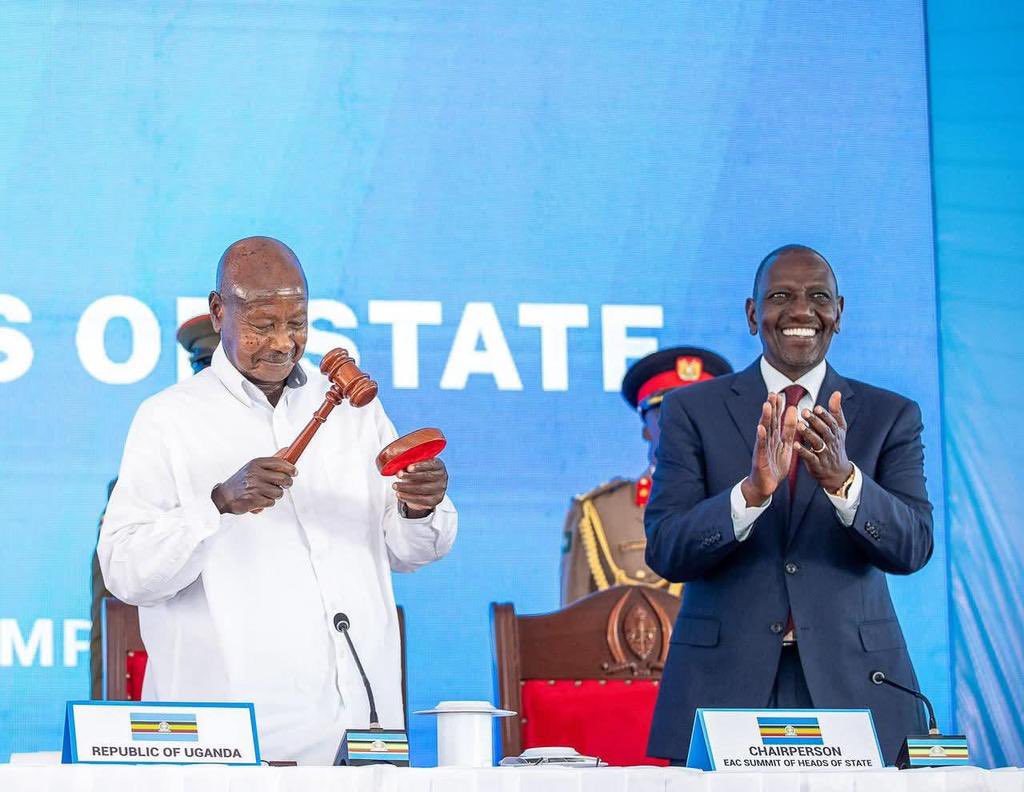
The 25th Ordinary Summit of Heads of State of the East African Community (EAC) has resolved to waive 50 percent of the $89 million in membership arrears owed by partner states, in a move aimed at easing financial strain and restoring the bloc’s operational capacity.
The decision was announced at the summit held under the theme, “Deepening Integration for Improved Livelihoods,” where Kenya’s President William Ruto handed over the rotating chairmanship of the regional bloc to Uganda’s President Museveni.
Addressing leaders at the summit, Ruto warned that unpaid membership dues had severely undermined the EAC’s ability to function effectively.
The arrears include about $27 million owed by the Democratic Republic of Congo, $22.7 million by Burundi and $21.8 million by South Sudan.
With the 2025/2026 EAC budget set at $109 million, the outstanding $89 million has placed significant pressure on the regional body’s programmes and operations.
“To alleviate the burden on countries that have arrears, we shall waive 50 percent of those arrears, and the remaining 50 percent must be paid within two years,” Ruto said.
He added that the summit also agreed to reform the bloc’s funding structure to make contributions more equitable among member states.
“Going forward, we must make contributions fair and equitable. The countries that benefit more should pay more, and therefore we have agreed to change the formula to 50 percent equal and 50 percent assessed contribution,” Ruto said.
Beyond financial reforms, the summit emphasized the need for deeper technological cooperation across the region. Ruto called for the adoption of the United Nations Digital Compact and urged partner states to invest in artificial intelligence education to strengthen the region’s digital economy.
“There is a need to address the needs of our people through emerging technologies. For our youthful group, AI can create immense value addition, but we must work together to ensure meaningful change is attainable,” he said.
The summit also approved measures aimed at reducing operational costs within the EAC. Under the new arrangement, members of the East African Legislative Assembly will have their salaries paid directly by their respective national parliaments instead of the regional body.
Leaders also agreed to change the decision-making threshold within the bloc, lowering it from full consensus to a 65 percent majority vote in order to prevent a single country from blocking key decisions.
As he assumed the chairmanship, Museveni called for stronger regional security cooperation, particularly in light of ongoing tensions between Rwanda and the Democratic Republic of Congo.
The two presidents were absent from the summit, reflecting the deepening rift between the neighbouring countries over the conflict in eastern DR Congo.
Museveni stressed the need for the region to develop a strong collective security mechanism capable of protecting the sovereignty of member states.
“The decisions of the summit are not subject to any other character or bureaucracy to massage them. It is our duty to honor our financial obligations to the community,” Museveni said.
The summit also agreed that the five senior positions within the EAC Secretariat will in future be reserved for partner states that have fully ratified the EAC treaty and met their financial obligations.
Leaders said the move is intended to strengthen accountability and ensure that leadership roles in the regional body are held by countries that comply with their commitments.
