
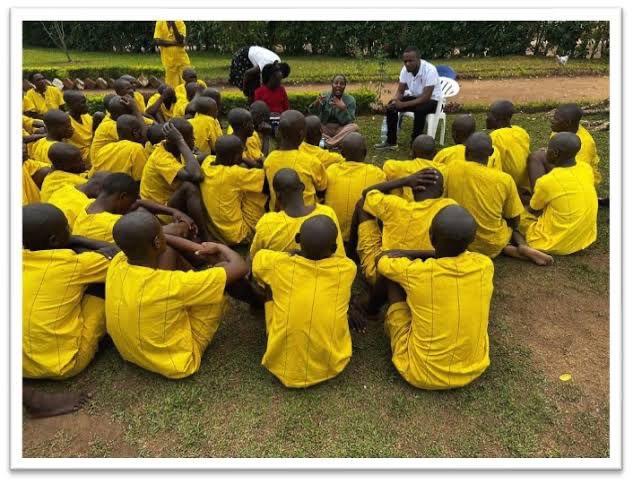
The Uganda Prisons Service has warned that extreme overcrowding in correctional facilities is accelerating the spread of HIV and other infectious diseases, creating what officials describe as a growing public health crisis that threatens both inmates and the wider community.
The warning was delivered during the launch of the Uganda HIV Marathon in Kampala, where prison health authorities outlined the scale of congestion and its implications for disease prevention and treatment inside detention facilities.
Assistant Commissioner for Health and head of the Prisons Health Unit, Dr. James Kisambu, said Uganda’s prisons house approximately 80,000 inmates at any given time about 350 percent of their intended capacity.
He warned that such overcrowding creates conditions that enable infectious diseases, including HIV and tuberculosis, to spread more easily.
“This situation increases the vulnerability of prisoners, and we see a higher proportion of infectious diseases within prisons compared to the communities outside,” Kisambu said.
Findings from the National Prisons TB, HIV and COVID-19 Survey 2024 comparing data collected in 2014 and 2024 show that HIV prevalence among prisoners declined only slightly from 14 percent to 12 percent over the decade.
In contrast, prevalence among prison staff dropped sharply from 12 percent to 2 percent. Uganda’s national HIV prevalence stands at just over 4 percent.
Kisambu said the modest decline among inmates underscores the difficulty of controlling infections in a population that frequently moves between prison and the community.
He noted that approximately 65 percent of inmates had never been tested for HIV prior to incarceration, making prison intake screening a critical entry point for diagnosis and care.
“Prison may be a difficult environment, but it provides a unique opportunity to reach people who cannot access health services in the community,” he said.
Upon admission, inmates undergo HIV testing, tuberculosis screening and other health assessments.
Those who test positive are enrolled on treatment and receive continuous care, enabling authorities to detect and manage infections that might otherwise remain untreated.
Despite these interventions, Kisambu warned that prison health cannot be separated from public health outcomes.
“Prisons act as a multiplier for infectious diseases. What happens inside eventually returns to the community. That’s why testing, treatment and preventive interventions in prisons are critical,” he said.
Health officials also highlighted reintegration challenges after release. Former inmates often face stigma and barriers when attempting to access community health services, prompting some to continue seeking care at prison-run facilities even after completing their sentences.
Experts say behaviours associated with HIV transmission do not disappear in detention settings.
“Behaviors brought from the community, including sexual practices, persist in prisons. Prison does not remove behaviors; it reflects the community,” Kisambu said. “Prevention and treatment in prison settings are vital for the health of both inmates and the wider public.”
To mitigate risks, the prisons service is working with the judiciary, police, health authorities, development partners and community organisations to ensure continuity of care and reduce HIV transmission.
Officials stress that expanding prison infrastructure, strengthening health services and improving reintegration support systems are urgently needed to address the dual crises of overcrowding and infectious disease.
The prison health warning comes as Uganda intensifies its national HIV response, with the Uganda AIDS Commission cautioning that the country must accelerate prevention and treatment efforts to avoid reversing hard-won gains.
Speaking in Kampala, Commission Director General Dr. Nelson Musoba said Uganda recorded approximately 36,000 new HIV infections in 2024 and must reduce that number to fewer than 10,000 annually by 2031 to stay on track toward ending AIDS as a public health threat.
Musoba outlined the country’s “three zeros” strategy: zero new HIV infections, zero AIDS-related deaths and zero stigma and discrimination.
“In 2024, Uganda recorded 36,000 new infections. Our target is to reduce this to less than 10,000 by 2031,” he said.
“The only way to turn off the tap is to ensure all HIV-positive individuals are on treatment and achieve viral suppression.”
He explained that individuals whose viral load is suppressed cannot transmit HIV, even if sexually active, and that adherence to treatment allows HIV-positive mothers to deliver HIV-negative babies.
Uganda also aims to reduce AIDS-related deaths to fewer than 5,000 annually. Achieving this milestone would signal epidemic control, where deaths fall below new infections, reflecting stable treatment adherence and viral suppression.
“If we achieve viral suppression at scale, it means people are not transmitting HIV,” Musoba said.
However, he warned that stigma and discrimination remain major obstacles.
“Stigma persists even after four decades of the epidemic. It is a mindset issue, but tackling it is essential to sustain prevention, testing and treatment uptake,” he said.
Modeling indicates Uganda could reduce new infections to around 9,000 by 2031 if current interventions are expanded, underscoring the need for sustained vigilance, innovation and community engagement.
Musoba emphasized the importance of partnerships among government agencies, the private sector, civil society and the media to mobilize resources and strengthen prevention messaging.
He said the Uganda HIV Marathon will serve as a platform for raising awareness, promoting responsible behaviour and strengthening community involvement.
“Young people are at the heart of this campaign,” he said. “Their leadership, peer influence and responsible decision-making are critical to sustaining Uganda’s momentum toward ending AIDS as a public health threat.”
Health experts say the situation in prisons highlights a broader national challenge: controlling HIV requires reaching vulnerable populations, expanding access to treatment and eliminating stigma.
Authorities warn that without urgent investment in prison infrastructure, expanded health services and strengthened prevention efforts nationwide, overcrowded detention facilities could undermine Uganda’s progress against HIV with consequences felt far beyond prison walls.
