
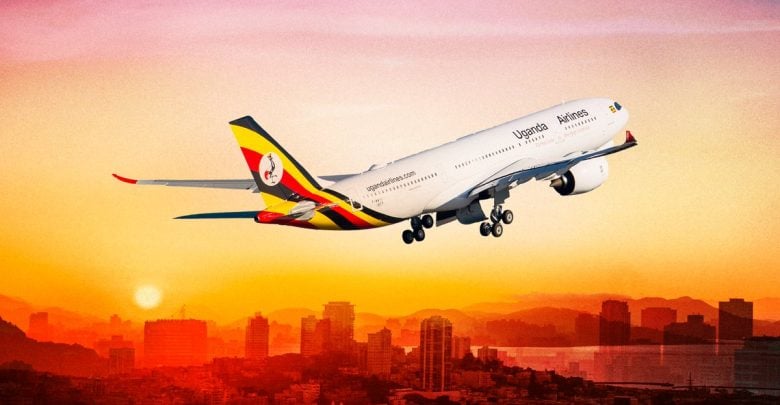
Parliament has approved Shs422.26 billion in supplementary funding for the 2025/26 financial year to expand Uganda Airlines’ fleet, according to an official statement.
The funds will be used to purchase two Boeing 787 passenger aircraft, one Boeing freighter, and two mid-range Airbus planes, as well as cover associated bridge leasing costs.
The allocation represents one of the largest supplementary requests for the national carrier since its 2019 revival, initially announced by Finance Minister Matia Kasaija in July 2025.
However, the decision sparked debate among MPs. Ibrahim Ssemujju (Kira Municipality) urged Parliament to demand a detailed acquisition plan, citing past issues with the Bombardier CRJ900 deal.
"The Ministry is requesting over Shs400 billion for new aircraft while the country has not fully recovered from the previous deal. Thorough due diligence must be presented," he said.
Opposition Leader Joel Ssenyonyi questioned the rationale for supplementary appropriations for foreseeable expenses, arguing that such requests should only cover "unabsorbable, unavoidable, and unforeseeable" costs.
In defense, Uganda Airlines CEO Jenifer Bamuturaki attributed recent delays and cancellations to sudden airport closures at Entebbe, Bujumbura, Juba, and Dar es Salaam, emphasizing that these disruptions were beyond the airline’s control.
Transport Minister Edward Katumba Wamala added that Uganda Airlines handles up to 40% of traffic at Entebbe with a limited fleet, necessitating additional aircraft to stabilize operations and meet rising demand.
The supplementary budget is part of a broader Shs1.696 trillion request for the Ministry of Works and Transport, which includes funding for infrastructure projects such as community access roads and national ambulance services.
Despite concerns over mismanagement and delayed flights raised by MPs such as Kibedi Nsegumire (Mityana North) and Maurice Kibalya (Bugabula North), Minister Katumba insisted that securing the aircraft is crucial to maintain Uganda Airlines’ growth and long-haul route expansion.
He confirmed that the airline is in the process of acquiring 10 aircraft: four mid-range or narrow-body Airbus planes, four wide-body Boeing aircraft, and two Boeing converted freighters for cargo.
Pre-delivery payments totaling Shs522.264 billion will be made in stages to both Boeing and Airbus.
Ssemujju, who identifies as a supporter of a national airline despite the losses, stressed the need for clarity and proper budgeting.
“Uganda Airlines is vital, but the process must be neat and transparent,” he said, urging quarterly reporting to Parliament on all supplementary expenditures.
The approved funds aim to bolster Uganda Airlines’ capacity, enhance cargo operations, and prepare the carrier for long-haul international flights, including potential services to China.
Uganda Airlines currently has a fleet of seven aircraft: two wide‑body Airbus A330-800neo wide‑bodies and four regional Bombardier CRJ-900LR jets in regular service, plus a short‑term wet‑leased Airbus A320-200 to augment capacity.
The fleet draws no Boeings — despite government plans to procure Boeing aircraft including freighters and Dreamliners, those had not yet entered service as of late 2025.
The airline serves around 17 direct destinations — key regional hubs such as Nairobi, Dar es Salaam, Juba, Johannesburg, Kinshasa, Lusaka, Harare, Abuja, Lagos and others, plus long‑haul international routes including Dubai and London Gatwick.
To counter operational challenges due to its limited fleet, the airline has supplemented that core fleet with wet‑leased Airbus A320-200 aircraft to cope with demand and maintenance cycles.
Under the wet‑lease/ACMI arrangements, UA has operated at least one A320‑200 on routes where the CRJ‑900s struggle with volume or weight — for example hot‑and‑high destinations such as Johannesburg, and on other busy regional routes like Nairobi, Kinshasa, Lagos and Abuja
