
Gender-based violence remains a major challenge for rural women, with community leaders in Masaka noting that it often stems from conflicts over economic resources such as land, seeds and household income.
As agriculture becomes increasingly digital, new risks are emerging, especially for women who are entering online spaces without adequate protection.
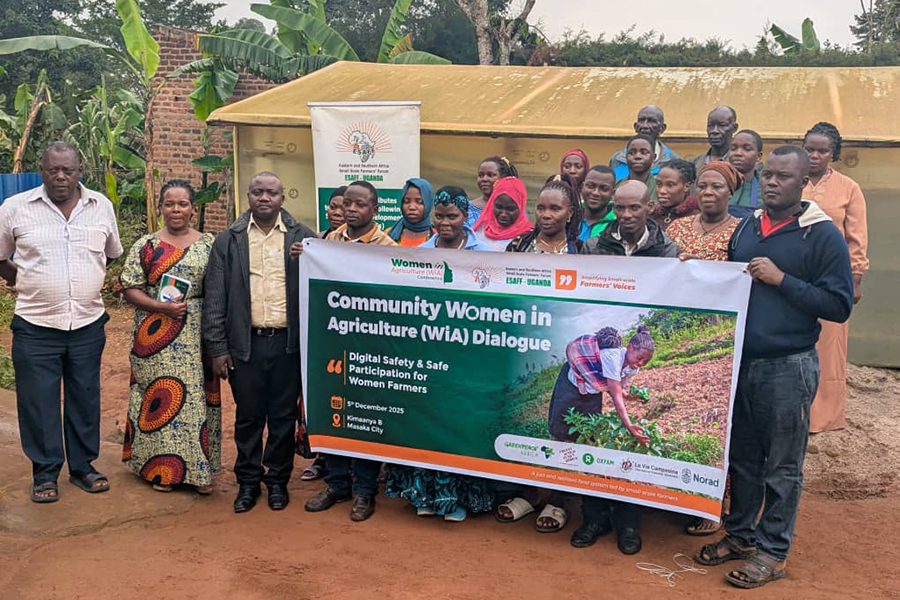
During the latest Community Women in Agriculture (WiA) dialogue held in Masaka District, stakeholders held a focused discussion on digital safety and safe participation for women farmers.
The session aimed at equipping women with practical knowledge and strategies to use digital tools confidently, securely and with full participation in the growing digital agricultural economy.
Jamie Walugembe, the LC1 chairperson of Kimaanya B, stressed the need for stronger local structures to safeguard women farmers as digital engagement becomes central to agricultural trade and communication.
“As local leaders, we must prioritise empowering our women farmers, safeguarding their voices and ensuring their safe and equitable participation in the marketplace, especially on digital platforms,” Walugembe said.
He noted that digital spaces bring both opportunities and risks, making community protection mechanisms more essential than ever.
Women farmers also voiced concerns about rising cases of online threats, fraud and cyberbullying, which they say discourage many from embracing digital tools meant to improve their productivity and market access.
Nakiguli Leticia, a member of the KGCA Farmer Group, called on local councils to play a more proactive role.
“As farmers, we request local councils to establish and enforce community bylaws that address the consequences of fraud and cyberbullying. These issues are affecting us, and we need clear protections within our communities,” she said.
Many farmers shared similar sentiments, emphasising that digital safety is no longer optional; it is essential for fair access to markets, information and financial services.
Masaka City Community Development Officer Wilson Kiiza highlighted the need to ensure that digital transformation benefits women equally.
“Digital safety is a non-negotiable foundation for rural development,” Kiiza said.
“We are committed to working with communities so women farmers can participate in the digital economy without fear. Technology must be a tool for their empowerment, not their exploitation.”
The WiA dialogue emphasised that reducing digital risks, alongside addressing home-based conflicts linked to agricultural resources, is critical to advancing gender equality in rural farming communities.
