
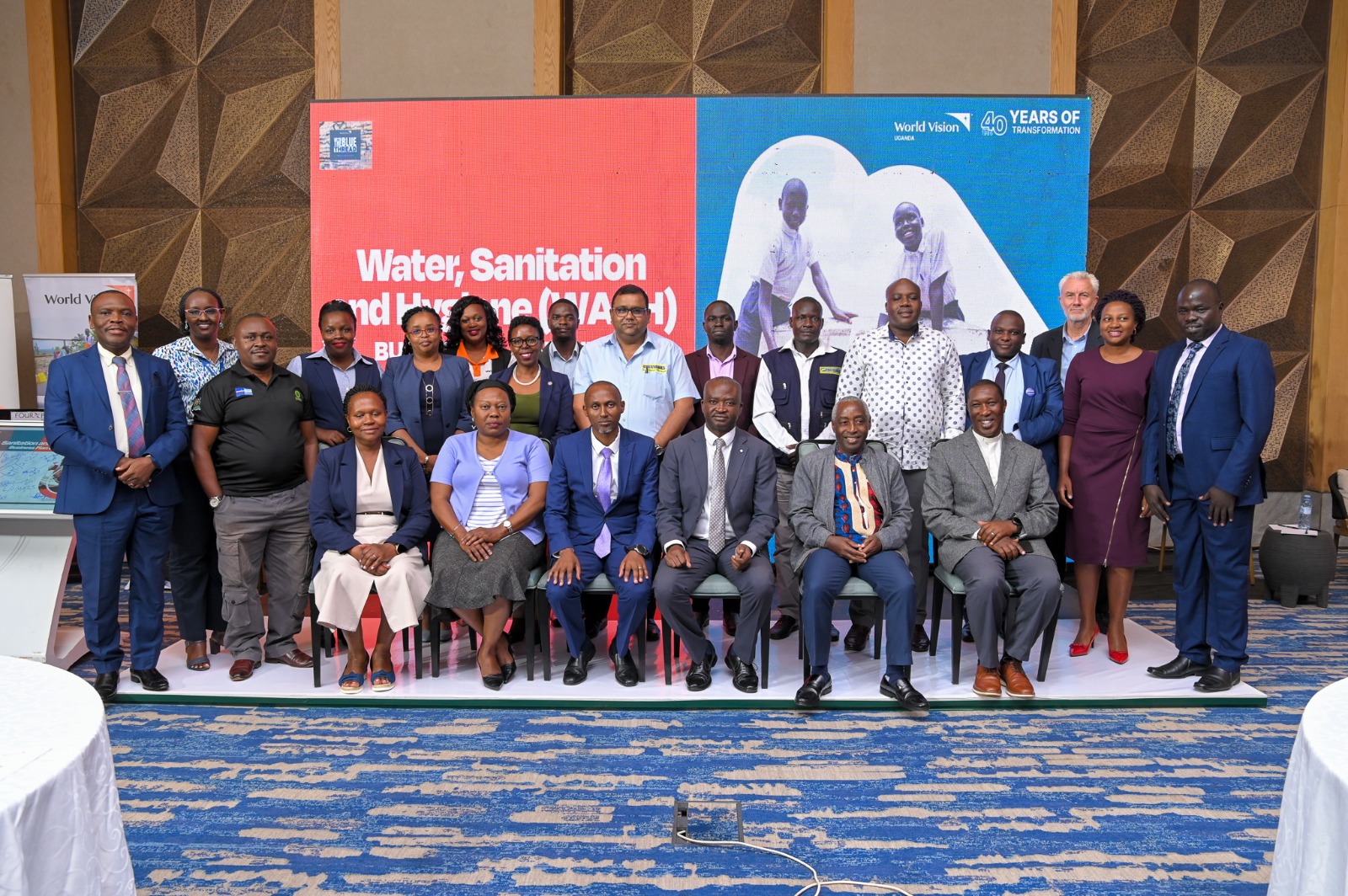
World Vision Uganda has officially launched its 2026–2030 Water, Sanitation, and Hygiene (WASH) Business Plan—a transformative blueprint that sets a new national benchmark for inclusive, climate-resilient, and sustainable WASH service delivery.
Anchored in the global WASH strategy Mapping the Blue Thread, Uganda’s National Development Plan IV, and Sustainable Development Goal 6, this strategic framework builds on over 35 years of World Vision’s experience in empowering communities through clean water and improved sanitation.
Between 2021 and 2025, World Vision Uganda reached approximately 1.16 million people with life-changing WASH interventions.
The new plan expands this impact, targeting 41 districts with integrated approaches that strengthen systems, promote equity, and foster innovation.
Key priorities include enhancing water quality, sanitation and hygiene, governance, financing, water security, and disaster preparedness.
Speaking at the launch event held at Four Points Hotel in Kampala, World Vision Uganda’s National Director, Jeremiah Nyagah, emphasized that the WASH Business Plan is both a call to action and a renewed commitment to scale inclusive, climate-resilient, and sustainable WASH services across Uganda.
He affirmed the organization’s dedication to driving transformative change through strategic partnerships, innovation, and community-centered solutions.
“We call on partners to champion market-based sanitation and community-led behavior change, especially in rural areas where 79% still lack improved sanitation. By engaging households in co-designing affordable, preferred solutions, and supporting them with seed capital, training, and vendor linkages, we can empower communities to make informed choices and drive lasting demand for better WASH services.”
In the new plan, World Vision Uganda aims to accelerate sanitation and hygiene via market-based solutions and the household engagement and accountability approach, ensuring communities are active participants in their own transformation.
“We must protect ecosystems not just for today, but for future generations. That means restoring and safeguarding our water sources through community-led reforestation, sustainable land use, and responsible waste management. With strong leadership from the Ministry of Water and Environment, enforcing buffer zones and promoting eco-friendly livelihoods we can reduce pressure on wetlands. Let’s also empower children as environmental stewards to raise awareness and inspire action at the grassroots.”
Nyagah emphasized that collaboration and partnership will be key to realizing the plan’s goals, especially in expanding safe and equitable access to water, sanitation, and hygiene infrastructure.
“For us to realize and achieve better well-being for the children, it requires government and partners to co-invest in safer infrastructure—safe, accessible, functional, equitable, and resilient water systems,” he said. “Let us strengthen real-time monitoring and quality assurance protocols to ensure long-term functionality.”
He highlighted the importance of involving communities in project design to ensure sustainability, adding that World Vision would continue leveraging digital innovations like M-Water to improve monitoring and accountability.
“Households should be engaged in co-designing because the mistake we make as development practitioners is to prescribe solutions without recognizing indigenous knowledge,” Nyagah noted.
“With digital tools like M-Water, the private sector can provide sensors and cloud platforms while the Ministry of Water sets standards for harmonized data use.”
Nyagah further rallied partners, including financial institutions and corporate actors, to co-fund WASH initiatives as part of their social responsibility commitments.
“We must mobilize resources to finance WASH interventions,” he urged. “Everyone should bring their one shilling, their 10,000 shillings—because it takes all of us working together to slay the enemy of poor sanitation and unsafe water.”
Presenting the details of the business plan, Wilfred Komakech, the WASH Programs Manager at World Vision Uganda, said the initiative’s theme “Mapping the Blue Thread” symbolizes water as the connector of people, places, and progress.
“When we talk about mapping the blue thread, we talk about water as the blue thread of integration—connecting people, connecting places, and connecting progress,” Komakech explained adding that their vision is to deliver adaptive WASH solutions that transform communities and create pathways out of poverty.
Komakech outlined four strategic goals under the plan: accelerating universal access to WASH services; focusing on vulnerable populations; demonstrating sustainable impact through accountability; and mobilizing financing for WASH interventions.
“We want to ensure we deliver water of enough quantity and quality to communities, schools, and healthcare facilities,” he said. “We also want to strengthen governance and financing of WASH to make it more transparent and sustainable.”
He added that World Vision will integrate digital monitoring tools and work closely with the Ministry of Water and Environment to map all water points nationwide for better coordination and reporting.
“Monitoring is key because we want to track how we are progressing,” Komakech said. “Through our digital platform, anyone can scan and follow progress in real-time. So far, we’ve mapped water points in Buikwe and Kamwenge districts, with plans to expand to four more districts.”
Deputy Speaker of Parliament, Thomas Tayebwa, represented by Kumi Municipality MP Silas Aogon, hailed the initiative as a crucial step toward achieving universal access to clean water and sanitation.
“This event marks a significant milestone in our collective journey toward achieving universal access to safe water, sanitation, and hygiene services for all Ugandans,” Tayebwa said. “The plan is a demonstration of bold commitment to improving lives, empowering communities, and building a more resilient Uganda.”
He emphasized that WASH interventions are foundational to development, improving education, health, and productivity—especially for women and girls.
“Improved access to clean water, dignified sanitation, and appropriate hygiene services enhances health, education, nutrition, and economic prosperity,” Tayebwa said.
“When communities gain reliable access to clean water, children flourish, women are empowered, and households experience improved health and productivity.”
Tayebwa further praised World Vision for embracing inclusive and climate-resilient approaches, particularly digital tracking and disability-friendly infrastructure.
“The use of digital tools like M-Water for real-time monitoring and data sharing will enhance our ability to make evidence-based decisions,” he said. “I applaud the commitment to constructing disability-friendly infrastructure and empowering women and marginalized groups in WASH governance.”
He called on all stakeholders to co-finance and support the plan’s implementation across Uganda.
“This launch is more than a ceremonial event it is a call to action,” Tayebwa said. “A call to invest, to innovate, and to collaborate so that by 2030, every Ugandan, regardless of where they live, has access to safe water, sanitation, and hygiene.”
By 2030, World Vision envisions a transformative shift in Uganda’s WASH landscape, scaling climate-resilient infrastructure, expanding access to WASH financing through Vision Fund, and advancing the women-centered Beyond Access design. Building on the success of the Rwizi Watershed Restoration project in Rakai District, the organisation aims to scale up Integrated Water Resources Management approaches that deliver lasting impact for Uganda’s most vulnerable communities.
