
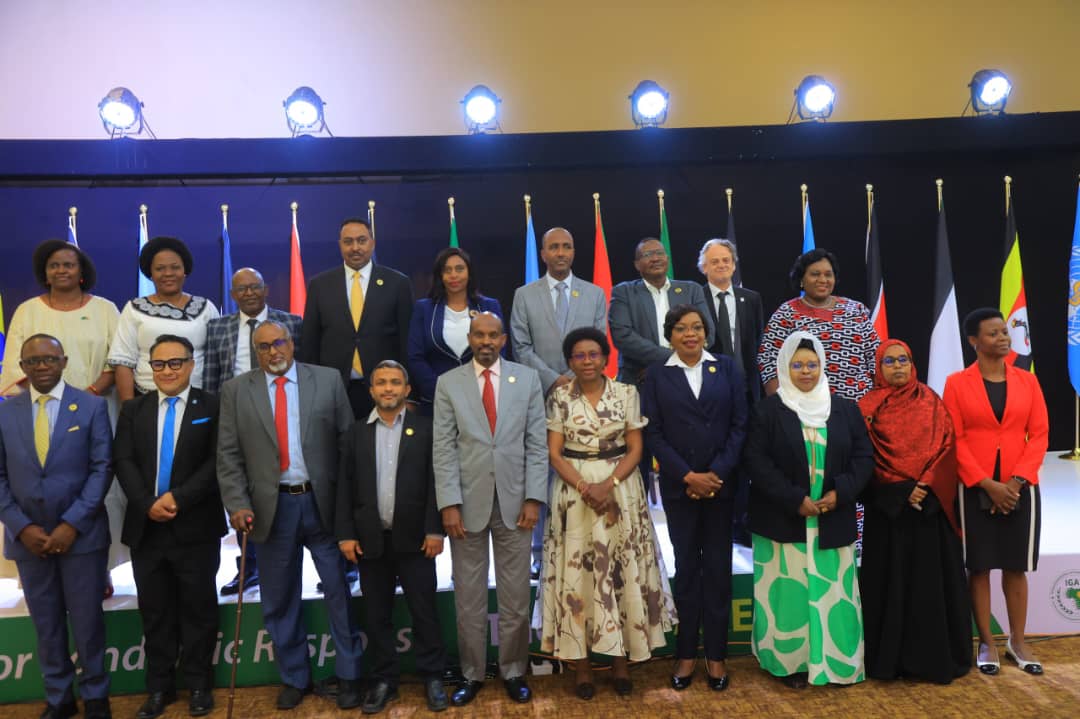
Health ministers from the Intergovernmental Authority on Development (IGAD) region have pledged sweeping reforms to strengthen pandemic preparedness, unveiling a unified “One Health” strategy to confront future cross-border disease threats.
Meeting in Kampala for the Second IGAD Ministerial Conference on Enhancing Preparedness for Pandemic Response, the officials inaugurated the Preparedness for Pandemic Response (PREPARE) Project, calling it a milestone for regional health security.
Uganda’s Minister of Health, Dr. Jane Ruth Aceng Ocero, said the COVID-19 experience had shown how fragile national systems could be when operating in isolation.
“COVID-19 did not respect borders, and neither will the next pandemic,” she told delegates. “We cannot afford to return to business as usual. Strengthening surveillance, laboratories, and community systems across our borders is not optional — it is essential.”
The ministers recalled the March 2020 IGAD Heads of State declaration that first set out a regional COVID-19 response plan.
They noted with “deep concern” the pandemic’s severe impact, including a 3.4% contraction in Africa’s GDP and disruption of more than 70% of essential health services.
South Sudan’s Health Minister, Sarah Cleto Hassan Rial, warned that the region remained vulnerable due to porous borders and limited health infrastructure.
“Our populations move daily across borders for trade, pastoralism, or refuge. This mobility, while vital for livelihoods, creates fertile ground for epidemics,” she said. “We must act together, or we will fall together.”
The One Health approach endorsed globally by the WHO, FAO, WOAH, and UNEP integrates human, animal, and ecosystem health. Ministers stressed that about 75% of emerging diseases are zoonotic, spreading from animals to humans. Somalia’s State Minister of Health, Dr. Mariam Mohamed Hussein, said the approach was overdue.
“From Rift Valley fever to Mpox, our region has lived through repeated zoonotic outbreaks. One Health is not theory for us it is survival,” she said. “We must embed it in education, policy, and practice.”
The communiqué cited the 2024 Mpox outbreak in Uganda’s Kasese District, which quickly spread to Kenya and later South Sudan, as proof of the urgent need for joint surveillance.
The ministers pledged to strengthen cross-border surveillance and early warning systems with unified digital platforms and rapid response teams, enhance laboratory capacity including interoperable cross-border networks and a regional biosafety strategy, and build community resilience by training health workers, developing harmonised One Health curricula, and rolling out gender-sensitive community engagement strategies.
Kenya’s Principal Secretary for Public Health, Mary Muthoni Muriuki, said investment must match ambition.
“Declarations are important, but without resources they remain words on paper,” she cautioned. “We urge partners and governments alike to back these commitments with sustained funding.”
Sudan’s Director-General for Health Emergencies, Dr. Elfaddil Mohammed Mahmoud Mohammed, highlighted the need for practical readiness.
“Every outbreak reminds us that response time is life or death. We must ensure that laboratories can confirm diseases rapidly, and that health workers on the frontlines are equipped and trained,” he said.
The ministers expressed gratitude to the Pandemic Fund, which has allocated about 40% of its initial disbursements to Africa. Ethiopia’s representative, Prof. Sileshi Garoma Abeya, called it a lifeline.
“Our countries cannot shoulder the costs alone. International solidarity through the Pandemic Fund is proof that the world has learned from COVID-19,” he said.
Civil society and humanitarian actors, including the Uganda Red Cross and the International Federation of Red Cross and Red Crescent Societies, also participated in the deliberations.
IGAD Executive Secretary, Dr. Workneh Gebeyehu, who chaired the meeting, framed the commitments as vital not only for East Africa but for the continent’s stability.
“Peace and prosperity are inseparable from health security,” he said. “A virus can destabilise economies, displace populations, and fuel conflict. Strengthening pandemic preparedness is therefore a matter of regional integration and survival.”
The ministers urged development partners, academic institutions, and the private sector to provide sustained support for implementing the communiqué. They pledged to reconvene regularly to assess progress and address emerging threats.
The assembly closed with thanks to Uganda for hosting. Delegates hailed Kampala’s organisation and hospitality, noting Uganda’s recent role in containing Ebola and Mpox outbreaks.
In her closing remarks, Dr. Aceng called for urgency.
“We cannot predict the next outbreak, but we can prepare for it. Our people deserve nothing less,” she said.
The communiqué was signed by ministers and senior representatives from all seven IGAD member states: Djibouti, Ethiopia, Kenya, Somalia, South Sudan, Sudan, and Uganda.
As the curtains fell on the Kampala meeting, the message was clear: pandemics will come again, but East Africa intends to meet them united, faster, and stronger.
