
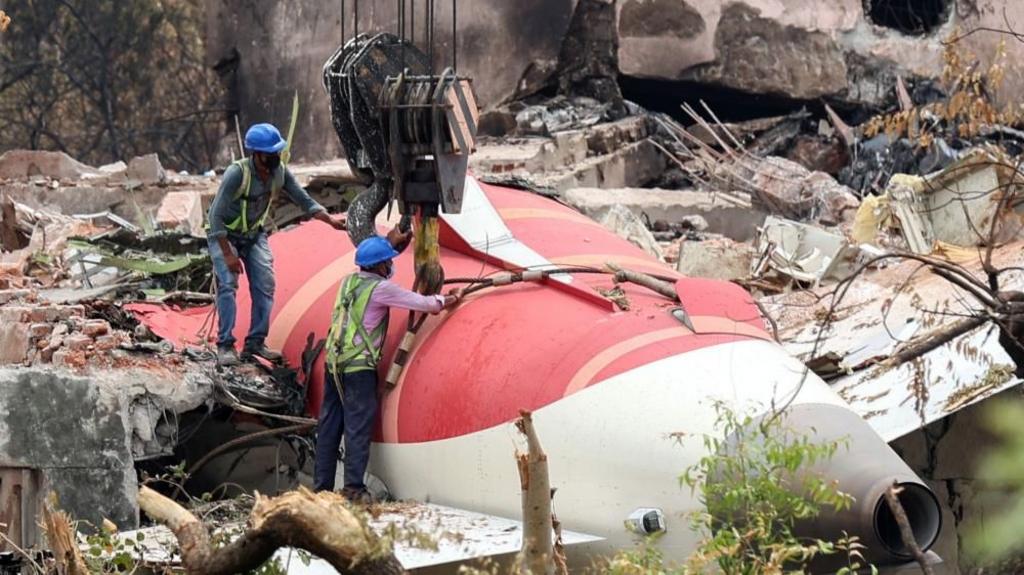
A preliminary report into the Air India Dreamliner crash in Ahmedabad has found that both engines lost thrust shortly after take-off because the fuel control switches were moved to the cut-off position, effectively shutting down fuel supply to the engines mid-air.
Cockpit audio recordings from the Boeing 787-8, registration VT-ANB, captured an exchange between the two pilots shortly after the engines failed.
One of them is heard asking, “Why did you do the cut-off?”, to which the other responds that he did not.
The report does not identify which pilot made either remark.
Data from the flight recorder confirms that both fuel switches were moved from the “run” to the “cut-off” position within moments of departure, prompting a total loss of thrust.
The crew responded by returning the switches to their normal in-flight setting, initiating an automatic engine relight process.
One engine restarted successfully, but the second engine failed to regain thrust. With insufficient power, the aircraft descended and crashed.
The Directorate General of Civil Aviation (DGCA), which is leading the investigation, has not made any definitive conclusions and says inquiries are ongoing.
However, investigators are paying close attention to a detail in the report referencing a 2018 safety bulletin issued by the US Federal Aviation Administration.
The FAA bulletin, issued in December 2018, warned that certain Boeing 737 aircraft had been delivered with fuel control switches whose locking features had been disengaged.
Although the issue was not classified as unsafe and did not trigger a mandatory Airworthiness Directive, the FAA advised operators to inspect the switches.
Air India did not conduct these inspections, as the guidance was advisory.
The same switch design is used on Boeing 787 aircraft, including the one that crashed in Ahmedabad. Aviation safety experts are now asking whether the switch design could have contributed to the accident.
Shawn Pruchnicki, a former airline accident investigator and aviation expert at Ohio State University, told the BBC that the questions raised by the report are serious.
“What does this exactly mean? Does it mean that with a single flip, that switch could shut the engine off and cut the fuel supply?” he said.
“When the locking feature is disengaged, what exactly happens? Could the switch just flip itself to OFF and shut down the engine? If that’s the case, it’s a really serious issue. If not, this also needs to be explained.”
The report also offers details about the flight crew. Captain Sumeet Sabharwal, 56, had 30 years of experience with Air India and over 15,000 flight hours, including more than 8,500 on the Boeing 787.
First Officer Clive Kunder, 32, had logged 3,403 total flying hours, including 1,128 on the Dreamliner. He joined the airline in 2017.
Both pilots were based in Mumbai and had arrived in Ahmedabad the day before the flight.
The report states that they had sufficient rest and passed breathalyser tests before the flight.
Kunder was the pilot flying at the time of the incident, while Sabharwal was the monitoring pilot. CCTV footage shows them at the gate ahead of take-off, appearing alert and composed.
CCTV from the airport also revealed no significant bird activity at the time of departure, ruling out bird strike as a possible cause.
The investigation will now focus on whether human error, mechanical fault, or a combination of both led to the accidental activation of the fuel cut-off switches.
The DGCA has reiterated that the probe is ongoing and the final report will present more conclusive findings.
For now, the preliminary details raise troubling questions about cockpit systems, switch design, and whether a known vulnerability was left unaddressed.
