

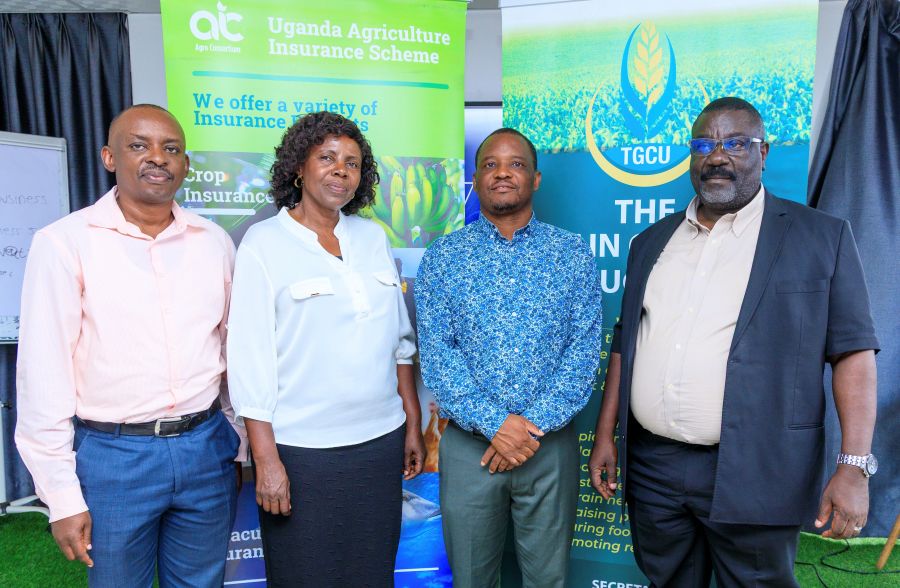
The Agro Consortium (U) Ltd (AIC) and The Grain Council of Uganda (TGCU) have launched an insurance partnership to support the Large-Scale Farmers Financing Scheme (LSF), a government-backed initiative designed to transform agriculture financing and risk management for Ugandan farmers.
As part of the launch, there was a stakeholder training session where AIC and TGCU engaged large-scale farmers, insurers, agricultural representatives, and industry players.
The session provided critical insights into the scheme, its benefits, and how farmers can participate.
Through this partnership, AIC will provide tailored agriculture insurance solutions, offering protection against climate-related hazards, pests, diseases, and other production risks.
By de-risking agricultural financing, the initiative ensures that large-scale farmers can invest confidently in their operations. John
Makosya, Chief Operations and Impact Officer at Agro Consortium, emphasized the game-changing potential of agriculture insurance.
“Agriculture insurance is a transformative tool for large-scale farmers. Our goal is to revolutionize insurance practices, ensuring that farmers are protected from the moment seeds are planted until harvest. At the Agro Consortium, we are committed to building a resilient and innovative agricultural sector,” Makosya said.
“ Education and advocacy are central to our mission, which is why we incorporated a training workshop in the launch to educate farmers on risk coverage, claims processes, and policyholder responsibilities. The future of Ugandan agriculture lies in resilience and innovation, and together, we aim to build a sector that not only feeds the nation but also drives economic growth and sustainability.”
Agriculture being the backbone of Uganda’s economy, contributes 24% to the GDP and employing approximately 70% of the population but over 80% of Ugandan farmers rely on rain-fed agriculture, leaving them highly vulnerable to climate change-induced risks such as droughts, floods, and pest infestations.
Despite these challenges, adoption of agriculture insurance remains low.
A 2021 report by the International Food Policy Research Institute (IFPRI) found that only 4.8% of farmers had adopted crop insurance during the main planting season, with 3.17% uptake during the second season.
A recent survey by the Uganda Insurers Association revealed that 64% of farmers cited a lack of awareness as the main reason for not adopting insurance, while 23% cited affordability concerns.
Speaking during the event, Robert Mwanje, Chairman of The Grain Council of Uganda, highlighted the personal and national significance of this partnership.
“As a farmer, I understand firsthand the challenges of unpredictable weather, pests, and financial insecurity. The LSF aligns with Uganda’s broader agricultural development goals, including enhancing food security, reducing borrowing costs, and promoting sustainable farming practices. The government’s support in de-risking agriculture insurance is crucial, as it creates an enabling environment for financing and lowers borrowing costs for farmers,”Mwanje said.
“ This partnership with Agro Consortium is a lifeline, helping farmers safeguard their investments and livelihoods. It’s time to shift from uncertainty to solutions that build resilience and profitability for all involved.”
According to AIC’s John Makosya, the initiative aligns with Uganda’s national priorities.
“The success of the LSF depends on strong collaboration among stakeholders. AIC and TGCU are committed to monitoring the scheme’s impact through data analysis and direct farmer feedback. Plans for long-term sustainability include ongoing farmer education, continuous stakeholder engagement, and partnerships with financial institutions to expand access to credit and insurance,” he said.
“ By de-risking agriculture, we promote commercial-scale production and provide farmers with a stable financial environment. However, farmers must take an active role in learning about and embracing agriculture insurance to fully benefit. Agro Consortium is committed to making this process seamless.”
Officials said the initiative will provide comprehensive insurance coverage to large-scale farmers, ensure affordability and accessibility of agriculture insurance, enhance financial stability for both farmers and lenders and offer protection against climate-related hazards, including drought, excessive rainfall, and natural disasters.