

Kenya is beginning to recognize people who identify as intersex, meaning they are born with genitalia, chromosomes or reproductive organs that don’t fit the typical definitions of male or female. A major step came recently when a government body, the Registrar of Societies of Kenya, acknowledged intersex people as a society.
Despite the step, intersex Kenyans say they battle prejudice and stigma related to their sexual orientation.
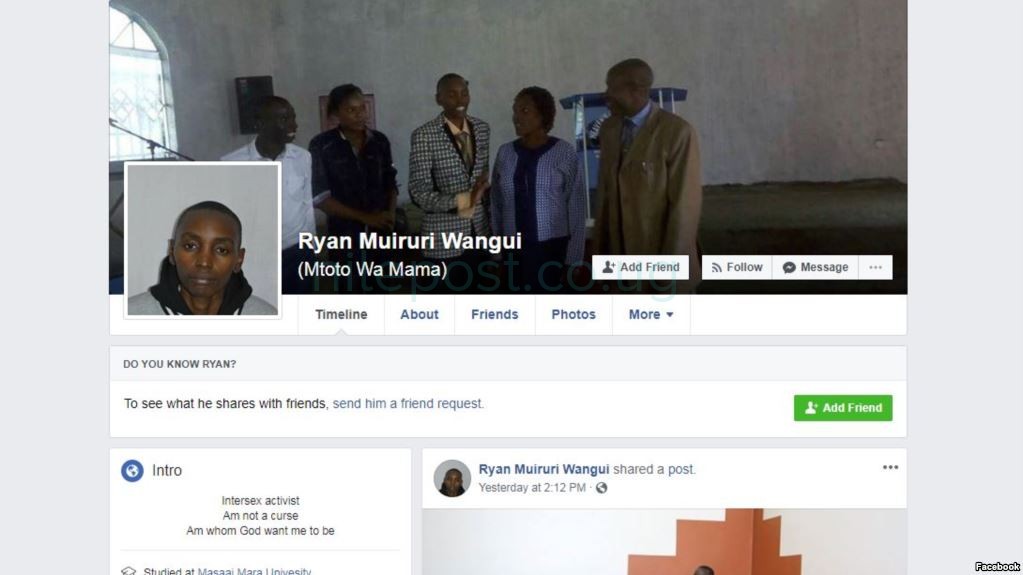
Ryan Muiruri says he is intersex and has faced challenges since the day he was born 28 years ago.
Muiruri was born Ruth Wangui in a small village in central Kenya. He says the midwife could not tell whether he was a boy or girl, so his mother decided he would be a girl named Ruth. Out of shame, Ryan's father abandoned the family.
When Muiruri reached puberty at age 13, he began to exhibit traits of the opposite sex, including more masculine features. Muiruri says he dropped out of school several times after facing constant bullying and attempted suicide three times.
'A lot of challenges'
"Intersex people face a lot of challenges," he said. "The challenges they face first of all come from the family, because when family does not accept those children as normal children, they don't give them the rights as children, so they are subjected to stigma and ridicule. If the family or the parent or siblings cannot hold your hand, that means no single person will understand you, because the first support we get, we get from our families or our loved ones."
In some cases, the babies are killed at birth.
For poor families who cannot afford what are called karyotype tests to determine a child's dominant sex chromosomes, intersex children are labeled as male or female.
Muiruri says he sought treatment for his condition, but doctors prescribed hormone replacement therapy to bring out his more feminine features. Nonetheless, in 2010, he changed his name to Ryan.
He says as adults, intersex people face difficulties obtaining legal documentation and integrating into society. Muiruri says he had a similar experience in May when he went to apply for a passport, as immigration officials accused him of impersonation.
'We want to create awareness'
Muiruri said these experiences led him to form the Intersex Society of Kenya, which was registered this month.
He said the recognition of intersex by the Registrar of Societieswas a milestone, especially in a country like Kenya, where homosexuality is illegal.
"Our expectation to this is: We want to create awareness," Muiruri said. "We expect the whole world to treat intersex people as human beings and give them equal rights and their dignity to liveand to exercise their needs as every child in the world."
The Intersex Society of Kenya has registered about 200 members. Of that number, 138 are children under 13. The others range in age from 14 to 43.Registration makes the society legal.
In recent months, Kenyan legislator Isaac Mwaura has asked parliament to pass a law to recognize a third gender to end discrimination against those who identify as intersex. VOA could not reach him for comment on the move by the Registrar of Societies to recognize intersex Kenyans.
For Muiruri and the Intersex Society of Kenya, it's all about creating awareness "that a third gender does exist," he said.
