

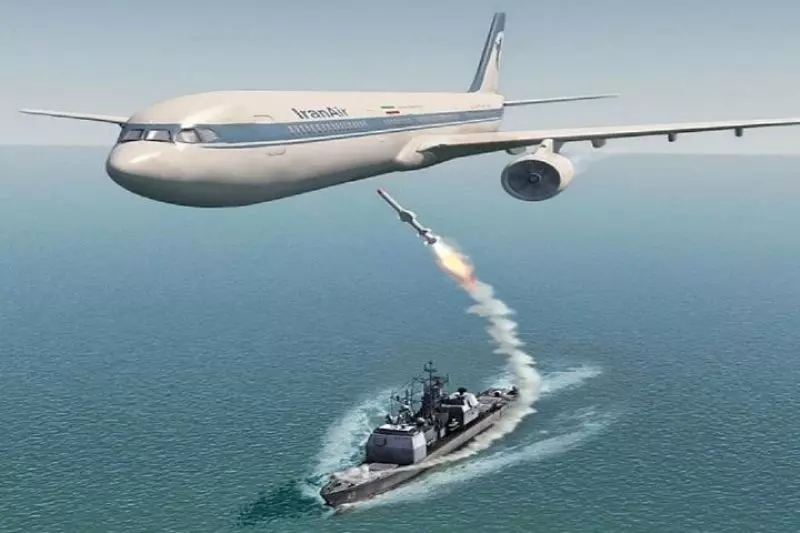
On July 3, 1988, the USS Vincennes, a United States Navy guided missile cruiser, shot down Iran Air Flight 655 over Iranian territorial waters in the Persian Gulf, killing all 290 passengers and crew aboard—including 66 children and 16 women.
The civilian Airbus A300 was on a routine commercial flight from Tehran to Dubai when it was destroyed amid escalating tensions during the Iran-Iraq War.
At the time of the attack Vincennes was traversing the Straits of Hormuz, inside Iranian territorial waters – in clear violation of international law, and IR655 was within Iranian airspace.
The tragedy remains one of the deadliest military-related aviation disasters in history and a profound scar on US-Iran relations.
The USS Vincennes was patrolling the Persian Gulf when its crew mistakenly identified the passenger plane as an attacking Iranian fighter jet.
Despite warnings and the aircraft’s clear identification signals, the cruiser fired two surface-to-air missiles, bringing the plane down over Iranian territorial waters.
An official US investigation later described the incident as a “tragic mistake” caused by misinterpretation of radar and transponder signals under stressful combat conditions.
Iran condemned the attack as an unprovoked act of aggression, calling it a “cold-blooded massacre of innocent civilians.”
Vice President George HW Bush expressed regret over the incident, stating, “The tragic loss of life on Iran Air Flight 655 was a terrible mistake, and we extend our deepest sympathies to the families of the victims.”
Secretary of Defense Frank Carlucci noted, “The crew acted in self-defense, believing they were under threat. There was no intent to target a civilian aircraft.”
Iran’s foreign minister Ali Akbar Velayati denounced the act as “terrorism” and “a crime against humanity,” demanding justice and compensation.
The attack deepened hostility between the U.S. and Iran, aggravating an already tense geopolitical situation.
In 1996, the US paid $61.8 million in compensation to victims’ families through an international settlement, but diplomatic relations remained strained.
The tragedy exposed critical flaws in military identification procedures and highlighted the devastating risks of conflict zones overlapping with civilian air traffic.
It also sparked calls for better safeguards to protect non-combatants during military operations.
Former Secretary of State George P. Shultz later said, “The loss of Flight 655 was an unintended and profound tragedy. It changed how we approach engagement protocols to prevent future disasters.”
Today, the downing of Flight 655 serves as a somber reminder of the human cost of war and the urgent need for peace and communication to avoid such calamities.
