
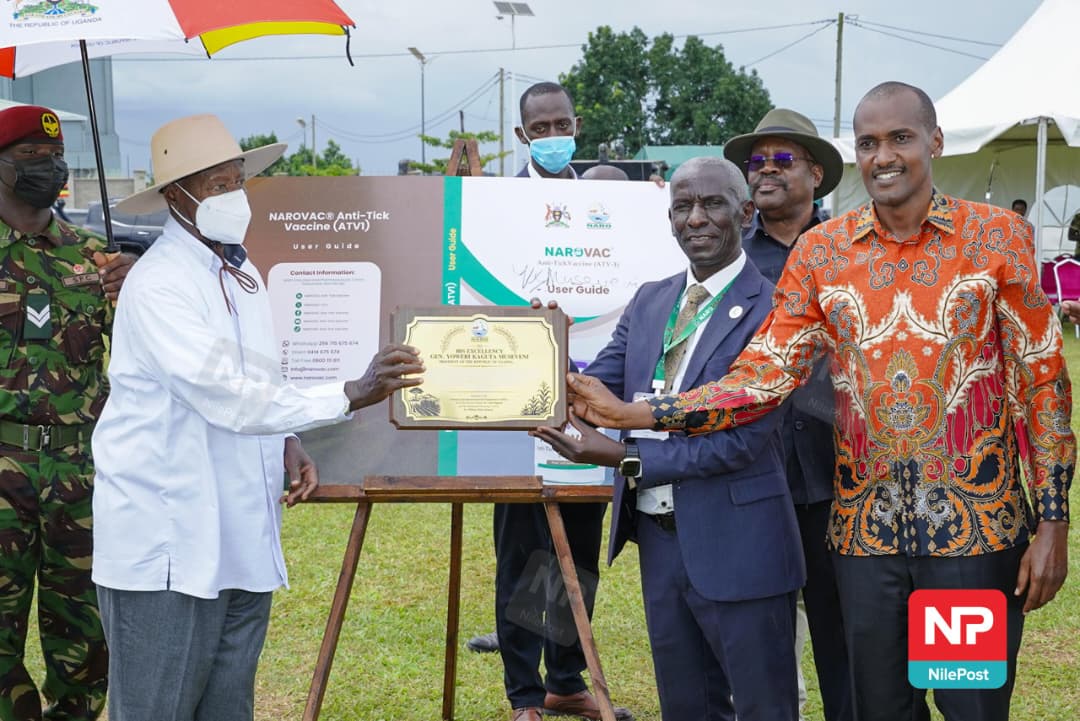
The National Agricultural Research Organisation (NARO) has requested Shs 600 billion from President Museveni to establish a vaccines and pharmaceutical city aimed at strengthening local vaccine production and reducing Uganda’s dependence on imports.
The request was presented by Dr. William Olaho Mukani, Chairperson of the NARO Governing Council, during the launch of the anti-tick vaccine (NAROVAC) at the National Livestock Resources Research Institute (NaLIRRI) in Nakyesasa, Wakiso District.
Dr. Mukani said the proposed facility will host multiple production plants operating different lines of vaccine and pharmaceutical manufacturing.
“We are requesting government to provide Shs 600 billion over a period of three years to enable us to actualize this dream of establishing a vaccines and pharmaceutical city,” he said.
He added that the initiative is expected to significantly strengthen Uganda’s livestock health systems and position the country as a regional hub for vaccine production and distribution.
President Museveni welcomed the proposal, expressing government readiness to support the project.
“The money being requested is not a lot. We shall ensure that it is made available,” Museveni said.
NARO currently produces about three million doses of the NAROVAC anti-tick vaccine per month and is expanding its capacity to meet growing demand. The institute’s annual production capacity stands at approximately 36 million doses, with plans to scale up to 60 million doses as regional demand increases.
Before commercial rollout, around 1.5 million doses were produced and used in extensive field trials. The vaccine plays a key role in protecting Uganda’s estimated 16 million cattle, which require multiple doses, including boosters, for effective tick control.
NARO operates under the Ministry of Agriculture, Animal Industry and Fisheries (MAAIF) and is mandated to coordinate public agricultural research in Uganda. Established under the National Agricultural Research Act of 2005, it oversees 16 research institutes covering crops, livestock, fisheries, forestry, agro-machinery, natural resources, and socio-economic studies.
The proposed vaccines and pharmaceutical city is expected to boost Uganda’s scientific innovation capacity, reduce reliance on imported veterinary medicines, and improve agricultural productivity across the livestock sector.
