
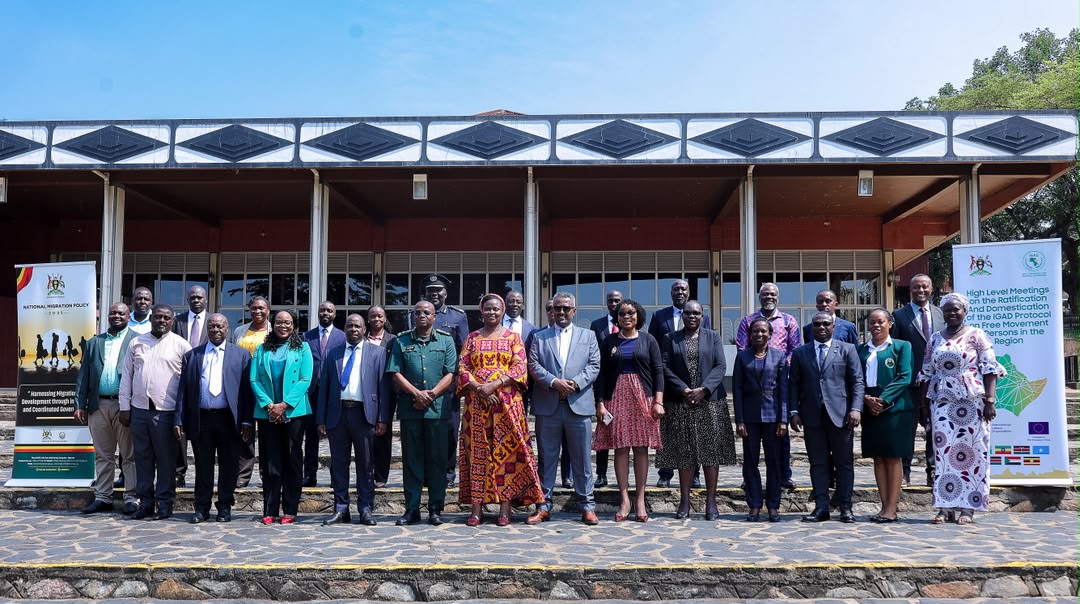
The Ugandan government has begun consultations on the preparation of a Cabinet Memorandum for the ratification of the Intergovernmental Authority on Development (IGAD) Protocol on the Free Movement of Persons, a move aimed at strengthening regional integration, labour mobility and economic cooperation across the Horn of Africa.
The three-day workshop in Entebbe has brought together officials from government ministries, the IGAD Secretariat, the International Labour Organization (ILO) and other stakeholders to build consensus on Uganda's position before the Protocol is presented to Cabinet.
Speaking on behalf of the ILO Director, Ephrem Getnet, Chief Technical Adviser for the Free Movement of Persons and Transhumance in the IGAD Region Project, commended Uganda for advancing the ratification process.
"The IGAD Protocol on the Free Movement of Persons represents a landmark achievement in the pursuit of deeper regional integration," Getnet said.
He noted that the Protocol has the potential to create jobs, expand trade and investment, facilitate skills development, strengthen cultural exchange and protect the rights of migrants.
"For Uganda, a country with a youthful and growing population, the Protocol presents a strategic opportunity to advance both national and regional development objectives," he added.
Getnet reaffirmed the ILO's commitment to providing technical assistance, policy advice and capacity building to support implementation of the Protocol.
Representing the Permanent Secretary of the Ministry of Internal Affairs, Acting Commissioner of Citizenship and Immigration Control, Col. Geoffrey Kambere, said Uganda's signing of the Protocol on May 14, 2024, demonstrated its commitment to deeper regional cooperation, with ratification now the next critical step.
"Facilitating free movement does not mean removing regulation. On the contrary, it requires stronger systems that enable secure, orderly and well-managed movement of people across borders," Kambere said.
He stressed that free movement and effective immigration control are complementary, noting that stronger border management, identity management and information-sharing systems would facilitate legitimate travel while enhancing national security and combating transnational crime.
Kambere also urged stakeholders to develop a strong Cabinet Memorandum, agree on a practical implementation roadmap and assess the Protocol's implications to ensure it advances Uganda's national interests while contributing to regional integration.
IGAD Head of Mission to Uganda, Joselyn Bigirwa, applauded Uganda for sharing best practices in identity management, immigration and border control during a recent regional learning mission involving the National Identification and Registration Authority (NIRA) and the National Citizenship and Immigration Control (NCIC).
She called on Uganda to accelerate the ratification process.
"We request the Government of Uganda to fast-track this process so that we can launch implementation of the Protocol in areas of the right of entry, stay and exit, labour mobility, the right to residence and the right of establishment," Bigirwa said.
According to IGAD, implementation of the Protocol will contribute to a more peaceful, prosperous and integrated region by facilitating lawful movement of people while supporting economic growth and regional cooperation.
