
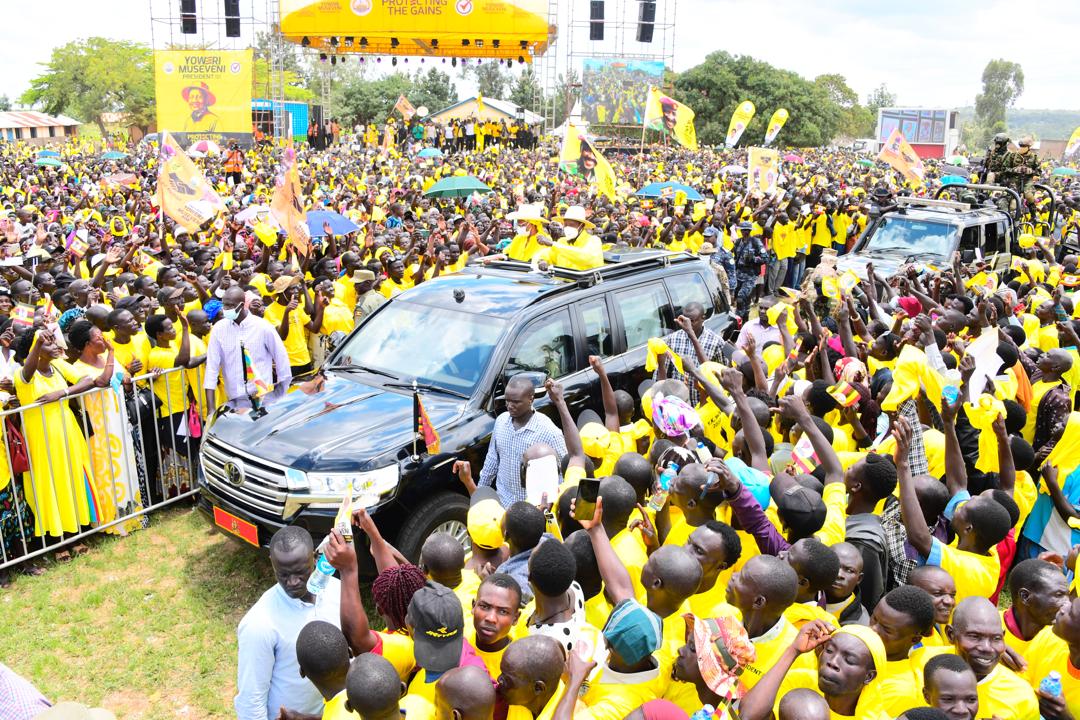
Communities in Nebbi District are calling on political aspirants to prioritise tangible development issues—such as improved road networks, quality education, and functional health facilities—instead of distributing handouts during campaign seasons ahead of the 2026 general presidential and parliamentary elections.
Residents say the persistent trend of luring voters with small gifts is outdated and undermines citizens’ ability to hold elected leaders accountable for long-term service delivery.
On Thursday, Mike Ogenrwoth, 32, expressed concern that many youths are easily compromised during campaigns and later abandoned.
“We the youths are only used by politicians during election campaigns to mobilize votes, but after the elections, youths become irrelevant to the politicians,” Ogenrwoth said.
Sofia Ayerango, a 65-year-old resident of Olyeko Cell in Nebbi Municipality, said communities continue to face hidden school charges and poor access routes, which worsen school dropout rates.
She noted that impassable streams without footbridges have long hindered children’s ability to reach school, yet leaders have failed to intervene.
“Politicians are liars. They don’t fulfill their promises, and this time round, locals must protest and vote out all political liars who have failed to fulfill their pledges,” Ayerango said.
National Unity Platform (NUP) presidential candidate Robert Kyagulanyi Ssentamu, popularly known as Bobi Wine, campaigned across the greater Nebbi region before proceeding to Arua, where he unveiled his party’s 2026 manifesto.
Key priorities highlighted include restoring constitutional order, cutting wasteful government expenditure, and strengthening the health and education sectors.
Kyagulanyi told voters in Pakwach, Nebbi, and Zombo that an NUP-led government would improve roads and enhance service delivery.
He accused the current administration of failing to curb corruption, alleging that Shs10 trillion is lost annually from the national treasury according to Inspectorate of Government reports, leaving critical sectors underfunded.
Sarah Anirwoth, a resident and businesswoman, said poor road networks have long crippled development and cross-border trade with the Democratic Republic of Congo. She cited the long-delayed 21-kilometre Nebbi–Goli tarmac road, which she said was promised years ago but not delivered.
Nebbi Resident District Commissioner Robert Abak dismissed Kyagulanyi’s statements as unrealistic, arguing that no government can provide employment for all citizens.
He insisted that the ruling NRM government is already empowering the public through self-skilling programmes.
“What the NUP presidential candidate is saying isn’t achievable. Where will he get the money to tarmac every road in the country? What the NRM government is doing is evidence-based—this is why, due to good work, NRM has disabled all powerful opposition groups,” Abak said.
Suleiman Hashim, the NRM flag bearer seeking a second term as MP for Nebbi Municipality, said Parliament recently approved a Shs77.2 billion loan to rehabilitate the Nebbi–Goli Road in order to boost trade between Uganda and DR Congo.
He added that the government also plans to construct a Health Centre III in each of the three divisions of Nebbi Municipality.
“Elected leaders must lobby for government projects that meet community needs to stimulate grassroots development,” Hashim said.
Uganda will hold its General Election on January 15, 2026, to elect a new president and members of parliament for the next five-year term.
