
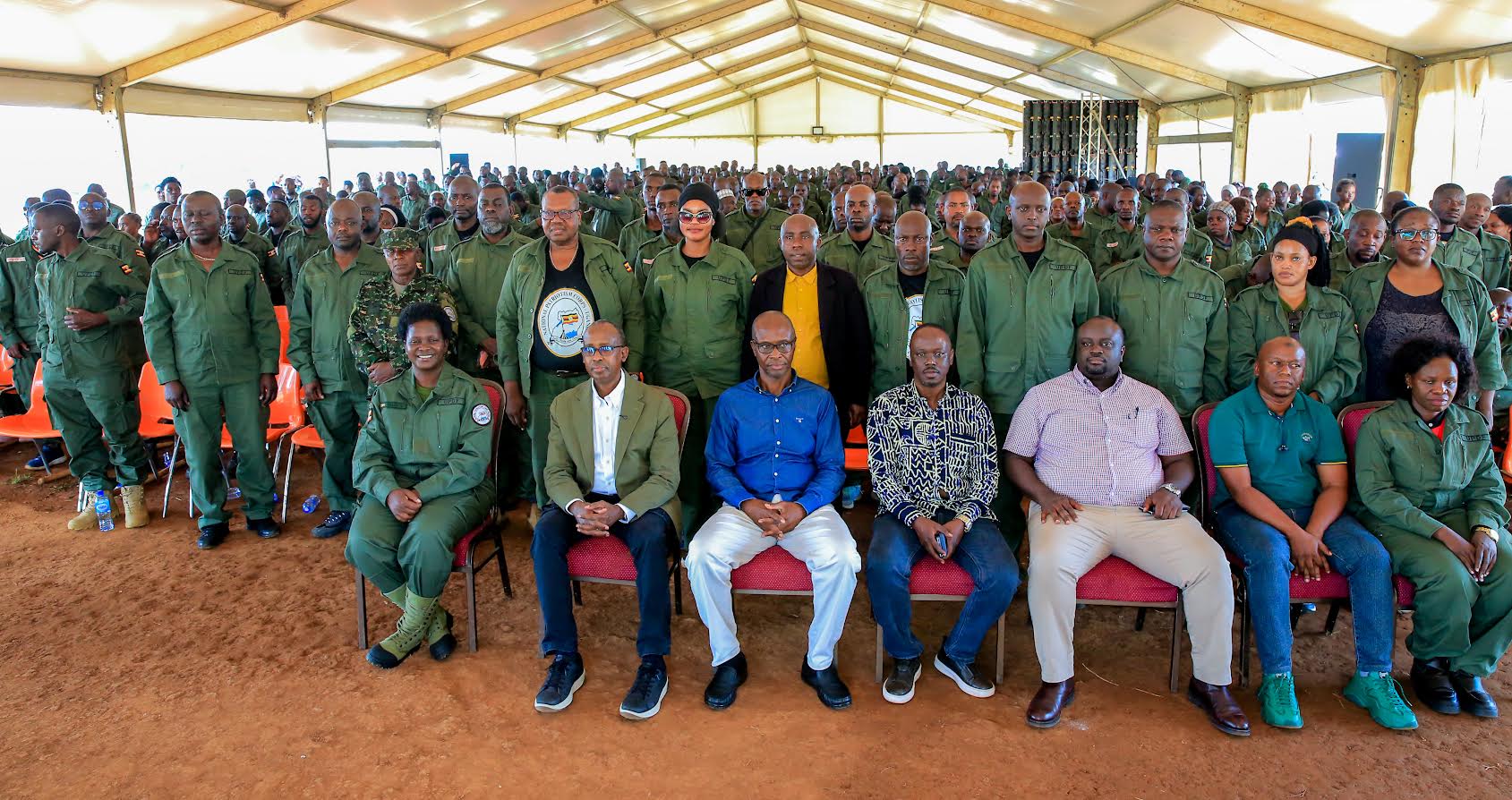
At least 1,030 Ugandans repatriated from South Africa following recent xenophobic attacks are undergoing what government officials describe as a remarkable transformation at the National Leadership Institute (NALI), Kyankwanzi, where they are rediscovering hope, patriotism and confidence to rebuild their lives back home.
The Commissioner for the National Secretariat for Patriotism Corps (NSPC) at State House, Hellen Seku, said the rehabilitation and ideological orientation programme has exceeded expectations, with many participants now viewing Uganda as the best place to invest their skills and secure their future.
According to Seku, the group comprises 438 men, 261 women and 331 children aged between zero and 16 years. They were repatriated after abandoning businesses, jobs and homes following a wave of xenophobic violence in South Africa.
Speaking during one of the training sessions at Kyankwanzi, Seku revealed that the programme has attracted interest from hundreds of other Ugandans who returned independently from South Africa and now wish to benefit from the same ideological training.
"I have received countless calls from Ugandans who returned on their own and now want to join this programme because they are seeing the positive transformation of their colleagues on social media," Seku said.
She added that many callers have requested to be included in future training cohorts after watching videos and testimonies shared by participants currently undergoing the programme.
Now in its second week, the programme focuses on patriotism, national identity, economic empowerment and leadership.
Seku said many participants arrived feeling hopeless, traumatised and uncertain about their future after losing livelihoods they had built over several years in South Africa. However, she noted that the intensive orientation has significantly changed their outlook.
"The way they came is not the way they are today. They now appreciate their country. Many have realised they were ignorant about Uganda's opportunities, wealth and economic potential. They now believe Uganda is the best country to live in."
She described President Yoweri Museveni's decision to facilitate the repatriation as an expression of compassion and national responsibility.
"We thank His Excellency for his fatherly heart and for giving these Ugandans another opportunity to rebuild their lives."
Seku also praised Mulago National Referral Hospital and other government health facilities for supporting returnees requiring specialised medical attention. She disclosed that some arrived in poor health, while others suffered severe psychological distress and were unable to remember even their home districts.
"We have had several medical cases. We thank Dr Rose Byanyima and the entire Mulago team for providing exceptional care. We also appreciate Kiboga Hospital and other facilities that have attended to our people," she said.
One unique challenge facing organisers has been caring for the hundreds of children who accompanied their parents. Seku said a temporary nursery has been established at Kyankwanzi to enable parents to fully participate in classroom sessions.
"We created a temporary nursery where the children are looked after while their parents attend classes. It has enabled mothers and fathers to concentrate on the training."
Expanding Africa's Market
Senior Presidential Advisor on Political Mobilisation Moses Byaruhanga, one of the guest lecturers at the programme, condemned xenophobic violence, warning that such actions undermine Africa's collective economic progress.
Byaruhanga said the South African government should continue discouraging xenophobia while African countries deepen regional trade and economic integration.
He observed that unemployment remains one of the major drivers of hostility toward foreign nationals.
"We need to expand markets across Africa so that industries create more jobs. If Africa becomes one common market, everyone stands to benefit."
Drawing comparisons with China, Byaruhanga said Africa's population of more than 1.4 billion people presents enormous economic opportunities if countries embrace the free movement of goods, services and people.
"China has a population similar to Africa's, yet it functions as one market. Why can't Africa do the same? A united African market would create jobs for South Africans, Ugandans, Nigerians and everyone else."
Byaruhanga assured the returnees that the government has already begun designing economic interventions to help them restart their lives.
He explained that although many may not qualify for the Parish Development Model because of programme requirements, alternative financing mechanisms already exist.
The government plans to organise the returnees into enterprise groups based on their skills before extending seed capital through existing government financing schemes.
"The government has money. Our biggest challenge has never been a lack of funds but poor organisation. Once these returnees organise themselves into productive groups, we shall support them."
He added that Seku will coordinate the formation of groups around viable economic activities before funding is released.
The initiative, he said, is also expected to encourage more Ugandans living abroad to return home and invest locally.
Industrialisation and Job Creation
Senior Presidential Advisor on Special Duties and Chairperson of the Presidential Advisory Committee on Exports and Industrial Development (PACEID), Odrek Rwabwogo, also addressed the returnees, outlining Uganda's long-term economic strategy.
Rwabwogo said Uganda intends to significantly increase exports by promoting value addition, industrialisation and affordable energy.
He said the government plans to strengthen manufacturing by providing cheaper electricity and expanding agro-processing industries.
"We want farmers to earn more by processing and packaging agricultural products before exporting them to international markets."
Using fish farming as an example, Rwabwogo said Uganda possesses enormous untapped potential capable of generating hundreds of thousands of jobs.
He noted that despite having more than 42,000 square kilometres of freshwater resources, Uganda currently produces only about 130,000 metric tonnes of fish annually, far below its production potential.
By comparison, he said Egypt, with significantly fewer freshwater resources, produces nearly one million metric tonnes of fish every year and earns billions of dollars.
"We can create over 200,000 jobs very quickly through fish farming, feed production, maize growing, soybean cultivation and processing industries."
Rwabwogo emphasised that sustainable economic transformation requires both knowledge and political stability, urging the returnees to understand how societies transition from subsistence economies to industrialised nations through innovation, discipline and education.
"Countries develop because people understand how economies grow. Knowledge changes societies."
He also appealed to Ugandans to respect the rule of law and avoid divisive politics.
"The country must remain peaceful and stable. Investors come where there is stability, and stability creates opportunities for everyone."
Addressing the emotional trauma experienced by many returnees, Rwabwogo encouraged them not to allow their painful experiences in South Africa to define their future, but instead view the setback as an opportunity to rebuild stronger lives in Uganda.
"What does not kill you makes you stronger. They have gone through a painful experience, but Uganda offers them another chance."
He argued that lasting national unity is achieved when citizens share in economic prosperity.
"The strongest unity is built around shared prosperity. When people benefit economically, they protect what they have built together."
