

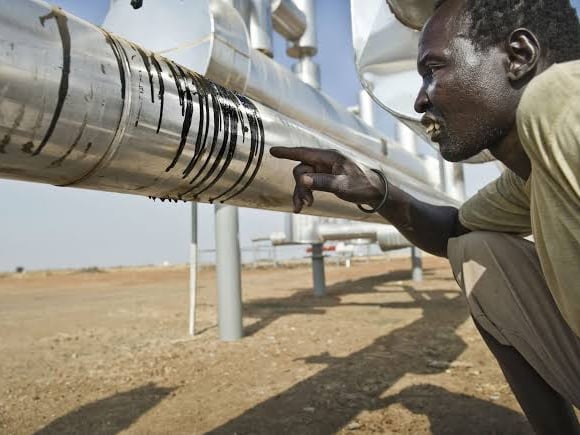
Sudan has warned it may be forced to shut down its oil export infrastructure following a surge in drone attacks by the Rapid Support Forces (RSF), a move that could have devastating economic consequences for neighbouring South Sudan, whose oil exports rely almost entirely on pipelines running through Sudanese territory.
In a May 9, 2025 letter addressed to South Sudan’s Undersecretary for Petroleum, Eng. Deng Lual Wol, Sudan’s Undersecretary for Energy and Petroleum, Mohieddien Naiem Mohamed Saied, cited escalating RSF assaults on critical oil infrastructure as a direct threat to the shared export arrangement.
Despite reaffirming Khartoum’s commitment to honouring the oil transit agreement, Saied warned that continued attacks may soon make it impossible to maintain operations.
“The recent wave of drone attacks launched by RSF and its backers against civilian infrastructure has targeted oil facilities in Sudan, which are bound to have an impact on Sudan’s capability to complete export operations,” the letter states.
Among the key sites hit were Pump Station #6 in Al-Hudi, damaged in a 9 May strike, and a major diesel depot in White Nile State attacked a day earlier.
Port Sudan’s fuel depots and airport terminals—vital for importing operational chemicals and equipment—were also targeted, disrupting power supplies essential for loading South Sudanese crude onto ships.
In response, the Sudanese authorities have instructed pipeline operators PETCO and BAPCO to prepare a fast-track shutdown roadmap, which may be activated if the attacks persist and render Sudan unable to meet its obligations under the 2012 Agreement on Oil and Related Economic Matters (AOREM).
The looming shutdown poses a significant risk to South Sudan’s fragile economy. Since gaining independence in 2011, the landlocked country has depended on Sudan’s pipeline network and Red Sea port to export its oil—its main source of revenue, accounting for about 90% of the national budget.
Without access to Port Sudan, Juba would have no viable short-term alternative to move its crude to international markets.
This is not the first time South Sudan’s oil flow has come under pressure. In March 2024, a pipeline rupture caused by sabotage in Sudan’s White Nile region forced a temporary suspension of crude exports.
Repairs took over two weeks and led to financial losses estimated at over $100 million.
Just weeks before the current warning, both countries had been in talks to extend the oil transit deal, which is due to expire in 2026, with South Sudan seeking to secure longer-term stability for its exports.
The Sudanese government’s latest alarm reveals the increasing vulnerability of cross-border infrastructure to the shifting frontlines of Sudan’s civil war, which has raged since April 2023 between the Sudanese Armed Forces (SAF) and the RSF.
For Juba, the threat is existential. A shutdown would not only cut off vital revenues but also potentially stall salaries for civil servants, social services, and efforts to stabilise the country ahead of its long-delayed elections scheduled for December 2025.
There are few alternatives. Talks of developing a new pipeline through Kenya’s Lamu Port under the LAPSSET Corridor project have stalled for years due to funding challenges and insecurity in the region.
With global oil prices fluctuating and donor aid shrinking, South Sudan’s ability to absorb a prolonged export halt is limited.
Sudan and South Sudan have long had a relationship marked by mutual dependency and political tension, particularly around oil transit.
But with Khartoum’s infrastructure now a battlefield, South Sudan’s oil lifeline is under unprecedented threat. Unless a diplomatic solution or ceasefire can be brokered to protect the pipeline, the economic fallout could deepen regional instability.