
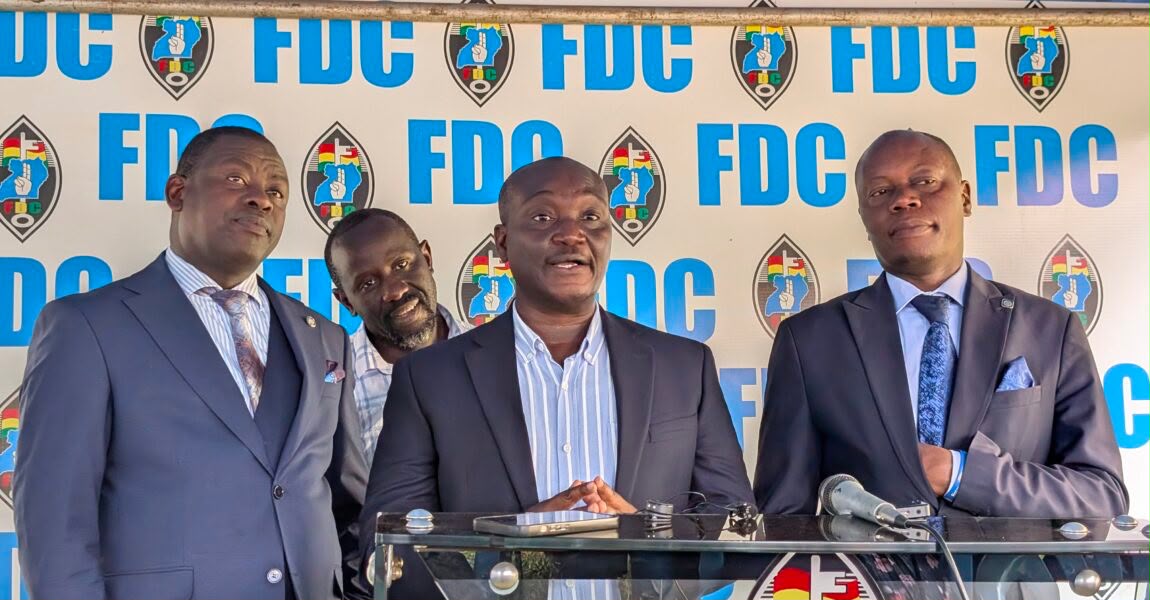
Opposition Forum for Democratic Change (FDC) has strongly criticised President Yoweri Museveni’s State of the Nation Address, accusing him of failing to fulfil his constitutional obligation and instead delivering what it described as a “personal memoir spanning decades” rather than an accountability report to Parliament.
The party said Article 101 of the Constitution requires the President to present a clear assessment of the country’s performance, including the economy, security, infrastructure, governance and government priorities for the coming year.
FDC argued that this requirement was not met.
“This is what Ugandans expected. Instead, he delivered a personal memoir that begins in 1959,” the statement reads.
The opposition accused the President of relying heavily on long historical comparisons instead of focusing on recent government performance and measurable annual progress.
“When he cites statistics, he compares 2026 to 1986. That is a 40-year gap, carefully chosen to make every figure look transformational,” the statement said.
While acknowledging Uganda’s long-term socio-economic transformation, the party maintained that such comparisons do not replace the need for yearly accountability.
“Nobody disputes that Uganda in 2026 is different from Uganda under Obote II. That is not the question Parliament was assembled to answer,” the statement added.
FDC said the address should have focused on performance since the last State of the Nation Address, including clear outcomes, failures, and targets for the next financial year.
The party also criticised President Museveni’s remarks discouraging Ugandans from seeking employment abroad, calling them unrealistic in the context of current economic conditions.
“Museveni’s call to Ugandans to stop going abroad for work is the most disconnected line in the entire address,” the statement said.
FDC argued that while government points to opportunities in agriculture, manufacturing, services and ICT, these have not translated into sufficient job creation.
“Telling Ugandans not to go abroad while offering no plan to create opportunities at home is not a solution,” it added.
The opposition further questioned flagship government initiatives such as the Parish Development Model (PDM), which it described as inadequate for addressing structural poverty and unemployment.
“PDM, the flagship wealth programme he cites, is a sh.1 million revolving fund per household. That is not a jobs programme,” the statement said.
The party added that “research has proved it that there can never be any community that gets out of poverty through handouts.”
FDC also highlighted what it termed gaps in accountability, saying the address did not adequately address unemployment, public debt, or the rising cost of living.
“There was no accountability for the previous term’s specific commitments. No measurable targets for the next year. No mention of unemployment figures,” the statement said.
The party argued that Uganda’s governance approach must shift toward measurable performance rather than broad political messaging.
“Museveni has governed Uganda for 40 years. By now, a State of the Nation Address should be a precise instrument: what we promised, what we achieved, what we failed, and what we will do next,” FDC said.
FDC Vice Chairperson Robert Centenary reinforced the party’s position, saying the address fell short of constitutional expectations.
“Ugandans deserved a report on the state of the nation, not a narration of history,” Centenary said. “A State of the Nation Address is not a platform for reflection on the past four decades; it is a tool for accountability on the past year and a roadmap for the next.”
He added that Parliament must strengthen its scrutiny role by demanding clearer performance indicators in future addresses.
“We must move away from broad political storytelling and demand measurable outcomes. That is the only way citizens can evaluate leadership in a meaningful way,” Centenary said.
In its recommendations, the opposition called for increased investment in agro-processing industries, expansion of vocational training, stronger support for small and medium enterprises, and structured financing for youth entrepreneurship.
The statement also urged government to prioritise medical interns, proposing that funds from cancelled public functions be redirected to their allowances.
FDC concluded by reaffirming its political slogan, “One Uganda, One People,” calling for what it described as more accountable, inclusive and results-driven governance.
