
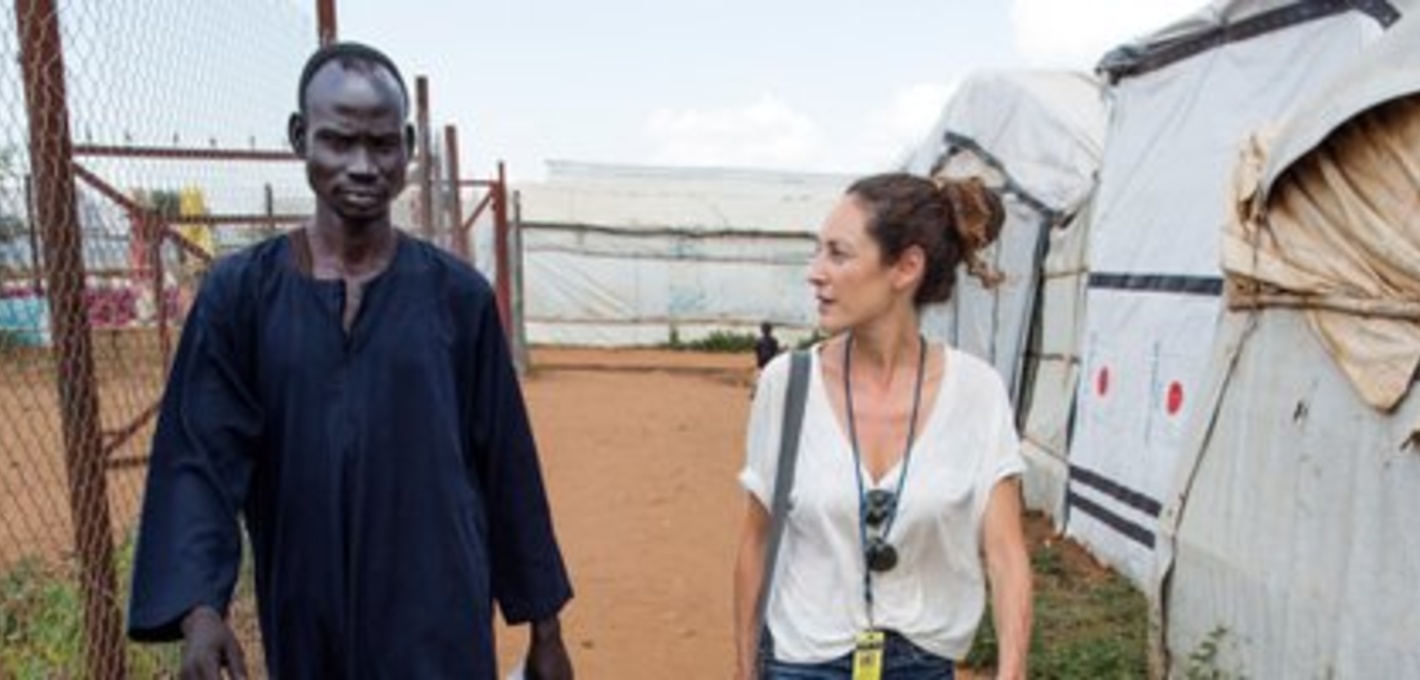
For years, Sam Mednick has covered developments in South Sudan for the Associated Press, but last month she was forced to leave the country, after the government's media authority accused her of reporting false information and revoked her credentials.
Now, she waits in Nairobi. She cannot return to South Sudan until March.
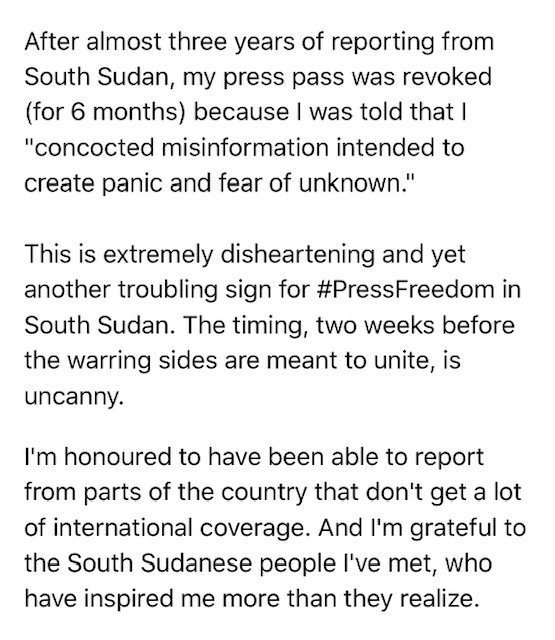
In her only public comment on the matter, Mednick, a freelance journalist, posted a tweet saying "after almost three years of reporting from South Sudan, my press pass was revoked for six months because I was told I concocted misinformation intended to create panic and fear of the unknown."
Mednick said that was "extremely disheartening" for her and called it "yet another troubling sign for press freedom in South Sudan."

Sam Mednick@sammednick
After almost three years of reporting from #SouthSudan I was told to leave.
 View image on Twitter
194 people are talking about this
South Sudanese officials see the matter differently. Elijah Alier, managing director of the South Sudan Media Authority, says Mednick reported there was tension in the country ahead of the formation of a unity government, something Alier calls incorrect.
South Sudan Information Minister Michael Makuei said the only time the government-run media authority forces a journalist to leave the country is when they have done something wrong.
"What I know is that there is no journalist who can be sent away unless he is proven to have written a controversial report, unless he is proven to have written hate speech, unless he is proven to have encouraged division and so forth within the South Sudanese community," Makuei told VOA's South Sudan in Focus.
In an email, Lauren Easton, Associated Press global director of media relations, said the AP "stands by Mednick and her story."
Rights groups and media advocates are standing by Mednick as well. Amnesty International has called the revocation of her credentials "an assault on press freedom in South Sudan," and referred to Mednick's treatment as "deeply troubling"
Seif Magango, deputy regional director for Amnesty International in East Africa, the Horn of Africa and the Great Lakes Region, called Mednick's treatment by South Sudanese authorities "an assault on the freedom of journalists to do their jobs."
"That is unacceptable," Magango told VOA's South Sudan in Focus.
The (FCAEA) released a statement saying Mednick's revocation of press credentials "represents a worrying escalation in the repression of the free press in South Sudan."
The association called on the international community, specifically the diplomatic community of South Sudan and East Africa, to prioritize press freedom in the region.

FCAEA@FCAEA
Replying to @FCAEA and 5 others
On November 3rd, French journalist @bastien_rnl was held overnight by South Sudanese authorities and deported on November 4th. No clear charges or accusations were given. (3)
FCAEA@FCAEA
We stand by our members & colleagues working for S Sudanese media, who regularly face intimidation and threats. We call on the international community, specifically the diplomatic community of South Sudan and East Africa, to prioritize press freedom. (4)
See FCAEA's other Tweets
According to Reporters Without Borders' latest global media report, South Sudan is ranked 139 out of 180 countries on its global media index. The global media body says this follows a disastrous record of journalists' murders, compounded by arbitrary arrests, torture and threats from South Sudan politicians in recent years.
Last week, Chris Trott, Britain's Ambassador to South Sudan asked South Sudanese authorities to hold accountable people who commit crimes against journalists.
In a statement read at a media freedom symposium in Juba, Trott called on South Sudanese officials to enact policies that ensure the safety of journalists and to put in place structures to prosecute violators of journalists' rights.
Mary Ajiith, head of the Association for Media Development in South Sudan, said journalists work under harsh conditions and their safety is not guaranteed. She said at least six journalists have been either arrested, assaulted, or intimidated in South Sudan in the last four months.
"Since 2011, the time South Sudan got independence, no single case has been investigated, no one has been held accountable even if the perpetrators are known. That means in the history of South Sudan so far nothing has been done to show that the safety and protection of journalists is important," said Ajiith.
Juba-based journalist Parach Mach said he has been arrested or harassed by South Sudan National Security Service officers on several occasions.
"The problem goes to whoever gives orders to security forces who arrest journalists to intimidate them. There is no country that can ever develop without the contribution of the media," Mach told South Sudan in Focus.
