
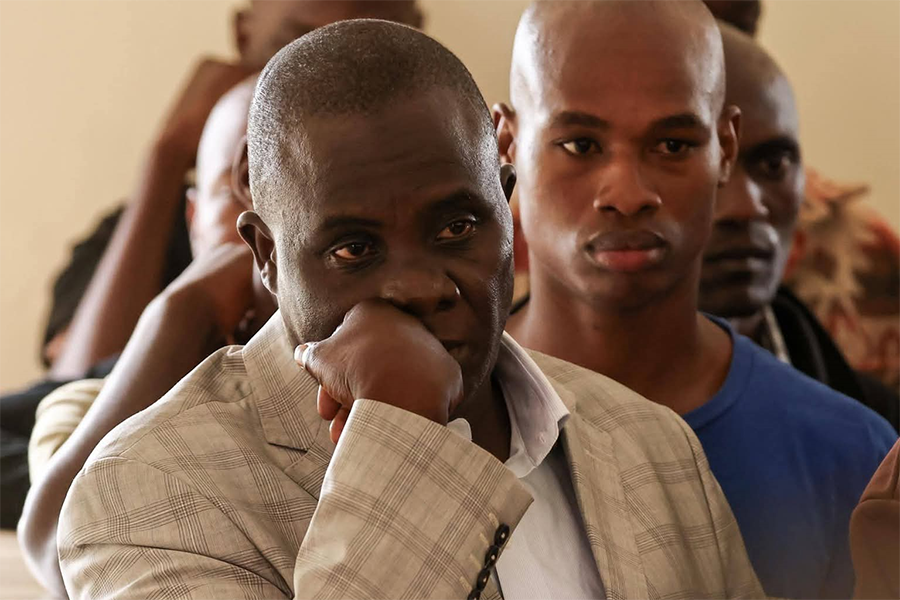
The High Court in Kampala has ordered the government to conclude investigations into the whereabouts of former Butambala County MP Muhammad Muwanga Kivumbi and report back to court within seven days, stopping short of immediately issuing a writ of habeas corpus.
In a ruling delivered on Tuesday, Justice Collins Acellam directed the respondents—the Chief of Defence Forces, the Inspector General of Police and the Attorney General—to file an affidavit setting out the outcome of investigations into Kivumbi's whereabouts before the court considers whether to grant the application.
"The Respondents are ordered to conclude investigations into the whereabouts of the Applicant," Justice Acellam ruled.
"The Respondents shall file an affidavit on behalf of the Uganda Police Force, setting out the outcome of those investigations, within seven (7) days from the date hereof."
The judge scheduled the matter for mention and hearing on July 29, 2026.
Kivumbi's lawyers had petitioned the court for a writ of habeas corpus after alleging that he was abducted on July 10 at a police checkpoint in Mpigi by unidentified military operatives shortly after being released on bail by the High Court.
The application sought orders compelling the security agencies to produce him before court, release him unconditionally and bear the costs of the proceedings.
According to an affidavit filed in support of the application by Hajj Musa Lutaaya, Kivumbi's brother, the former legislator was travelling with him when their vehicle was stopped at a police checkpoint near Mpigi Police Station.
Lutaaya alleged that police officers at the checkpoint assisted in dragging Kivumbi into another vehicle, which drove away to an unknown destination.
He further claimed that Kivumbi was later taken to Bombo Military Hospital in critical condition after allegedly being tortured by his captors.
However, the Uganda Police Force denied detaining the former MP.
In an affidavit sworn by Assistant Commissioner of Police Godwin Tumugumye, police said there was no record showing that Kivumbi had been arrested or detained by the force.
"The Applicant was not in the custody of the Uganda Police Force and was not being held in any police facility," the affidavit stated.
Police further told the court that although Kivumbi's vehicle had been stopped at a checkpoint, he was "neither arrested, abducted, nor detained by the Uganda Police Force."
Justice Acellam said the writ of habeas corpus is a constitutional safeguard designed to protect personal liberty by requiring whoever is detaining a person to produce them before court.
"The writ of habeas corpus ad subjiciendum is a constitutional safeguard for personal liberty. It enables the Court to inquire into the legality of a person's arrest, imprisonment, or detention, and to require the person or authority holding the detainee to produce that person before Court," he said.
He noted that the remedy is intended for cases where a person is allegedly being held unlawfully, without charge or due process.
However, the judge said the court could not effectively issue the writ while Kivumbi's whereabouts remained unknown.
"An order of habeas corpus would be ineffective at this stage if it cannot be directed to the person or authority required to produce the Applicant," Justice Acellam ruled.
"Since the Applicant's whereabouts remain unknown, and since the Respondents have indicated their willingness to continue inquiries to establish where he is, it is prudent to allow them a limited opportunity to do so."
The judge added that before granting a writ of habeas corpus, the court "must be satisfied as to both the Applicant's whereabouts and the person or authority responsible for his detention."
The ruling means the application remains pending, with the court expected to determine the next course of action after receiving the government's report on Kivumbi's whereabouts.
