
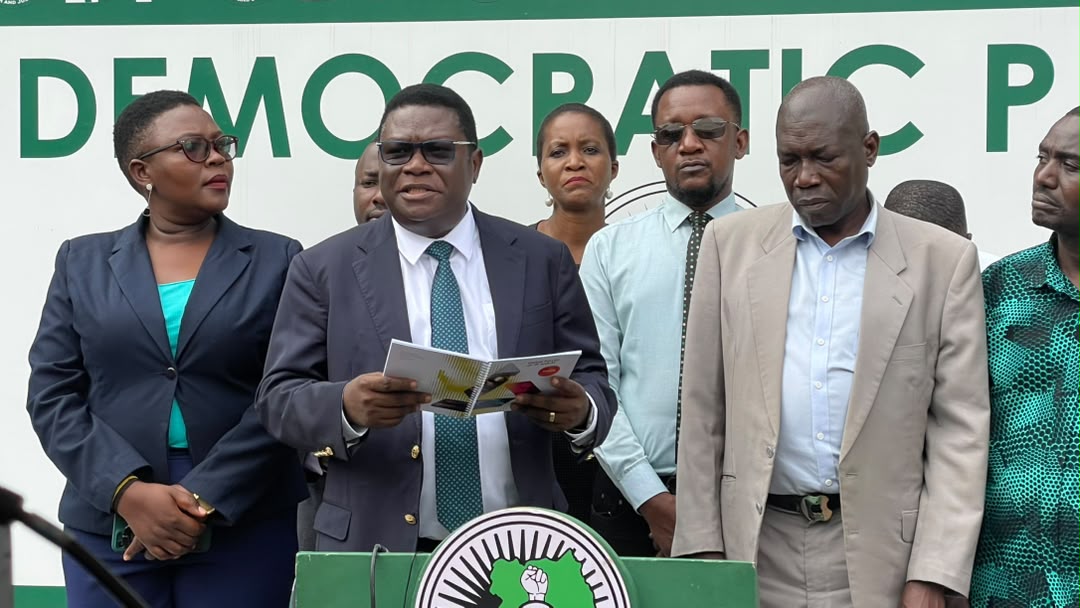
KAMPALA — Democratic Party President-General Norbert Mao has called for a briefing involving security agencies over concerns surrounding alleged cases of illegal detention, torture, excessive use of force and delayed trials.
Speaking at a press conference at the DP headquarters on Tuesday, Mao said the government must ensure that all actions by security agencies are guided by the Constitution, arguing that the law must apply equally to all citizens regardless of their status.
Mao, who is also the Justice and Constitutional Affairs minister, said he has raised concerns about the country's human rights situation and wants the Cabinet Standing Committee on Human Rights to receive a briefing from security agencies to better understand the circumstances surrounding the reported cases.
According to Mao, the meeting would bring together the ministers of Justice and Constitutional Affairs, Internal Affairs, Foreign Affairs, Local Government and Gender, Labour and Social Development, as well as the Attorney General, the Government Chief Whip and the National Resistance Movement (NRM) secretary general.
"Sometimes security organs do things which only they understand, but it is their duty to explain to others what it means. The Minister of Justice needs to be briefed," Mao said.
He cited the cases of opposition figures, including former presidential candidate Dr Kizza Besigye, Kampala Lord Mayor Erias Lukwago and Butambala County MP Muwanga Kivumbi, saying they had raised public concern.
A fortnight ago, General Caleb Akandanwaho, aka Salim Saleh, wrote to his nephew General Muhoozi Kainerugaba, the chief of defence forces, on the security concerns and detention of Lukwago, noting however that it was prudent upon Minister Mao to seek the briefing of security agencies on the matters and address them to the nation.
Mao said the principles of a fair trial and the right to bail must be upheld, adding that security agencies should avoid actions that undermine public confidence in the justice system.
"Laws are not suggestions. It doesn't matter who you are, that is the same oath we take. There is no need to use excessive force against someone who is not using force," he said.
He described allegations of torture, illegal detention and unlawful arrests as unacceptable under the law.
"My flag is up on the question of torture, excessive force, illegal detention and illegal arrests," Mao said.
On political dialogue, Mao, who chairs the Inter-Party Organisation for Dialogue (IPOD), said political parties must continue engaging despite their differences.
He revealed that the IPOD Council had approved the participation of the National Unity Platform (NUP) in the dialogue platform, with an IPOD summit expected before the end of the month.
"If Iran and America, who bomb each other, can talk, what about Uganda?" Mao asked.
He said the summit would discuss human rights, governance and corruption, among other national issues.
"The spirit of dialogue is catching fire. I have been in talks with the NUP leadership and we have agreed that they must take up their position," he said.
Mao also announced plans for a week-long retreat for the DP National Executive Committee and the party's elected Members of Parliament to reorient leaders and formulate a new five-year strategic plan.
He said the party needed renewal and discipline to reconnect with its founding principles.
"We are treating disorientation and we treat it with orientation," Mao said.
He urged party members to participate in the upcoming local council and women council elections under the DP ticket.
"All parties have problems. DP has always been a game changer in Ugandan politics because we have stood on principle," he said.
Commenting on Uganda's evolving political landscape, Mao said political parties must adapt to emerging centres of influence or risk losing relevance.
"When the music changes, the dance must change. Even if it is a good dance, those looking at you might think you are deaf," he said.
Mao rejected claims that his recent political engagements signalled alignment with the ruling NRM.
"The speakership race was a big statement. Mao is not part of NRM," he said.
He maintained that the Democratic Party's historical role has been to defend democratic values and serve as the country's conscience.
"The greatest threat to democracy is abuse of power," Mao said.
