
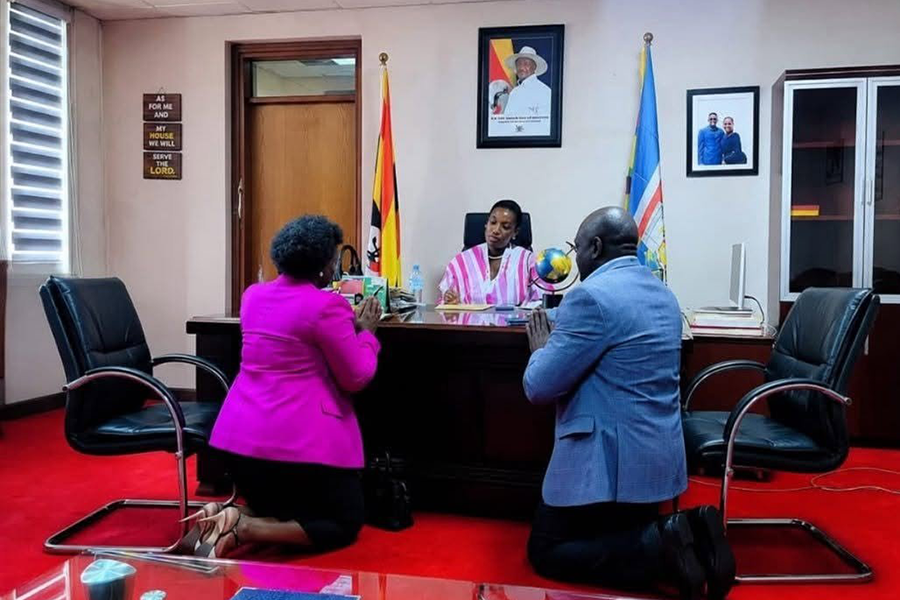
Power has a peculiar habit. It can make ordinary rooms feel like royal courts, turn offices into stages and transform public servants into performers seeking approval from those who temporarily occupy positions of influence.
A photograph can sometimes capture more than a moment. It can reveal an entire culture. And yet it remains for years to either exalt or haunt.
There is a new bug in town and it is such an ugly face of the bug that gets public officials kneeling before political leaders. These are not just for postures but they raise deeper questions about the kind of public service Uganda wants to build, the meaning of authority and whether institutions are becoming subordinate to personalities.
Remember when former minister Aidah Nantaba and another woman were pictured kneeling before then Speaker of Parliament Anita Among? Now there is another; two Busia local government officials are pictured on their knees before State Minister for Local Government Justine Nameere.
The individuals involved may have their own explanations for the gestures. They may view them as expressions of respect, tradition, humility or courtesy. But public symbolism matters. The danger is that such displays feed into a culture where access to power appears tied to personal allegiance rather than professional responsibility.
A government office is not a throne room. A minister is not a monarch. A public official is not a subject. The foundation of modern governance rests on a simple principle: authority belongs to institutions, not individuals.
The minister occupies the office temporarily. The civil servant serves the state permanently. The citizen remains the ultimate source of power. Any culture that reverses this relationship weakens the very institutions meant to protect the public.
There is a difference between respecting leaders and worshipping power.
Respect is demonstrated through professionalism, competence and commitment to duty. Worship of power is demonstrated through exaggerated displays of submission, where people compete to prove loyalty to individuals rather than commitment to national service.
Would Minister Nameere be proud if she walked into Busia Local Government offices to find lower ranked civil servants grovelling at the feet of the same two officials she had on their knees in her office?
History has shown that leaders surrounded by excessive praise often lose touch with reality. When everyone around a powerful person is afraid to disagree, the leader receives applause instead of honest counsel. Bad decisions go unchallenged. Institutions become weaker. The public interest becomes secondary to personal survival.
Many countries that suffered from authoritarian excesses did not collapse overnight. They gradually developed cultures where leaders were treated as larger than life, where officials abandoned independence and where loyalty to personalities became more valuable than loyalty to the law.
The tragedy is that political power is never permanent.
Those who kneel before power today often forget that power itself has a short memory. The person before whom everyone bows today may tomorrow need the same institutions they once controlled.
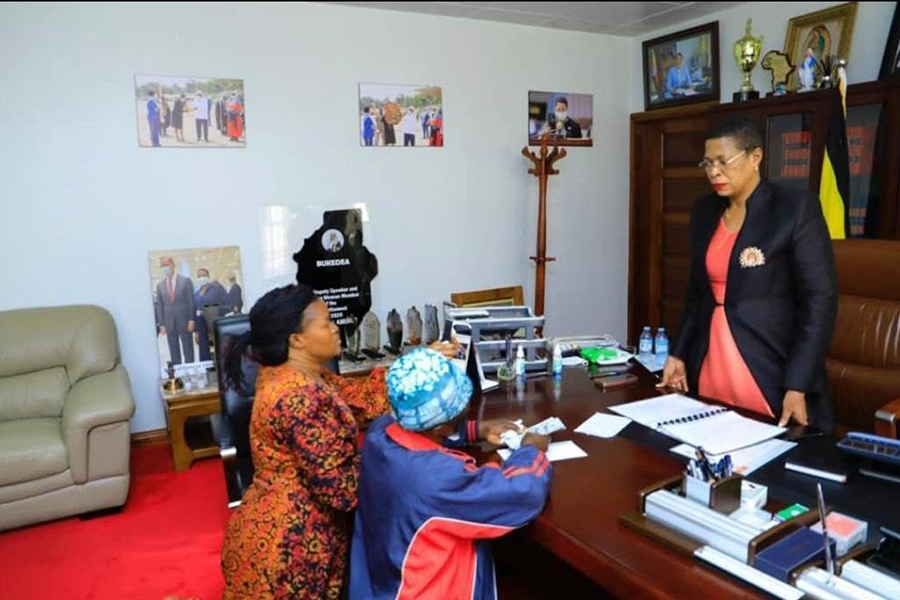
Anita Among's own political journey offers a powerful lesson in the uncertainty of influence. Only until two months ago one of the most powerful figures in Uganda's political establishment, she now finds herself in uncertainty after being humilitated with searches on her home. The same political environment that elevated her also demonstrated how quickly circumstances can change.
For those closest to centres of power, the lesson should be clear: proximity to influence is not immunity from history.
Minister Nameere, as someone regarded as once a close confidante of Among, is perhaps best placed to understand this reality. The story of every powerful person who falls contains a warning for those still standing beside them. The bird that flies closest to the sun may enjoy the warmth of the skies, but it must also remember what happens when its feathers begin to burn.
Public office should therefore demand a different kind of humility — one that does not require people to kneel before personalities, but compels leaders to kneel before the needs of the people.
The true measure of a minister is not the number of officials who bow before them. It is the number of citizens whose lives improve because they occupied that office.
Imagine General Yoweri Museveni, who wields all the power on the land, but you will not see civil servants grovelling before him. Yes, Evelyn Anite did it in Kyankwanzi and a few have done it but the President has often appeard uncomfortable by the act.
The true mark of a leader is not the fear they command, but the confidence they inspire.
Uganda needs public servants who can stand upright — not because they lack respect for authority, but because they understand that their highest loyalty belongs to the Constitution, the institutions of the state and the people they were appointed to serve.
A nation is strengthened when leaders are respected. It is weakened when leaders must be worshipped.
