
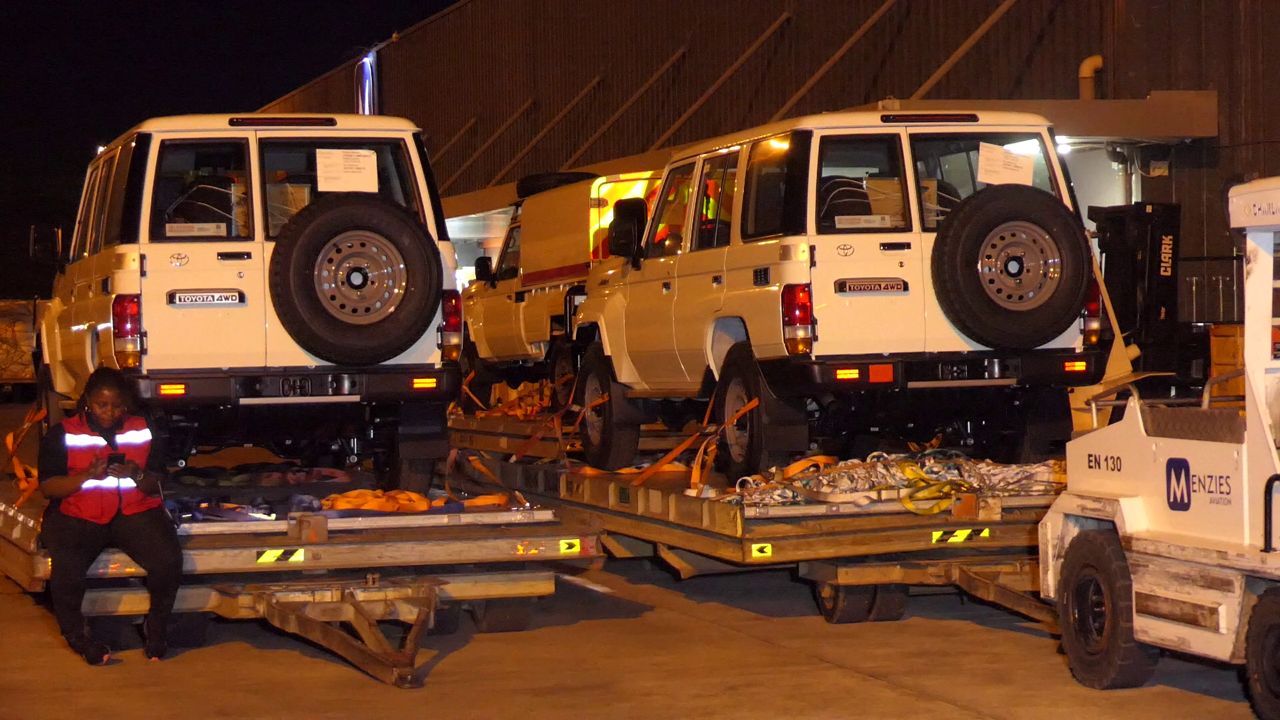
A fleet of 18 brand-new Toyota Land Cruiser vehicles has arrived in Uganda to strengthen Ebola response operations in eastern Democratic Republic of Congo (DRC), providing a major logistical boost to frontline humanitarian teams battling the outbreak.
The vehicles were delivered to Entebbe International Airport on Wednesday night aboard a chartered Boeing 747-400 cargo aircraft before being prepared for transportation overland to eastern DRC.
The consignment adds to two similar vehicles that arrived from Dubai two weeks earlier, bringing the total fleet to 20 specialised 4x4 vehicles designated for humanitarian operations.
The vehicles were donated by the International Federation of Red Cross and Red Crescent Societies (IFRC) and will be deployed to support Ebola response activities, including the transportation of patients, movement of medical teams and volunteers, delivery of essential supplies, and safe burials of victims.
Irene Nakasiita, Director of Communications, Resource Mobilisation and Partnerships at the Uganda Red Cross Society, received the donation on behalf of the organisation.
“The Uganda Red Cross Society is already supporting efforts to contain Ebola in the DRC. This fleet will reinforce response activities both at the Uganda-DRC border and within the affected communities in eastern DRC,” Nakasiita said.
The vehicles are expected to cross into the DRC through the Ntoroko border point as part of efforts to improve mobility for response teams operating in affected communities.
Nathan Kimani, the IFRC Regional Fleet Representative for Africa, said Entebbe was selected as the entry point because of its proximity and logistical advantages in moving the vehicles into eastern DRC.
“Five of the vehicles have been specially configured for the safe and dignified transportation of Ebola victims for burial, while the rest will support the movement of medical personnel, volunteers, and essential supplies to help contain the outbreak,” Kimani explained.
He commended the Uganda Red Cross Society for supporting the safe transfer of the donated fleet into the DRC.
The delivery comes at a time when the DRC continues to battle an Ebola outbreak, particularly in Ituri Province, where health authorities and humanitarian organisations face challenges linked to insecurity, displacement and limited health infrastructure.
Bunia, the capital of Ituri Province, has been among the areas affected, with communities facing difficulties accessing healthcare services, clean water and other essential support. More than 500 people have reportedly died since the latest Ebola outbreak was declared in May.
The outbreak has been complicated by years of armed conflict, population movements and pressure on already limited healthcare systems, making containment efforts more difficult.
The arrival of the vehicle fleet is expected to improve the speed and efficiency of emergency operations by enabling faster movement of response teams, medical supplies and patients while supporting safe and dignified burials.
The development follows a recent visit by Ugandan Ministry of Health officials to the DRC and comes after the Ugandan government expressed readiness to deploy medical personnel to support the Ebola response.
While the DRC continues to manage the outbreak, Uganda has reported no new confirmed Ebola cases but remains on heightened alert due to its shared border with the DRC.
Ugandan authorities have continued strengthening surveillance, preparedness and cross-border coordination measures to prevent possible transmission.
Humanitarian organisations, including the IFRC and national Red Cross societies, remain central to the response through community awareness, contact tracing, safe burial services and logistical support.
